
Case study · Fluid dynamics & phase behavior
Frost-free microfluidic visualization: a 1000 bar, -70°C cryogenic test cell
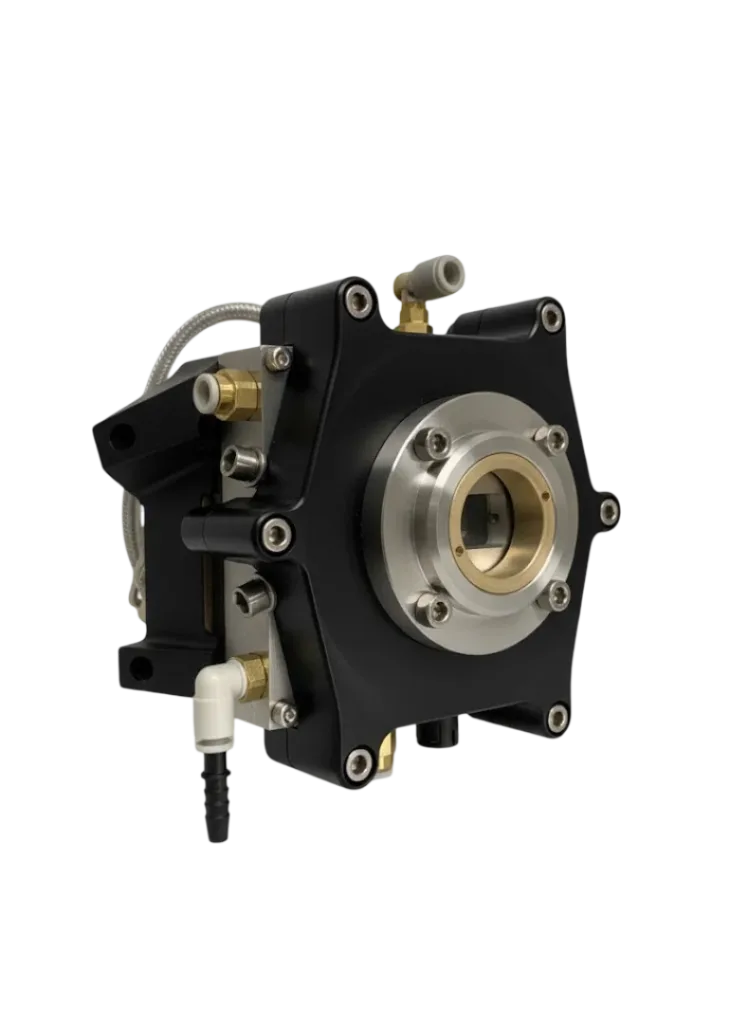
For a leading research center in the energy sector, IRIAN Mecatronics designed and built a test rig to visualize microfluidic flows at 1000 bar (14,500 psi) and -70°C (-94°F). The custom equipment solves the key challenge of optical observation under cryogenic high-pressure conditions by preventing frost formation on the viewport.
At a glance
- Client
- A leading research center for a major energy company
- Field
- Fluid Dynamics
- Technique
- Visualizing phase changes in microfluidic flow
01 — The research question
How can you visualize and characterize microfluidic flow under cryogenic high-pressure conditions?
Studying the phase behavior of fluids under extreme conditions is essential for validating models and developing new technologies in the energy, chemical, and geoscience sectors. This often requires reproducing combinations of pressure and temperature in the lab that are beyond the capabilities of standard equipment. In this project, the goal was to simulate deep reservoir conditions at a micro-scale: injecting a fluid at up to 1000 bar (14,500 psi) into a microfluidic chip, cooling it to -70°C (-94°F), and directly observing crystallization or phase change phenomena. No off-the-shelf laboratory equipment combines such high pressure, localized cryogenic cooling, and clear optical visualization.
Maintaining a clear, frost-free optical view of a microfluidic chip at -70°C (-94°F) while it is subjected to an internal pressure of 1000 bar (14,500 psi).
02 — Our approach
The design process: from problem to solution
Localized, vibration-free cooling
Achieving a stable -70°C (-94°F) over a very small area is a challenge. We selected a solid-state thermoelectric cooling system, applied directly to the sample holder. Unlike liquid nitrogen or mechanical chiller systems, this solution is compact, responsive, and generates no vibrations that could disturb optical measurements or microfluidic flow.
Ensuring frost-free observation
At -70°C (-94°F), ambient moisture instantly freezes on the viewing window, making it opaque. To ensure continuous observation, the microfluidic chip and the viewport are isolated in a sealed chamber, which is kept under a slight positive pressure with dry gas. This solution is more reliable than a simple purge and ensures a perfectly clear viewing window, similar to our modular HP sapphire reactor.
Sealing at 1000 bar and -70°C
Ensuring a seal at 1000 bar (14,500 psi) requires materials and fittings that can withstand thermal shock and temperatures of -70°C (-94°F) without becoming brittle. We selected standard, field-proven materials and connection technology for these conditions, avoiding the development of proprietary fittings. This provides the client with maximum safety and flexible connection to their upstream equipment, a principle we apply to all our custom HPHT reactors and cells.
03 — Technical specifications
| Maximum injection pressure | 1000 bar (14,500 psi) |
|---|---|
| Minimum operating temperature | -70°C (-94°F) |
| Compatible microfluidic chip dimensions | 30 x 20 x 1.175 mm |
| High-pressure connections | 4 x 1/16" VALCO ports |
| Inerting chamber operating pressure | 0.2 bar (3 psi) max |
| Temperature instrumentation | 2 x PT1000 probes |
04 — Other applications
Does your project have similar requirements?
Pharmaceuticals / Biochemistry
To study the crystallization of active ingredients, the principle of localized cooling and frost-free visualization is directly transferable. Wetted materials would be selected for biocompatibility (e.g., Hastelloy, PEEK) and the pressure ranges adjusted as needed.
Materials Science
Observing phase transitions in polymers can benefit from the same precise thermal control in a controlled environment. The sample holder geometry and the integration of additional sensors (e.g., stress, optical) would be adapted to the specific measurements required.
Aerospace
For testing fluids (fuels, lubricants) under cryogenic conditions, the combination of high pressure/low temperature and the robust design are key assets. The flow path would be adapted for specific flow rates and measurements (e.g., viscosity, cloud point).
An engineer from our design office replies as soon as possible.