
Case study · Extreme environment simulation systems
Studying live microorganisms at 1000 bar: biocompatible high-pressure reactors for deep-sea simulation
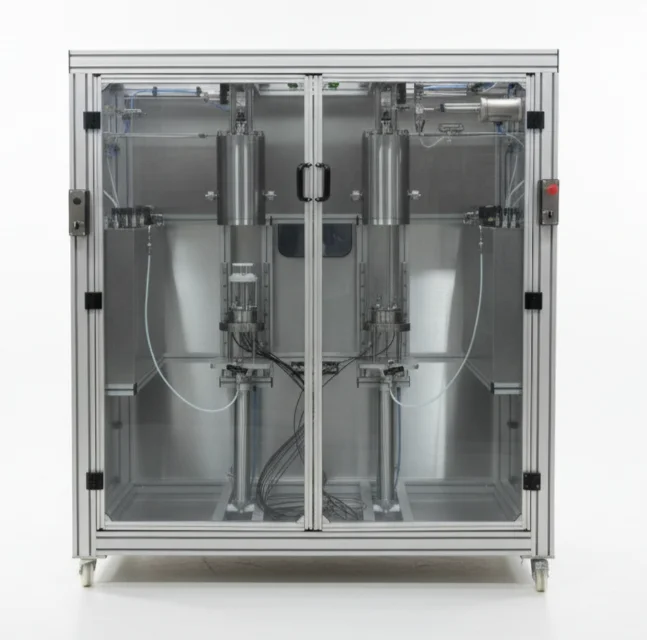
For a public geoscience research laboratory, IRIAN Mecatronics designed and built a custom reactor test bench. The equipment allows researchers to study live microorganisms under abyssal conditions (1000 bar [14,500 psi], 2°C [35.6°F]), ensuring full biocompatibility and sampling without depressurization.
At a glance
- Client
- Public geoscience research laboratory
- Field
- Biology / Geosciences
- Technique
- Culture and analysis of microorganisms under pressure
01 — The research question
How to keep a live biological sample in its native conditions for laboratory study?
Studying biological processes in extreme environments (high pressure, low temperature, specific chemistry) requires recreating these conditions stably in the lab over long periods. The challenge is twofold: not only replicating the physical conditions, but also allowing for instrumentation and sample handling without altering or contaminating the specimen, which would invalidate any measurement. In this project, a laboratory needed to study microorganisms collected from the deep sea. This required simultaneously combining a pressure of 1000 bar [14,500 psi], a low temperature of 2°C [35.6°F], resistance to seawater corrosion, and absolute biocompatibility. Standard laboratory equipment does not offer this combination of performance, let alone critical features like integrating optical sensors or sampling without depressurization.
Instrumenting and handling a fragile biological sample under extreme pressure without depressurizing, contaminating, or altering it.
02 — Our approach
Our design approach: from technical challenge to custom solution
Ensuring biocompatibility and thermal stability at 1000 bar
To prevent any sample contamination and resist saline corrosion, we selected inert, biocompatible materials. Thermal regulation at 2°C [35.6°F] is managed by an external fluid circulation loop. This design avoids any contact between thermal components and the experimental medium, ensuring both biological integrity and uniform temperature.
Enabling sample collection without depressurization
A pressure drop, however brief, would have killed the microorganisms under study. We developed an isobaric sampling system that isolates a small volume of the medium at 1000 bar [14,500 psi] and instantly compensates for the volume loss in the reactor. This allows the user to analyze samples at different stages of the experiment without compromising its validity.
Integrating in-situ measurement sensors
To monitor pH and O2 in real time, optical fibers had to pass through the vessel wall. We designed and qualified custom feedthroughs that provide a perfect seal at 1000 bar [14,500 psi] while preserving the integrity of the optical signal. This enables the user to directly correlate biological activity with physicochemical conditions.
03 — Technical specifications
| Maximum operating pressure | 1000 bar [14,500 psi] |
|---|---|
| Temperature control range | 2°C to 30°C [35.6°F to 86°F] |
| Main cell volume | 2 L |
| Configuration | Two identical benches, each with two independent cells (one 2 L cell, one for several smaller samples) |
04 — Other applications
Does your project share one of these constraints?
Oil & Gas (Flow Assurance)
The common constraint is studying the formation of solids (hydrates, paraffins) under HP/LT conditions. The principle of a high-pressure cell with precise thermal control and optical access, like our PVT analysis systems, remains identical.
Pharmaceuticals / Biotechnology
Here, the shared need is a biocompatible vessel to study the effect of pressure on molecules or microorganisms. The principle of precise control and sterile isobaric sampling is directly transferable, by adapting materials and design to GMP standards.
Materials Science
For synthesizing or testing materials under extreme conditions, the ability to maintain stable conditions over long periods in a resistant reactor is key. The design principle is the same, adapting materials and temperature ranges, which is a core expertise in Extreme environment simulation.
An engineer from our design office replies as soon as possible.