
Case study · Fluid dynamics & phase behavior
Titanium HPHT variable-volume cell for stirred fluid studies (50 mL, 500 bar)
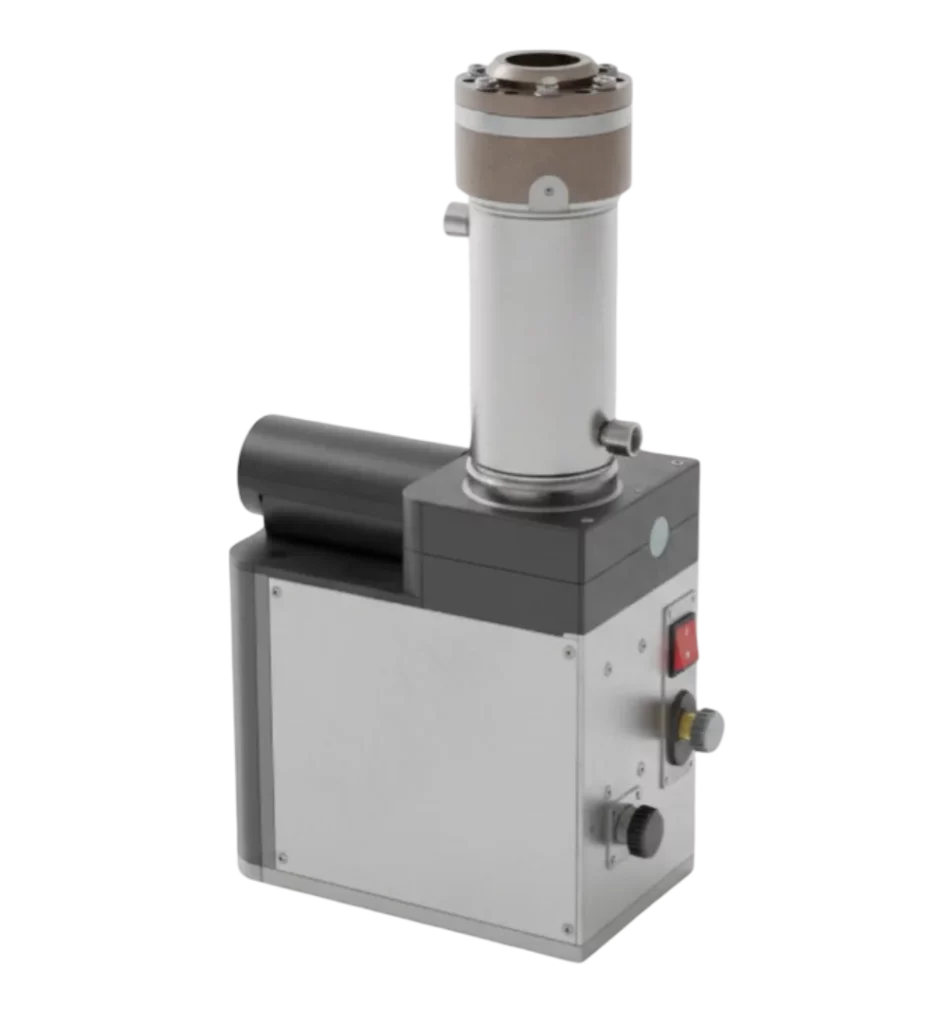
IRIAN Mecatronics designed and built a 50 mL HPHT cell for a public research center in materials chemistry. This custom equipment is used to study the phase behavior of fluids at 500 bar (7,250 psi) and 150°C (302°F), with full visual observation and stirring in a chemically inert (CO2) environment.
At a glance
- Client
- Public research center in materials chemistry
- Field
- Materials Chemistry
- Technique
- Phase behavior, high-pressure visualization
01 — The research question
How can you characterize a high-pressure fluid in a minimal reactive volume, with both stirring and direct observation?
Studying the phase behavior of fluids (liquids, gases, CO2) under extreme conditions often requires combining several functions in a single piece of equipment: maintaining stable pressure and temperature, ensuring sample homogeneity, observing phenomena in real time, and guaranteeing complete chemical inertness. The challenge increases when the available sample volume is very small, which concentrates mechanical and thermal stresses in a confined space. In this project, a laboratory needed to conduct these studies on 50 mL volumes at 500 bar (7,250 psi) and 150°C (302°F), with full CO2 compatibility. Standard HPHT reactors and cells or PVT cells do not combine all these requirements: a titanium body, a very small volume, internal stirring, a full-volume viewing window, and easy routine maintenance.
Integrating a magnetic drive, a full-view window, and multiple connections into a 50 mL titanium body rated for 500 bar, without compromising the reliability of critical seals or the ease of maintenance.
02 — Our approach
A design focused on reliability and maintainability
Securing pressurization and volume control
To ensure stable pressure over long periods and secure the test in case of a power outage, we used a non-reversible mechanical power transmission. Unlike a direct drive, this system locks in position when motor torque is absent. The pressure is maintained passively, safeguarding the test without relying on an active safety brake.
Simplifying maintenance by decoupling functions
Disassembling a sapphire window for cleaning is a risky operation for the HP seal. We designed a double-flange assembly: the first, external flange, secures and seals the sapphire and is never touched during routine operations. The second provides access to the cell for cleaning. This eliminates the risk of damaging the critical seal.
Ensuring a leak-proof seal with a contactless drive
Introducing a stirrer into a 500 bar vessel creates a potential leak point. To prevent this, torque is transmitted via a magnetic coupling through a titanium diaphragm. This design eliminates any mechanical shaft pass-through and any dynamic rotating seal, ensuring an absolute seal and maximum reliability, even with corrosive fluids like CO2.
03 — Technical specifications
| Maximum operating pressure | 500 bar (7,250 psi) |
|---|---|
| Maximum volume | 50 mL |
| Operating temperature range | 3°C to 150°C (37°F to 302°F) |
| Wetted materials | Titanium Ti-6Al-4V ELI (Grade 23), FFKM, PEEK, PTFE |
| Stirring speed range | 50 to 1,000 rpm |
| Flow rate range (volume change) | 1 µL/min to 20 mL/min |
| Fluid connections | 4 x 1/16" Valco-type ports |
04 — Other applications
Does your project have similar requirements?
Pharmaceuticals / active ingredient synthesis
Common requirement: Reactions in supercritical media (CO2) in small reactors, requiring observation, stirring, and chemical inertness. What would remain the same: The principle of the HP variable-volume cell, the seal-less magnetic drive, high-pressure visualization, and CO2 compatibility.
Geosciences / reservoir fluid studies
Common requirement: Analyzing the phase behavior (PVT) of hydrocarbons or CO2 sequestration fluids under downhole conditions. What would remain the same: The HPHT cell, precise volume/pressure control, visualization, and stirring. A related piece of equipment is our Modular HPHT reactor for corrosive geochemistry.
Energy / hydrogen storage
Common requirement: Measuring hydrogen absorption/desorption by materials as a function of pressure and temperature. What would remain the same: The variable-volume cell principle for precise gas quantity control, temperature regulation, and intrinsic safety.
An engineer from our design office replies as soon as possible.