
Case study · HPHT reactors & cells
Custom 500°C reactor for high-temperature corrosion testing
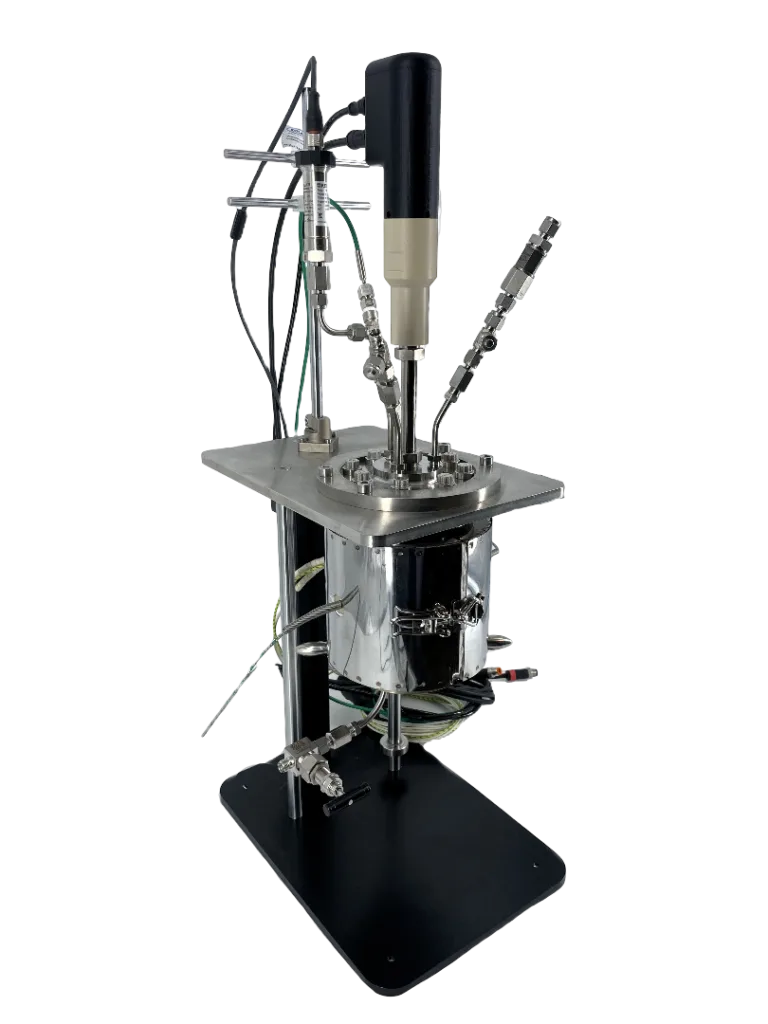
For a public energy research center, which needed to test materials in an oxidizing gas environment at 500°C, IRIAN Mecatronics designed and built two custom reactors. The design ensures a perfect seal and reliable stirring in conditions that destroy standard steels and gaskets.
At a glance
- Client
- Public energy research center
- Field
- Materials Research
- Technique
- High-temperature corrosion testing
01 — The research question
How to maintain the integrity and sealing of a reaction vessel in a chemically aggressive, very high-temperature environment?
Studying materials under extreme conditions requires building a vessel that can withstand those same conditions without interfering with the test. As temperature and chemical aggressiveness increase, standard construction materials reach their limits: they corrode, contaminate the experiment, lose their mechanical strength, or can no longer guarantee a proper seal. This project involved running corrosion tests at 500°C (932°F) under 130 bar (1885 psi) of oxidizing gas. At this temperature, conventional stainless steels are subject to rapid corrosion, and the polymer seals (elastomers, thermoplastics) used in most standard reactors and autoclaves are immediately destroyed.
Ensuring a perfect seal and reliable mechanical stirring at 500°C—a temperature where standard steels corrode and polymer seals are destroyed.
02 — Our approach
Our design approach
Choosing an intrinsically stable material
At 500°C in an oxidizing environment, a conventional steel would be quickly attacked, contaminating the tests and compromising safety. We selected a material whose chemical composition gives it intrinsic stability under these conditions. This choice guarantees the long-term integrity of the reactor and the purity of the experimental results.
Ensuring a leak-tight seal without polymer gaskets
Since the 500°C temperature prohibits any soft seals, the main seal is achieved by the controlled plastic deformation of a metal gasket. This principle, common in ultra-high vacuum applications, is adapted here for high pressure. It provides a perfect and reliable seal using a material compatible with the thermal and chemical stresses of the test.
Stirring without contact or active cooling
To stir the reaction medium, we used a magnetic drive for motion transfer. A careful thermal design isolated the sensitive components (magnets, bearings) from the hot zone. This solution eliminates the need for a complex and failure-prone external cooling circuit, ensuring reliable stirring.
03 — Technical specifications
| Maximum operating temperature | 500°C (932°F) |
|---|---|
| Maximum operating pressure | 130 bar (1885 psi) |
| Number of units | 2 identical reactors |
04 — Other applications
Does your project have similar challenges?
Energy production (incineration, biomass)
The challenge is to sample or install sensors in very hot and corrosive flue gas streams. The principle of a superalloy probe with metal-to-metal sealed passages would be the same to ensure durability and reliability.
Aerospace
The goal is to test the resistance of materials (for engines, heat shields) in a simulated reactive atmosphere. This would require a vessel made of an inert, oxidation-resistant material and a reliable high-temperature seal to maintain the controlled atmosphere.
Materials chemistry
When synthesizing powders (ceramics, catalysts) under a controlled atmosphere, preventing contamination is critical. The principle of a non-reactive reactor with a metal-to-metal seal would be used to guarantee product purity and atmosphere control.
An engineer from our design office replies as soon as possible.