
Case study · Geoscience & subsurface studies
Custom triple-cell test rig for reservoir formation damage analysis at 400 bar, 250°C
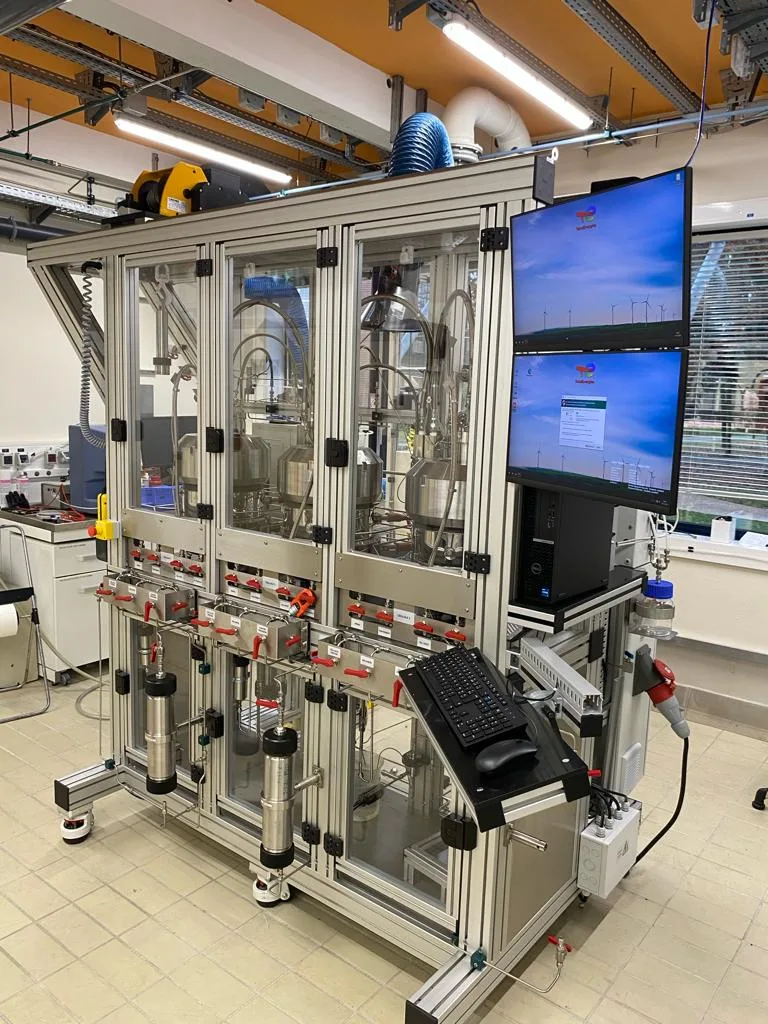
For a global energy leader, IRIAN Mecatronics designed and built a triple-cell test rig to characterize reservoir formation damage. The equipment simulates downhole conditions (400 bar / 5,800 psi, 250°C / 482°F) and withstands extremely corrosive drilling fluids, including 15% hydrochloric acid.
At a glance
- Client
- A global energy leader
- Field
- Geoscience & Oil and Gas
- Technique
- Fluid-rock interaction & formation damage
01 — The research question
How to measure the impact of complex, corrosive fluids on rock permeability under downhole conditions?
Understanding how a porous medium degrades when exposed to fluids under pressure and temperature is a key challenge in many fields, from geoscience to catalysis. Measuring this interaction in the lab, known as damage, helps predict the behavior of a geological reservoir or the lifetime of a material, but it requires simulating often extreme conditions. Our client, an energy leader, needed to quantify the permeability reduction in reservoir rock caused by complex drilling fluids to optimize their operations. No standard equipment could meet all their constraints at once: 400 bar pressure, 250°C temperature, resistance to highly aggressive fluids (15% HCl), a radial flow geometry, and the ability to run three parallel tests on samples of various sizes.
Ensuring reliable and repeatable fluid-rock interaction measurements while simultaneously containing high pressure, high temperature, and extremely corrosive fluids across three parallel, independent tests.
02 — Our approach
A custom design for reliability under extreme conditions
Ensuring resistance to multi-fluid corrosion
The test fluids included a mix of strong acids and abrasive muds, whose corrosivity is amplified by pressure and temperature. We therefore built all wetted parts from Hastelloy C-276, an alloy that is inert to the entire range of fluids. This allows the user to run consecutive tests without cross-contamination or equipment damage.
Tripling test productivity safely
Operating three HPHT systems is demanding, especially with heavy Hastelloy components. To maximize productivity within the same footprint, we integrated the three cells vertically on a single frame, equipped with an assisted lifting system. Sample loading is fast and safe for operators.
Adapting to different samples and protocols
R&D requires the flexibility to vary sample sizes and flow regimes. Each cell thus incorporates a floating piston that automatically adjusts to the rock sample's height, and dedicated fluid circuits allow for selecting the flow mode. The equipment offers great versatility without requiring major mechanical changes.
03 — Technical specifications
| Maximum operating pressure | 400 bar (5,800 psi) |
|---|---|
| Maximum operating temperature | 250°C (482°F) |
| Architecture | 3 independent vertical cells |
| Wetted materials | Hastelloy® C-276 |
04 — Other applications
Does your project share similar constraints?
Deep geothermal energy and geological storage (H2, CO2)
The challenge is to study the interaction between rock and fluids (steam, H2, supercritical CO2) under corrosive HPHT conditions. The special alloy construction, P/T control, and the principle of measuring permeability changes would be retained.
Chemistry and heterogeneous catalysis
This involves parallel testing of solid catalyst aging under a flow of corrosive reactants at HPHT, as with our 6-reactor bench. The multi-reactor bench principle, special alloy construction, and centralized control would remain the same.
Nuclear Industry
The objective is to study the long-term leaching of storage materials exposed to corrosive fluids at HPHT. The robustness of the containment cell, its corrosion resistance, and its ability to maintain stable conditions would be retained.
An engineer from our design office replies as soon as possible.