
Case study · Geoscience & subsurface studies
Custom 5-Liter HPHT cells for storing and transferring fluids at 1200 bar
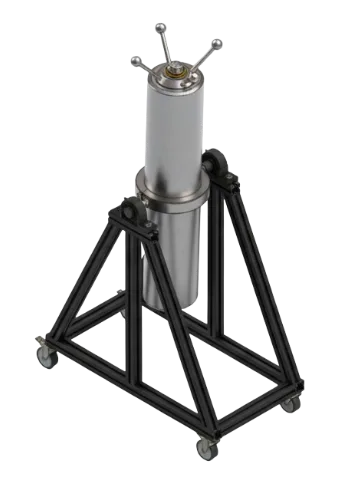
For the R&D center of a major international energy company, IRIAN Mecatronics designed and built a set of six 5-liter storage and transfer cells. This custom equipment allows researchers to handle corrosive fluid samples under extreme conditions (1200 bar / 17,400 psi, 150°C / 302°F) while ensuring sample integrity and operator safety.
At a glance
- Client
- R&D center of a major international energy company
- Field
- Reservoir fluid studies
- Technique
- Fluid sample storage, transfer, and conditioning
01 — The research question
How to store, transfer, and condition large-volume fluid samples at extreme pressure and temperature?
Handling fluid samples at High Pressure High Temperature (HPHT) is a common need in R&D, from reservoir fluid analysis to process chemistry and geosciences. The challenge grows with the sample volume: the mass, inertia, and mechanical stresses on the pressure vessel increase by an order of magnitude, making operator safety the primary design driver. In this project, a lab needed a set of versatile cells to handle representative samples from oil reservoirs. Standard equipment was ruled out by the combined constraints: a pressure of 1200 bar (17,400 psi) and a temperature of 150°C (302°F), applied to a 5-liter volume containing highly corrosive fluids (brines, CO2).
Reconciling the mass and size of a large-volume vessel rated for 1200 bar with the need for simple, fast, and safe handling in a laboratory environment.
02 — Our approach
Our approach: an integrated design for safety and versatility
Ensuring corrosion resistance
The fluids under study (brines, hydrocarbons with CO2) are extremely corrosive at 150°C (302°F) and 1200 bar (17,400 psi). To prevent sample contamination and ensure the equipment's longevity, we selected a specific metal alloy. Its composition provides natural passivity and high mechanical strength in these hot, chloride-rich, and acid gas environments.
Assisting handling and mixing
A 5-liter cell rated for 1200 bar is too heavy to be rotated safely by hand. We therefore decoupled the pressure containment from the handling mechanism: the cell is integrated into a mobile external frame that bears the load and assists with rotation. This solution, simpler and more robust than an internal agitator with complex sealing, allows a single operator to mix the contents and move the cell effortlessly.
Securing high-temperature heating
Heating a metal vessel of this size to 150°C (302°F) creates a surface that poses a severe burn risk. To protect the operator, a distributed external heating system is fully enclosed in a thermally insulated protective casing. This insulation ensures safety, improves temperature stability, and reduces energy consumption.
03 — Technical specifications
| Operating pressure | 1200 bar / 17,400 psi |
|---|---|
| Operating temperature | 150°C / 302°F |
| Useful volume | 2 to 5 liters |
| Number of units built | 6 |
04 — Other applications
Can this approach solve your problem?
Fine chemicals / Polymers
For batch syntheses in large-volume reactors under pressure and in corrosive environments, this approach remains relevant. The principles of a pivoting frame for mixing and safe, enclosed heating would be maintained, while adapting the material (Hastelloy, Inconel) and adding the necessary process connections.
Deep geothermal / CO2 storage
Studying the interaction between geothermal fluids or supercritical CO2 and rock samples requires large-volume HPHT test benches. The design for high pressure and corrosion resistance (brines, CO2, H2S) is directly transferable, with adjustments to materials and integrated sensors.
Food processing / Supercritical extraction
Supercritical CO2 extraction requires efficient mixing inside a pressure vessel. The concept of a large-volume tilting cell is ideal for this. The materials would be food-grade (316L stainless steel), the pressures more moderate, and the closures optimized for frequent opening and closing cycles.
An engineer from our design office replies as soon as possible.