
Case study · Geoscience & subsurface studies
Ultra-low flow measurement: a custom thermo-osmosis test bench for porous media
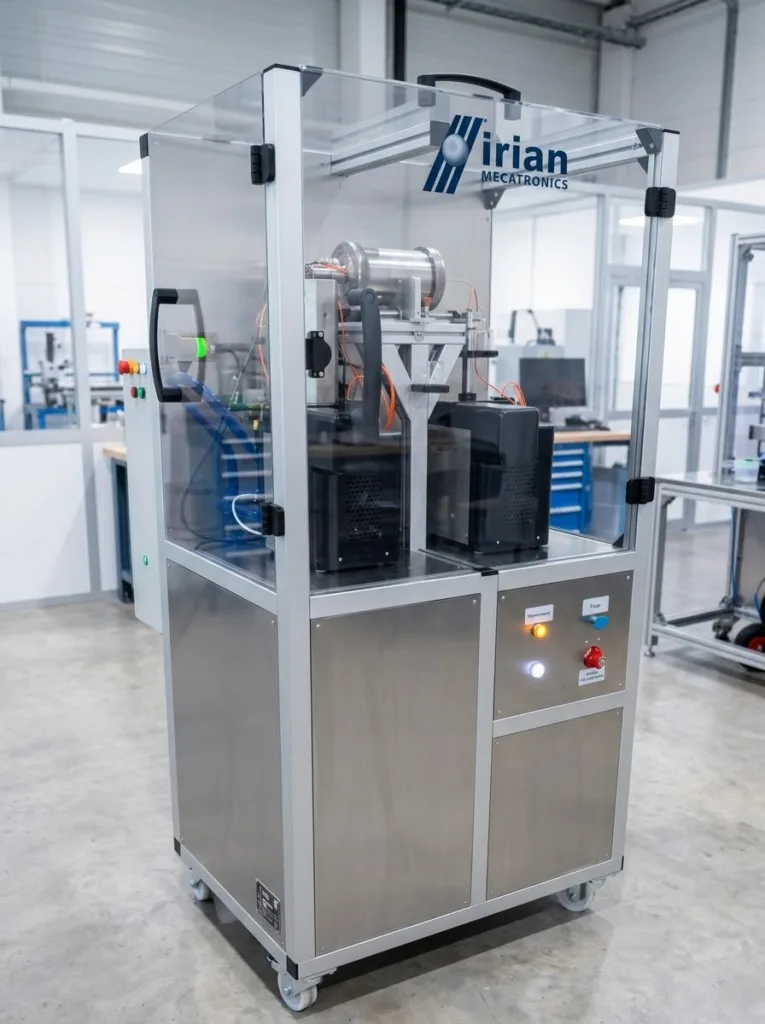
For a national geoscience research institute, IRIAN Mecatronics designed and built a custom test bench to quantify extremely slow water transport through claystone samples. The equipment applies a controlled thermal gradient to a core under confining pressure, measuring flow rates as low as 20 microliters per day with nanoliter-scale resolution.
At a glance
- Client
- National geoscience research institute
- Field
- Geosciences, geological storage
- Technique
- Micro-flow measurement, thermo-osmosis, permeability
01 — The research question
How to measure microliter-per-day flow through tight rock samples?
Quantifying extremely slow liquid flow through tight porous media is a recurring challenge in geosciences, civil engineering, and membrane studies. To yield reliable data, the measurement must remain stable for weeks or months under controlled pressure and temperature. The project's goal was to measure water transport through claystone samples subjected to a temperature gradient, to validate safety models for deep geological storage. The standard solution, continuous weighing of reservoirs, was prohibitively expensive and too sensitive to environmental disturbances (vibrations, air drafts) to ensure stable measurements over such a long period.
Achieving a volume measurement resolution in the nanoliter range with multi-month stability, without using expensive weighing systems that are sensitive to their environment.
02 — Our approach
Our approach: from physical principle to reliable equipment
Measuring volume by mechanical displacement
Since the flow rate was too low for standard flowmeters, we ruled out continuous weighing as too expensive and unstable. We opted for direct volume measurement based on the displacement of two high-precision positive displacement pumps. This method provides nanoliter resolution and absolute stability over several months, as it is immune to lab disturbances.
Creating a thermal gradient at the core of the cell
To study thermo-osmosis, we needed to apply a stable temperature gradient across 10 mm of rock. External heating would have been uniform. We therefore integrated independent heating systems into the platens in contact with each face of the sample. This allows the user to control a precise, asymmetrical thermal profile.
Ensuring stable confining pressure
The test's validity required a constant, isostatic confining pressure, which a simple pressure reducer cannot provide. We designed a gas booster circuit with a buffer volume and fine control using a piloted back-pressure regulator. The cell is thus isolated from source fluctuations, ensuring the sample's integrity.
03 — Technical specifications
| Sample dimensions | Ø 40 mm x 10 mm |
|---|---|
| Maximum confining pressure | 50 bar (725 psi) |
| Maximum injection pressure | 30 bar (435 psi) |
| Maximum operating temperature | 40°C (104°F) |
| Flow rate range | 1.10⁻⁶ to 0.08 mL/min |
| Volume measurement resolution | 0.000001 mL (1 nL) |
| Pressure measurement resolution (fluid) | 0.001 bar (0.015 psi) |
04 — Other applications
Is this technology right for your project?
Civil engineering and construction materials
The principle of flow measurement using positive displacement pumps can be adapted to measure water permeability or the diffusion of aggressive agents in high-performance concrete. Only the test cell would need to be modified for larger samples and more corrosive fluids.
Membrane technologies and fuel cells
The high-precision pump system is also suitable for characterizing gas or liquid permeation through membranes. The cell design would be adapted for flat membranes, and materials would be selected for compatibility (e.g., hydrogen, methanol).
Pharmaceuticals and medical devices
This ability to measure minute volume changes is directly applicable to studying the very slow release of an active ingredient from a solid matrix. The test cell would be redesigned as a biocompatible diffusion chamber using medical-grade materials.
An engineer from our design office replies as soon as possible.