
Case study · Extreme environment simulation systems
High-pressure fluid injection in microgravity: a 330 bar system for onboard research
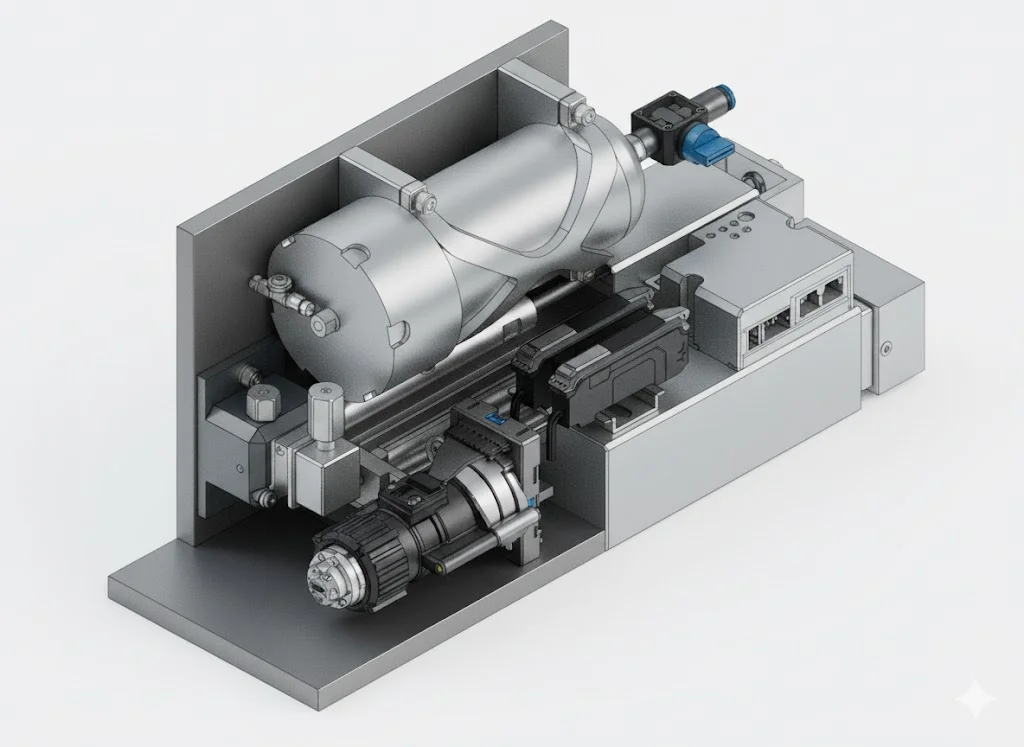
For an aerospace research consortium, IRIAN Mecatronics designed and built a reagent injection system for a microgravity experiment. The equipment provides a stable, programmable supply and metering of three fluids at 330 bar (4785 psi) in an environment where gravity cannot be used to separate liquid and gas phases.
At a glance
- Client
- Aerospace research consortium
- Field
- Aerospace & onboard research
- Technique
- High-pressure fluid injection in microgravity
01 — The research question
How can you inject a liquid at a controlled flow rate when gravity is not available?
Laboratory pumping systems rely on a simple principle: gravity. It keeps liquids at the bottom of reservoirs, allowing pumps to draw a homogeneous liquid phase. When this force disappears—in space or in onboard environments with movement and vibrations—liquids float, gas bubbles can be drawn in, and the equipment's operation becomes unpredictable. Our client needed to conduct a supercritical water oxidation (SCWO) experiment in microgravity, which required injecting three reagents with precise stoichiometry. Standard hardware was unusable: without gravity to ensure a free surface, the pump supply was unreliable. The constant risk of injecting gas instead of liquid would have invalidated the entire experiment.
The challenge: to guarantee a stable liquid supply and injection without the force (gravity) that naturally ensures phase separation and flow direction.
02 — Our approach
A design driven by autonomy and reliability in zero gravity
Storing fluids without relying on gravity
In microgravity, a liquid does not stay at the bottom of a tank. To avoid drawing in gas, we ruled out standard reservoirs and instead stored the fluids in variable-volume containers. An external pressure applied to a flexible membrane ensures positive displacement of the liquid, guaranteeing a stable supply to the pumps regardless of orientation.
Ensuring stable, programmable injection at 330 bar
The reaction demanded very fine stoichiometric control. We selected a positive displacement injection technology (syringe pumps) where the flow rate is directly proportional to a mechanical speed. This principle makes the flow rate independent of pressure variations and ensures a continuous, pulse-free injection from the microliter-per-minute range up to 330 bar.
Regulating reactor back-pressure autonomously
To maintain the outlet pressure at 330 bar without relying on an external gas source—a major constraint in onboard environments—the regulator is piloted by hydraulic pressure. This setpoint pressure is generated by the system itself, making it completely autonomous and simplifying its integration and operation.
03 — Technical specifications
| Operating pressure | 330 bar (4785 psi) |
|---|---|
| Number of injection lines | 3 |
| Injection flow rate range | 1 µL/min to 100 µL/min |
| Volume per syringe pump | 3.5 mL |
| Storage volume per fluid | 200 mL |
04 — Other applications
Does your project require reliable fluid metering in challenging conditions?
Continuous flow chemistry
The challenge is to guarantee a stable, pulse-free flow rate to control stoichiometry in microreactors. The principle of high-precision injection with positive displacement pumps and fine pressure regulation would remain identical.
Geosciences
This involves injecting fluids (brines, CO₂) at a controlled flow rate into rock cores under HPHT conditions. The precise volumetric injection architecture and back-pressure regulation are directly transferable to porous media flow studies.
Onboard systems (naval, submarine)
The challenge is to ensure a metering system operates reliably despite constant motion (roll, pitch). The principle of positive displacement storage, which makes the system insensitive to its orientation, is the most robust solution.
An engineer from our design office replies as soon as possible.