
Case study · Geoscience & subsurface studies
Modular HPHT reactor for corrosive fluid-rock interaction studies (550 bar)
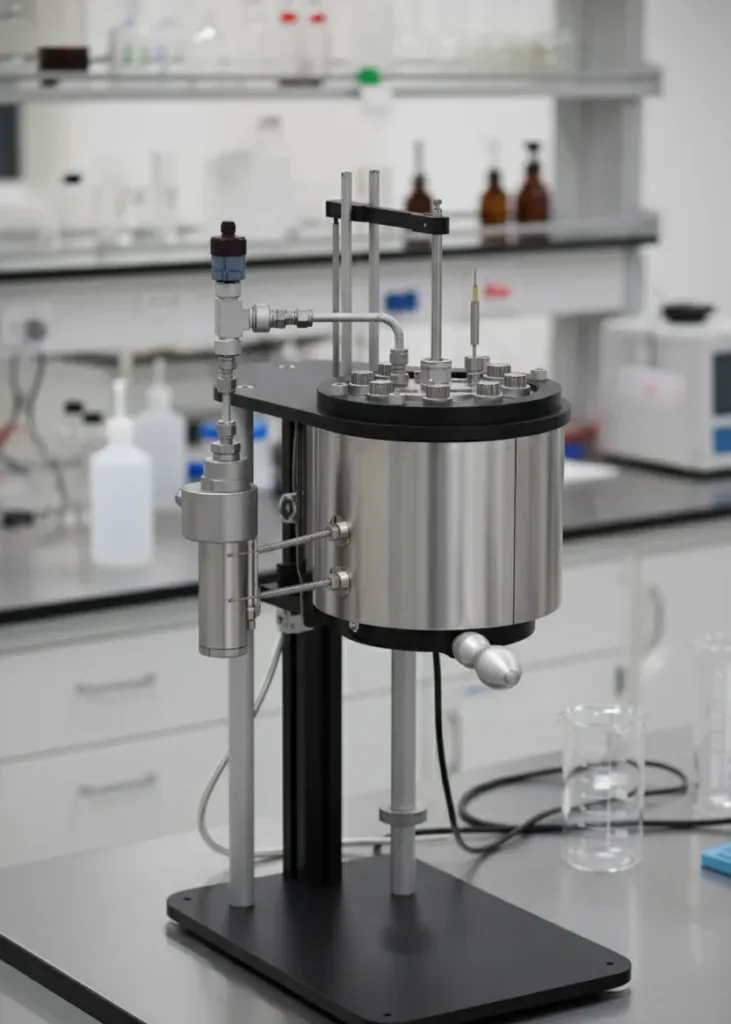
For a public geoscience research center, IRIAN Mecatronics designed and manufactured a custom high-pressure, high-temperature (HPHT) reactor. The system simulates fluid-rock interactions under deep reservoir conditions (550 bar / 8,000 psi, 250°C / 482°F) with highly corrosive gases like H2S, while providing the modularity to easily switch between different experimental configurations.
At a glance
- Client
- A public geoscience research center
- Field
- Geosciences
- Technique
- Fluid-rock interactions in corrosive HPHT conditions
01 — The research question
How to simulate multiple geochemical scenarios in corrosive HPHT conditions with a single piece of equipment?
Studying geochemical interactions in deep reservoirs requires replicating extreme conditions: high pressure, high temperature, and aggressive fluids such as brines containing H2S or CO2. Each experimental protocol—whether static reaction, percolation, or gas-phase interaction—typically requires a dedicated, specialized autoclave. Our client needed to conduct these different types of experiments with a single system to save on cost and lab space, and to ensure data consistency. However, no standard off-the-shelf solution offered the modularity to switch between configurations while guaranteeing resistance to such aggressive fluids at 550 bar.
The challenge was to design a modular reactor architecture that could be reconfigured for different experiments while ensuring flawless sealing and material integrity against corrosion from combined high temperature, high pressure, and aggressive multiphase fluids.
02 — Our approach
A modular and safe design for research in extreme conditions
Ensuring integrity against the most aggressive fluids
The combination of hot brine, H2S, and CO2 attacks most steels. We therefore opted for a dual-barrier defense: an Alloy 625 structure for mechanical integrity, lined with a PTFE coating on all wetted surfaces. This approach prevents both equipment degradation and sample contamination.
Enabling multiple protocols with a single reactor
To switch between a static (batch) mode and a floating-piston configuration, we designed a system with interchangeable lids. Each lid holds the specific instrumentation for one operating mode. This approach avoids overcomplicating the design with unused ports, thereby reducing potential leak points.
Facilitating the handling of a heavy system
A high-pressure reactor is heavy, and opening it is a delicate operation. To simplify frequent handling in the lab, the reactor body is mounted on an articulated mechanical stand. This mechanism assists the operator with opening and closing, making sample access faster and safer.
Ensuring maximum safety at 550 bar
To prevent any risk from accidental overpressure, we integrated a dual safety system compliant with the PED (Pressure Equipment Directive). An active system cuts off the heating in case of deviation, addressing the cause at its source. As a last resort, a rupture disc—a purely mechanical passive device—releases the pressure if a critical threshold is reached.
03 — Technical specifications
| Operating Pressure | 550 bar (8,000 psi) |
|---|---|
| Operating Temperature | 250°C (482°F) |
| Usable Volume (standard configuration) | 700 cm³ |
| Usable Volume (with PTFE beaker) | 520 cm³ |
| Wetted Materials | Alloy 625, PTFE lining |
| Operating Modes | Batch (with/without beaker, with probes), Floating piston (without probes) |
| Control & Communication | Ethernet/IP |
| Certification | PED 2014/68/EU |
04 — Other applications
Does your project resemble this case study?
CO2 Capture, Utilization, and Storage (CCUS)
To study the interaction between supercritical CO2 (with impurities like H2S and brine) and rock or wellbore cement. The core HPHT architecture, corrosion resistance, and control system would be retained, while the volume and ports would be adapted.
Energy (geothermal, oil & gas)
To test corrosion inhibitors or material aging in HPHT production fluids containing H2S. The design of the corrosion reactor and safety features would be kept, with the addition of specific instrumentation.
Geological hydrogen storage
To assess hydrogen embrittlement and biogeochemical reactions. The high-pressure gas capability and modularity are transferable. Materials would need to be certified for hydrogen compatibility, and ATEX safety protocols would be adapted.
An engineer from our design office replies as soon as possible.