
Case study · Precision pumps & injection systems
Fail-safe high-pressure pump with non-reversible drive for long-duration experiments
For a client in geoscience research, IRIAN Mecatronics designed and built a custom high-pressure pump. The equipment simulates geological reservoir conditions (750 bar / 10,880 psi) and guarantees pressure is maintained during a power failure, securing long-duration experiments.
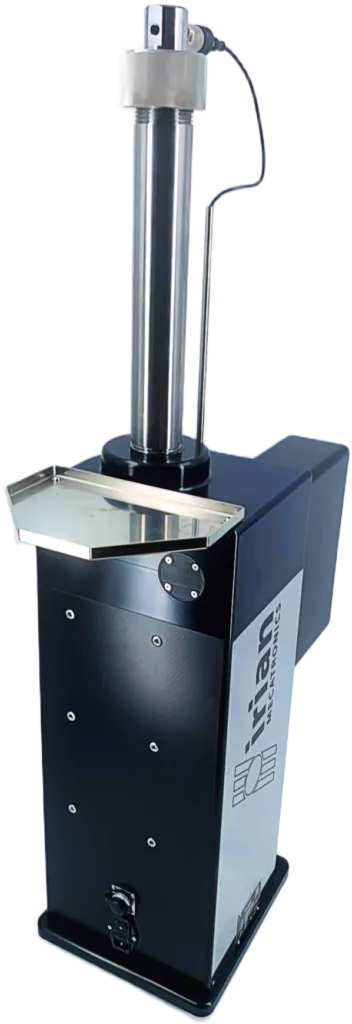
At a glance
- Client
- Geoscience research organization for the energy sector
- Field
- Geosciences, fluid mechanics
- Technique
- Confining pressure maintenance, ultra-low flow rate fluid injection
01 — The research question
How to maintain a high, stable static pressure, even during a power outage?
In many geoscience, chemistry, or materials science experiments, pressure stability is non-negotiable. When a test runs for several days or weeks, a simple power outage can cause depressurization and ruin all the work. The challenge is to combine very fine motorized volume control with a safety mechanism that guarantees confinement in case of failure. Our client needed to simulate geological reservoir pressure conditions (750 bar / 10,880 psi) in the lab to study fluid behavior. Commercial high-pressure pumps did not offer a satisfactory solution: those with fine flow control were reversible and would lose pressure in an outage, while more secure alternatives lacked the resolution for precise control over long periods.
To provide ultra-fine motorized control of volume at very high pressure while making the system mechanically non-reversible to maintain confinement during a power failure.
02 — Our approach
Designing an inherently safe pump
Ensuring a non-reversible drive
The challenge was to prevent the fluid pressure (750 bar / 10,880 psi) from pushing the piston back if the motor failed. We used a drivetrain with a very high gear reduction, which is naturally non-reversible. The experiment's safety becomes intrinsic to the mechanics, without adding a brake that could fail, and the gear reduction provides very high control resolution.
Selecting a fatigue and corrosion-resistant body material
The pump body had to withstand mechanical fatigue from the pressure and be compatible with potentially corrosive reservoir fluids. A high-yield stainless steel was chosen for its ability to handle the pressure without excessive oversizing and for its corrosion resistance, preserving the purity of the samples.
Preventing piston galling and seal wear
To avoid galling under high load between the piston and the steel body, the piston was machined from a non-ferrous alloy with a low friction coefficient. This choice, combined with an elastomer seal offering broad chemical compatibility, ensures the pump's reliability and longevity by reducing maintenance.
03 — Technical specifications
| Operating pressure | 750 bar (10,880 psi) |
|---|---|
| Control | PC-based Human-Machine Interface (HMI) |
| Integration | Ethernet connectivity, compatible with standard industrial protocols |
04 — Other applications
Does your project require stable and secure pressure?
Fine chemistry / Polymerization
For precisely injecting reactants into a pressurized reactor, where a failure could compromise a batch. The non-reversible drive principle would remain key to ensuring dosing safety and protecting the production.
Materials testing / Rock mechanics
For applying a stable confining pressure during triaxial compression tests, where measurement validity depends on this stability. The non-reversibility and high-pressure capability would be retained.
Food industry / Supercritical CO2 extraction
For keeping the pressure of a supercritical fluid stable, where any variation affects the yield. The precise volume control and inherent safety of the pressure hold would be directly transferable, with materials adapted to food-grade standards.
An engineer from our design office replies as soon as possible.