
Case study · Extreme environment simulation systems
High-Pressure Bioreactor Retrofit: Reliable Operation at 10 000 Psi in Corrosive Media
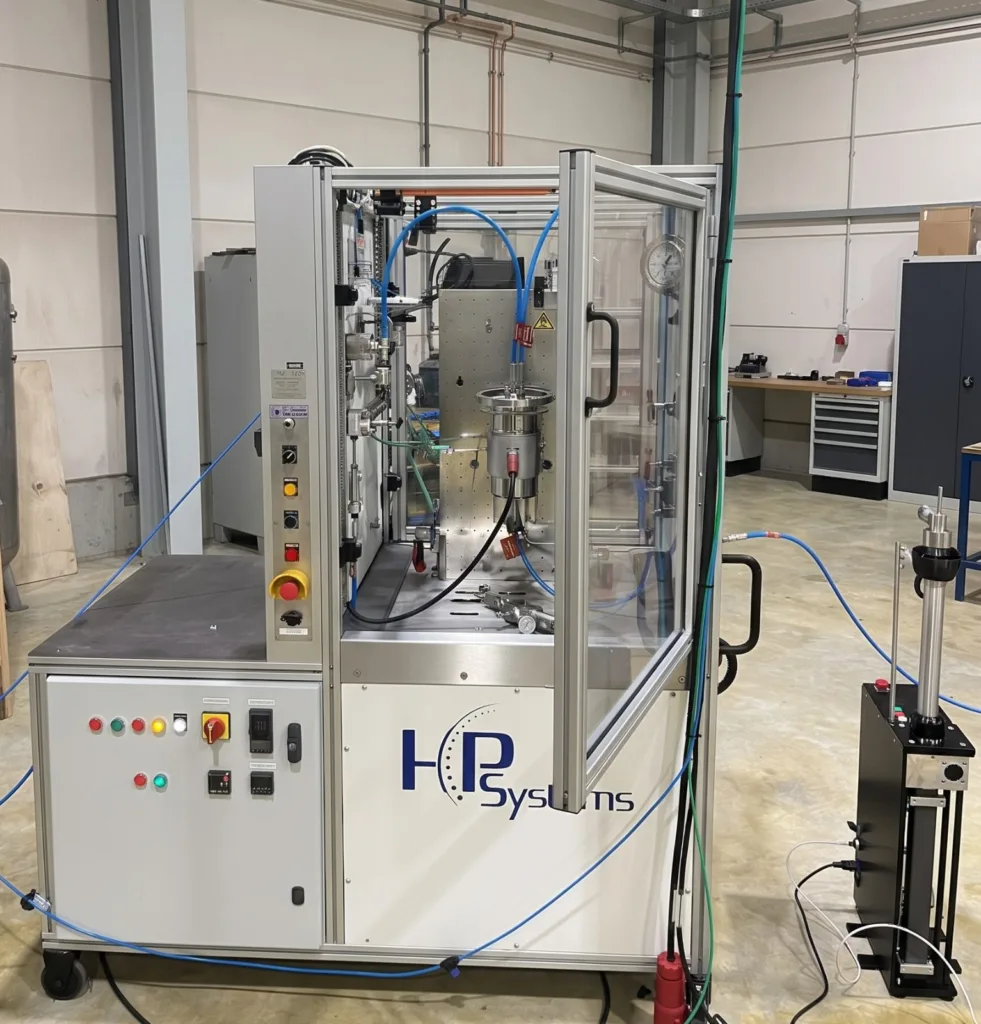
For a marine environmental science research lab, IRIAN Mecatronics recommissioned and improved the reliability of an existing test rig. The work involved integrating an injection and pressure control system capable of operating at 10 000 Psi and 150°C with highly corrosive saline fluids.
At a glance
- Client
- University research laboratory in marine environmental sciences
- Field
- Hydrothermal environment simulation
- Technique
- Pressure control and fluid injection
01 — The research question
How to ensure stable and accurate pressure control in a corrosive environment?
Maintaining stable pressure in a reactor is key to the reproducibility of many experiments in chemistry, geoscience, or environmental science. The challenge grows when the fluid is corrosive, the pressure is high, and the temperature varies: standard control components reach their limits, lacking precision, responsiveness, or chemical resistance. In this project, a lab had a test rig to simulate deep hydrothermal conditions, but it was out of service. An off-the-shelf solution was not an option, as new, reliable components had to be integrated into an existing architecture while staying within a tight budget, far below the cost of a new bench.
How to guarantee stable and accurate pressure control at 10 000 Psi in a hot saline fluid, by adapting high-performance components to a failing existing rig, without exceeding the budget for a recommissioning project?
02 — Our approach
A pragmatic approach: diagnose, improve, and secure
Delivering continuous and stable injection at 10 000 Psi
To feed the reactor, the system needed a stable and precise flow rate, even a very low one, without being affected by the 10 000 Psi back-pressure. We selected a positive displacement syringe pump. Its mechanism guarantees a pulse-free flow and direct control of the injected volume, unlike HPLC pumps. This allows the user to program precise injections or constant flow rates over long periods.
Maintaining stable back-pressure in a corrosive environment
The reactor pressure had to remain stable within 0.5 bar despite temperature fluctuations. We integrated a dome-loaded back-pressure regulator driven by an electronic pressure controller. This design separates the control circuit (air) from the process circuit (corrosive HPHT fluid), providing much more precise, responsive, and automatable control than a manual spring-loaded system. It is a core component of our test rigs for <a href="https://irian-mecatronics.com/fluid-dynamics-phase-behavior/">fluid dynamics</a>.
Restoring the safety and functionality of the existing rig
The budget required replacing only what was strictly necessary. After a complete diagnosis, our technicians brought the electrical cabinet into compliance, replaced defective sensors, and added a certified safety relief valve. This pragmatic approach, typical of our <a href="https://irian-mecatronics.com/maintenance-retrofit-requalification-services/">maintenance, retrofit, and requalification</a> services, made the rig functional and safe again at a controlled cost.
03 — Technical specifications
| Maximum operating pressure | 690 bar (10,000 psi) |
|---|---|
| Pump flow rate range | 0.0001 to 79 mL/min |
| Pressure control accuracy (back-pressure) | ± 1% of full scale (FS) |
| Pressure control accuracy (pump) | ± 0.7 bar |
| Flow control accuracy (pump) | ± 0.3% of setpoint |
| Maximum fluid temperature | 150 °C (302 °F) |
| Syringe volume | 170 mL |
04 — Other applications
Could this approach solve your own technical challenge?
Geosciences / Oil & Gas (EOR)
The challenge is similar when injecting brines or polymers into rock core plugs. Using a syringe pump for a stable flow rate and a dome-loaded regulator for back-pressure remains the most robust solution to ensure reliable permeability measurements.
Chemistry / Catalysis
For the continuous feed of a high-pressure reactor, stable pressure and precise flow are critical. The syringe pump and dome-loaded regulator combination is still relevant.
Energy / Geothermal
Studying geothermal fluids in supercritical conditions involves managing high pressure, high temperature, and corrosion simultaneously. The control principle can be transposed, although the pressure and temperature levels may require higher-grade alloys and sealing technologies.
An engineer from our design office replies as soon as possible.