
Case study · Fluid dynamics & phase behavior
Visualizing gas hydrate formation: a modular high-pressure sapphire reactor
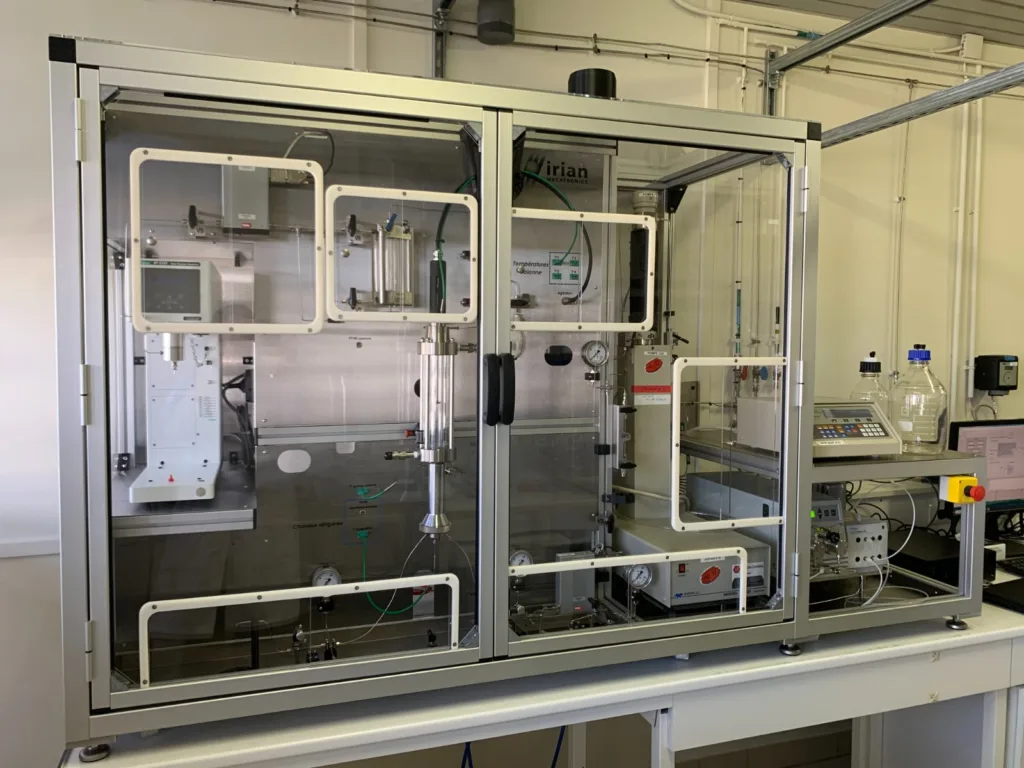
For a global energy leader, IRIAN Mecatronics designed and manufactured a custom high-pressure reactor to visualize gas hydrate formation. The equipment is used to study the phenomenon at 120 bar (1740 psi) in a corrosive environment, featuring two interchangeable experimental configurations: a static porous medium and a stirred medium.
At a glance
- Client
- A global energy leader
- Field
- Oil & Gas, geosciences
- Technique
- Phase change visualization, crystallization kinetics
01 — The research question
How to visualize and quantify crystallization under pressure with varying flow conditions?
Studying the formation and dissolution of crystals (hydrates, salts, polymers) under pressure is crucial for process control in chemistry, geosciences, and energy. The phenomenon is highly dependent on local conditions such as temperature, pressure, and flow. Observing the process across a representative volume, rather than through a small viewport, is essential for understanding its kinetics and validating simulation models. This is a key challenge in Fluid Dynamics & phase behavior. Our client needed to understand CO2 hydrate formation in two scenarios: one simulating a reservoir (static porous medium) and the other a pipeline (agitated medium). Standard reactors do not offer full-column visualization, and existing sapphire cells were too small to accommodate the required complex, interchangeable instrumentation.
To enable direct visual observation over the full height of a 120 bar (1740 psi) column, accommodate two radically different and interchangeable internal experimental setups, and withstand a corrosive environment.
02 — Our approach
A modular design for a dual experimental challenge
Ensuring full visualization at 120 bar
To observe the location and kinetics of crystallization over a 200 mm height, a metal cell with viewports would have offered a discontinuous view. We therefore built the reactor around a monolithic sapphire tube, which serves as the cell body. This approach ensures a complete and continuous view without optical distortion.
Enabling two test scenarios in a single rig
Rather than building two separate test rigs, we designed a modular system. The cell body is constant, but two different top assemblies ('heads') are easily interchangeable. Each head integrates specific instrumentation and actuators: one for an instrumented sand pack, the other for a stirrer with torque measurement. This design maximizes the value of the investment.
Ensuring chemical compatibility and thermal control
To withstand the corrosivity of saltwater and CO2, all wetted parts were machined from Titanium Ta6V and Hastelloy. To regulate the temperature from -10°C to +80°C (14°F to 176°F) without obstructing the view, an external double jacket was integrated, ensuring homogeneous and reliable thermal control.
Facilitating handling and maintenance
Changing configurations and cleaning the system require frequent disassembly. To make these operations simple and safe, the entire column assembly is mounted on a pivoting, lockable stand. This allows the operator to tilt the equipment effortlessly for draining, filling, or maintenance.
03 — Technical specifications
| Operating Pressure | 120 bar (1740 psi) |
|---|---|
| Operating Temperature | -10°C to 80°C (14°F to 176°F) |
| Usable column volume | 63 cm³ |
| Sapphire tube dimensions | Ø 20 mm x 200 mm |
| Maximum stirring speed | 1500 rpm |
| Wetted Materials | Titanium Ta6V, Hastelloy X (probes) |
| Instrumentation (sand pack setup) | Up to 4 thermocouples |
| Instrumentation (stirred setup) | Real-time torque measurement, integrated thermocouple |
04 — Other applications
Does your project have similar requirements?
Fine chemicals / pharmaceuticals
A common challenge is visualizing crystallization or polymerization kinetics to optimize a process. The core design—a jacketed sapphire column, modularity, and torque measurement for viscosity tracking—can be adapted for these applications. See our page on custom HPHT reactors & cells.
Geosciences / geological CO2 storage
This involves studying fluid-rock interactions under reservoir conditions. The HP cell with full visualization and the instrumented sand pack setup would be retained, with materials and pressure ranges adapted to accommodate rock core samples.
Food & beverage / supercritical extraction
To observe the effect of supercritical CO2 extraction on a solid matrix, the visualization cell and precise P/T control would be key features. Materials would be adapted to meet sanitary standards (e.g., 316L stainless steel, PEEK), and the design would be optimized for easy cleaning.
An engineer from our design office replies as soon as possible.