
Case study · Fluid dynamics & phase behavior
Characterizing shear-sensitive additives without sample degradation: a low-shear pressure drop test rig
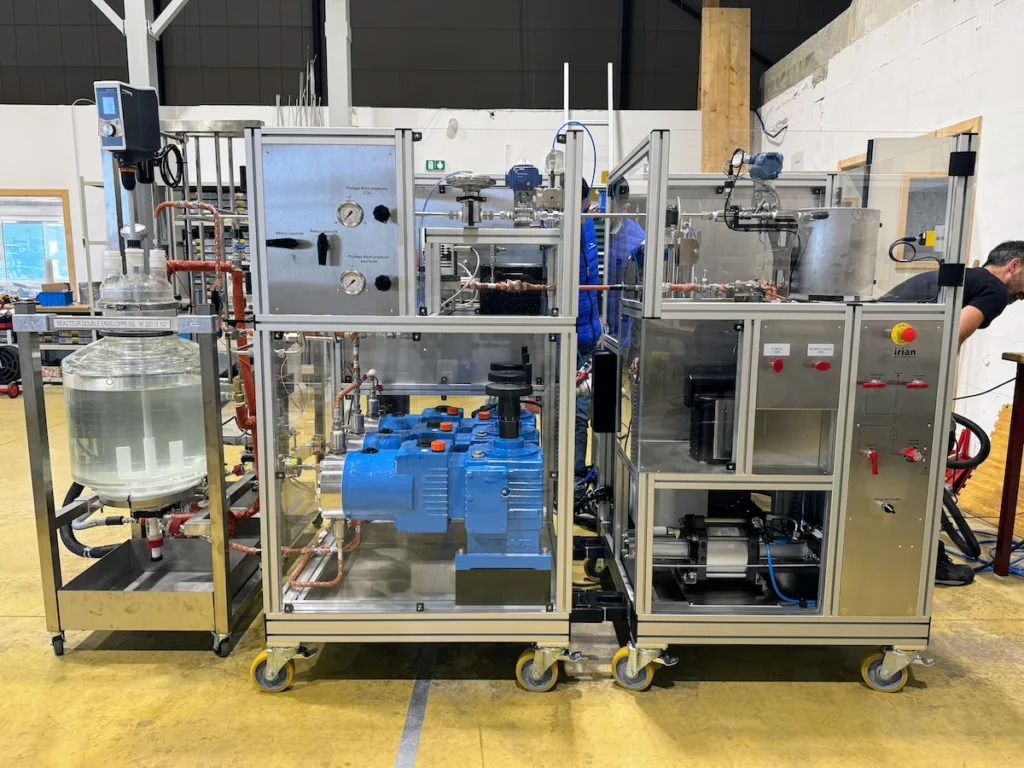
For a major player in the energy industry, IRIAN Mecatronics designed and built a custom test rig to quantify the effectiveness of drag-reducing agents (DRAs). The system measures pressure drop reduction in turbulent flow (up to 50 bar [725 psi] and 70°C [158°F]) while preserving the integrity of the additives, which are highly sensitive to mechanical shear.
At a glance
- Client
- A major player in the energy industry
- Field
- Oil & Gas / fluid dynamics
- Technique
- Pressure drop measurement / additive effectiveness
01 — The research question
How to measure the effect of a fragile product without the instrument skewing the results?
Many fluids and additives, from long-chain polymers to biological suspensions, are sensitive to mechanical stress. Characterizing their properties (viscosity, texture, effectiveness) is a challenge: the measurement instrument itself—with its pumps, valves, and bends—can shear and irreversibly degrade the sample, making the results useless. The difficulty lies in creating a test environment that replicates the conditions of interest without introducing parasitic stresses that destroy the sample. Our client needed to quantify the performance of drag-reducing agents (DRAs) to optimize hydrocarbon transportation in pipelines. This required simulating turbulent flow at a high Reynolds number.
The challenge was to generate a high-Reynolds-number turbulent flow—which inherently creates high shear in the pipe—while protecting the shear-sensitive DRA molecules from degradation throughout the rest of the flow loop, particularly at the injection point.
02 — Our approach
Our approach: preserving the sample at every stage of the flow loop
Injecting the additive without alteration
To inject concentrations of a few ppm of a fragile product into a pressurized line, we designed a positive displacement system. Its fluid path eliminates all shear points (restrictions, sharp edges) typical of standard metering pumps. This ensures the additive is tested in its original state, guaranteeing reliable measurements.
Simulating pipeline flow in the lab
To simulate a long pipeline section in a compact space, the rig uses 6-meter test tubes coiled into spools. These columns are mounted on a removable and interchangeable heated support. This allows the user to quickly explore different velocity and shear conditions across several diameters, all within a compact, temperature-controlled custom test bench.
Designing a full-bore fluid circuit
To prevent any parasitic degradation from skewing the measurement, the entire circuit in contact with the mixture is designed with full-bore components. By avoiding standard valves and fittings that create restrictions, we ensure that the measured pressure drop is solely due to friction in the column, not to artifacts.
Measuring very low pressure drop with high accuracy
DRA performance is determined by a small pressure difference under a high static pressure (50 bar). We used a high-resolution differential pressure transducer with short, direct impulse lines. This provides the user with high-fidelity data, enabling precise and reliable quantification of the additive's effectiveness.
03 — Technical specifications
| Maximum operating pressure | 50 bar (725 psi) |
|---|---|
| Maximum operating temperature | 70°C (158°F) |
| Target Reynolds number range | 5,000 - 50,000 |
| DRA injection flow rate | 0.002 to 2.5 cm³/min |
| Test column diameters (OD) | 1/8", 1/4", 1/2" |
| Test column length | 6 m (approx. 20 ft) |
| Differential pressure measurement uncertainty | ±0.035% |
04 — Other applications
Does your project involve a shear-sensitive fluid?
Food & Beverage
Common challenge: Pumping and circulating fragile products (emulsions, sauces) without breaking down their texture. What we would keep: The principle of a very low-shear circuit, with a syringe pump and full-bore valves, adapted with sanitary materials and fittings (316L stainless steel, tri-clamp).
Biotechnology / Pharma
Common challenge: Handling protein solutions or cell suspensions without denaturing molecules or lysing cells. What we would keep: The design of the low-shear high-precision injection pump and the overall circuit layout, adapted for scale (e.g., microfluidics) and biocompatible materials.
Cosmetics
Common challenge: Manufacturing creams or gels whose properties depend on shear-sensitive colloidal structures. What we would keep: The mastery of shear control throughout the process to guarantee final product consistency, adapting the design to meet cleanliness and chemical compatibility standards.
An engineer from our design office replies as soon as possible.