
Case study · Geoscience & subsurface studies
Custom multi-sample permeability test rig for corrosive HPHT studies | 140 bar
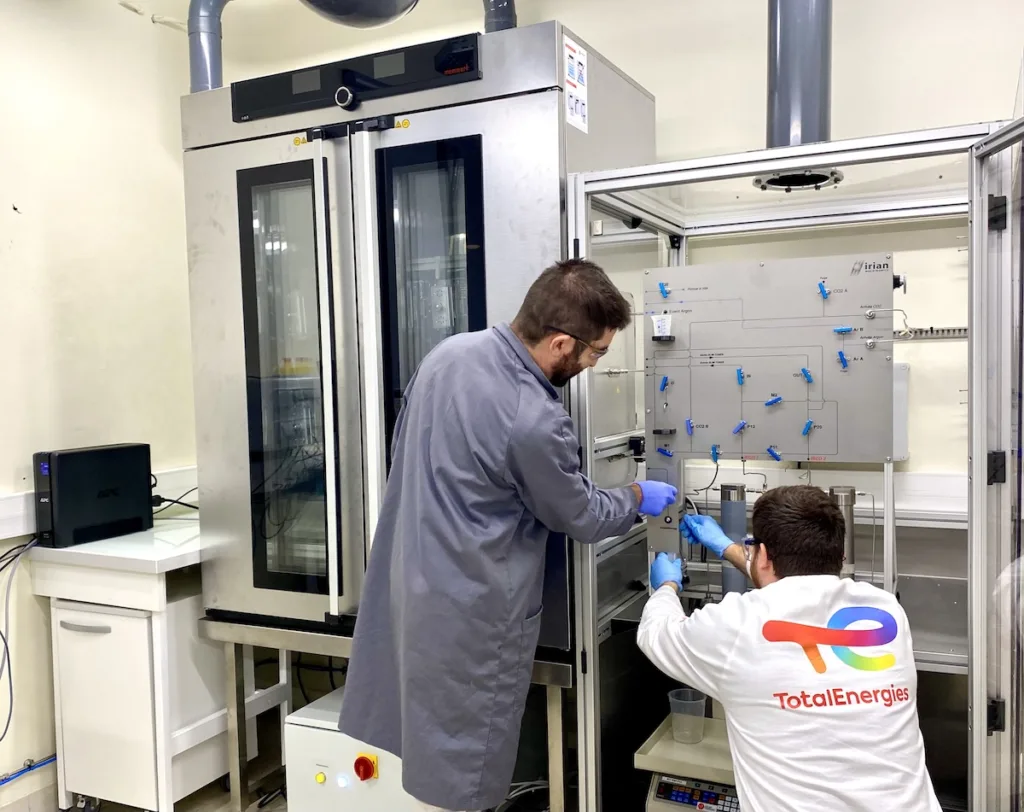
For a research center of a global energy company, IRIAN Mecatronics designed and built a test rig to measure the permeability of six samples in parallel. The equipment ensures high-precision (0.05%) differential pressure measurements under extreme corrosive conditions at 140 bar (2,030 psi) and 130°C (266°F).
At a glance
- Client
- Research center of a global energy company
- Field
- Geosciences, Carbon Capture, Utilization, and Storage (CCUS)
- Technique
- HPHT permeability measurement in corrosive media
01 — The research question
How can you accurately measure a very small pressure drop when the fluid and operating conditions actively degrade the measurement system?
Characterizing the permeability of porous media under reservoir conditions (high pressure, high temperature) requires precise fluid flow control over extended periods. The experiment's reliability hinges on the system's material integrity. Corrosion in the flow path introduces particles, contaminates the fluid, and causes measurement drift, masking the very phenomena being studied. The project's objective was to study carbonation by injecting CO2-saturated brine at 140 bar (2,030 psi) and 130°C (266°F). At these conditions, the fluid becomes a highly aggressive carbonic acid. Standard stainless steel components would corrode rapidly, generating particles that damage valves, distort pressure measurements, and prevent any reliable study—a challenge we also addressed in our custom Hastelloy reactor systems.
Ensuring stable and accurate high-precision differential pressure measurements when the operating conditions (corrosive fluid, HPHT) actively degrade both the flow path materials and the sensors.
02 — Our approach
Design driven by measurement integrity
Eliminating corrosion at the source
The process fluid (brine + CO2 at 130°C / 266°F) is highly corrosive to stainless steels. We built all wetted parts from Hastelloy C-276, a material that is inherently inert in this environment. This design choice ensures the equipment's long-term integrity and prevents fluid contamination, guaranteeing repeatable measurements.
Ensuring direct and stable pressure measurement
To measure a very low pressure drop, we selected sensors with diaphragms made of a corrosion-resistant alloy. This approach avoids complex fluid separation systems, which are sources of leaks and measurement artifacts. The digital output preserves signal integrity all the way to the PLC, providing a direct, reliable, and precise measurement.
Improving the reliability of the automated circuit
Particles from the sample or from corrosion can damage the seats of conventional needle valves and cause leaks. We used a valve technology with an operating principle that is less sensitive to solid particles. This choice increases the reliability of the automated system and prevents failures during long-duration tests.
03 — Technical specifications
| Maximum operating pressure | 140 bar (2,030 psi) |
|---|---|
| Maximum operating temperature | 130°C (266°F) |
| Capacity | Up to 6 slim tubes simultaneously |
| Pressure measurement accuracy | 0.05% |
| Pressure measurement resolution | 0.01 bar (0.145 psi) |
| Wetted materials | Hastelloy C-276 (as-described version) or Stainless steel (base version) |
04 — Other applications
Could this approach apply to your project?
Geosciences and CO2 Storage (CCUS)
For characterizing rock-fluid interactions (permeability, reactivity) under reservoir conditions with brines, CO2, or H2S. The core principles—a fully inert HPHT circuit, high-precision pressure measurement, and automation—would be directly applicable.
Fine chemistry and materials science
For qualifying the aging resistance of materials (alloys, polymers) exposed to critical fluids like wet H2 or geothermal brines. The HPHT control architecture, use of high-performance alloys, and data acquisition system would be identical, with the pressure vessel design adapted as needed.
Chemical process development
For developing synthesis processes involving highly corrosive reagents or solvents under extreme conditions. The robust sealing, chemically inert flow path, and precise control of parameters (pressure, flow rate) are directly transferable to reactors or pilot plants.
An engineer from our design office replies as soon as possible.