
Case study · Geoscience & subsurface studies
Measuring rock deformation and permeability with a custom HPHT triaxial cell
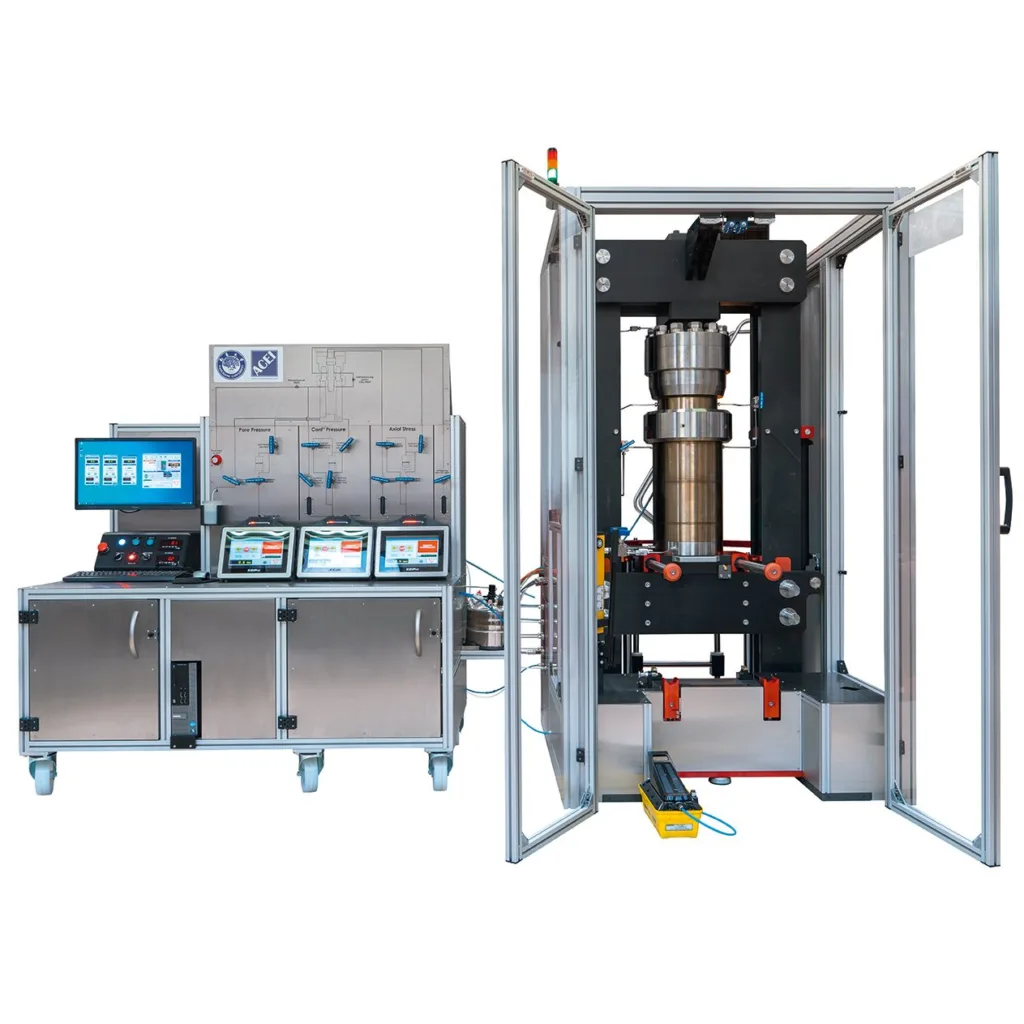
IRIAN Mecatronics designed and built a custom high-pressure, high-temperature (HPHT) triaxial test cell for a major university geoscience research center. The equipment simulates deep geological conditions (150 MPa / 21,750 psi, 150°C / 302°F) to measure rock sample deformation and permeability with micrometer resolution in the presence of corrosive fluids.
At a glance
- Client
- Major university geoscience research center
- Field
- Geoscience, rock mechanics
- Technique
- HPHT triaxial testing, permeability measurement, mechanical characterization
01 — The research question
How to characterize a porous material's behavior under multiple stresses in a reactive environment?
Studying the mechanical and hydraulic behavior of a porous solid material like rock requires controlling several parameters at once: a confining pressure to simulate depth, an axial stress to simulate tectonic forces, a pore fluid pressure, and temperature. The study's reliability depends on the ability to maintain stable control over these parameters and to measure the resulting ultra-low deformations and flow rates. This project aimed to replicate deep geological environments to characterize rock properties.
Maintaining stable control and micrometer-level measurement resolution during long-term tests while subjecting the sample to extreme pressures, temperatures, and corrosive fluids.
02 — Our approach
The design approach: three key decisions to ensure measurement reliability
Ensuring absolute pressure stability for ultra-low flow rate measurements
Measuring very low permeability (down to 10⁻¹⁷ m²) requires perfect pore pressure stability. The chosen design ensures a perfectly continuous mass flow rate, free from the typical oscillations of single-piston systems that would skew the measurement. This stability makes it possible to quantify extremely low permeabilities and maintain constant conditions over tests lasting several weeks.
Isolating the pore pressure circuit for use with corrosive fluids
The fluid injected into the rock can be a strong acid or base, which would attack standard steels at high temperatures. The solution is to isolate this fluid in a dedicated circuit where all wetted parts are made of chemically inert materials. This allows the user to test a wide range of reactive fluids without risk of corrosion, contamination, or skewed results—a key challenge in geochemical studies with corrosive fluids.
Measuring the sample's deformation, not the machine's
An accurate measurement of rock deformation is often compromised by the compliance of the press frame and piston. To eliminate these parasitic deformations, the displacement sensor was placed as close as possible to the sample. This provides the user with a stress-strain curve that faithfully reflects the material's intrinsic behavior.
03 — Technical specifications
| Confining pressure | Up to 150 MPa (1500 bar / 21,750 psi), accuracy ±0.2 MPa |
|---|---|
| Axial stress | Up to 500 MPa (5000 bar / 72,500 psi), accuracy ±0.2 MPa |
| Pore pressure | Up to 100 MPa (1000 bar / 14,500 psi), accuracy ±0.2 MPa |
| Temperature | Up to 150°C (302°F), extendable to 200°C (392°F), control ±1°C |
| Permeability measurement range | 10⁻¹³ m² to 10⁻¹⁷ m² |
| Axial deformation measurement resolution | ±1 µm |
| Pore volume measurement resolution | ±0.001 cm³ |
| Standard sample size | Ø 20 mm x 40 mm |
04 — Other applications
Does your application share similar challenges?
Energy: H₂ storage, CO₂ capture
The long-term behavior of reservoir rocks or cements in the presence of H₂ or supercritical CO₂ is a common concern. The principles of triaxial confinement, pore pressure regulation, and permeability and deformation measurement would remain the same.
Advanced materials / composites
Studying the mechanical strength and aging of materials under multi-axial stress in harsh environments presents a similar need. The principles of applying controlled stress, precision deformation measurement, and thermal control are directly transferable.
Process engineering / pharmaceuticals
When studying the compaction of powders or granules, measuring fluid permeability under high stress is a shared challenge. The principles of applying axial stress and pore pressure, along with measuring very low flow rates, remain relevant.
An engineer from our design office replies as soon as possible.