
Case study · Extreme environment simulation systems
Isolating an instrument from extreme environments: A custom flow meter for 6,000 m deep-sea sampling
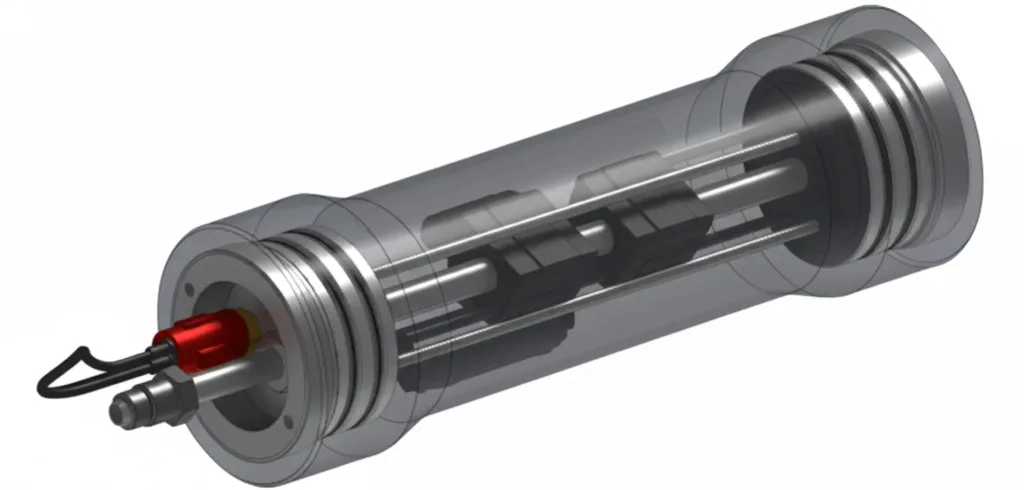
For a major oceanographic research institute, IRIAN Mecatronics designed and built a custom flow meter to operate at a depth of 6,000 meters. The equipment shields a standard non-intrusive sensor from external pressure (625 bar) and corrosion, ensuring the scientific validity of seawater samples.
At a glance
- Client
- Major oceanographic research institute
- Field
- Oceanographic research
- Technique
- Non-intrusive volumetric flow measurement
01 — The research question
How do you measure flow accurately when the instrument cannot survive the environment?
Some environments are so extreme—very high pressure, corrosion, radiation, explosive atmospheres—that no standard sensor can operate in them reliably. The solution is not to search for a perfect sensor that does not exist, but to isolate a proven measurement instrument from the specific stress it cannot handle, without altering the measurement itself. This was the challenge for this project: to measure the volume of water pumped by a sampling tool at a depth of 6,000 meters. No off-the-shelf flow meter could withstand the 625 bar external pressure and corrosive seawater, let alone guarantee a non-contact measurement to avoid contaminating the scientific sample.
Achieve an accurate flow measurement with a sensor that can withstand neither the external pressure nor the corrosive environment, without disturbing the measured fluid.
02 — Our approach
The approach: Isolate rather than harden
Protecting the sensor from pressure and corrosion
The flow sensor and its electronics were not designed for 625 bar of external pressure. Rather than searching for a non-existent hardened sensor, we housed it in a sealed enclosure maintained at atmospheric pressure. This approach allows the use of a standard, proven instrument, fully protected from crushing forces and seawater.
Ensuring a non-contact, contamination-free measurement
To preserve the scientific integrity of the sample, all intrusive measurement methods (such as turbines or electrodes) were ruled out. We selected a non-intrusive technology, where the sensor measures through the pipe wall, which guarantees zero contamination, no internal corrosion, and no pressure drop that could affect the sampling process.
Transmitting signals from extreme depths
The electrical power and measurement signal had to pass through the enclosure wall without compromising its seal. We integrated specific bulkhead connectors, qualified for very high-pressure subsea environments, to ensure a reliable connection and protect the electronics from any water ingress.
03 — Technical specifications
| Maximum operating depth | 6,000 m |
|---|---|
| Operating external pressure | 625 bar (9,065 psi) |
| Design external pressure | 630 bar (9,137 psi) |
| Measurement principle | Non-intrusive |
| Output signal | 4-20mA |
| Power supply | 24V/DC |
04 — Other applications
Does your project face a similar constraint?
Nuclear
The constraint is measuring a parameter in a radioactive or corrosive fluid. The principle of a vessel isolating a standard sensor from the process fluid remains identical, adapting materials and certifications for radiation resistance and decontamination.
Chemical / Pharmaceutical (ATEX zones)
The challenge is using a high-performance analyzer that is not certified for an explosive atmosphere. The containment principle is transferable using an ATEX-certified enclosure, chemically compatible materials, and suitable connectors.
Deep geothermal / oil & gas
The need is to protect sensitive instrumentation from downhole conditions (HPHT, H2S). The HP containment vessel is still the solution, but it must be designed for extreme temperatures and with specific materials (Inconel, Hastelloy), a core expertise in our equipment for geosciences.
An engineer from our design office replies as soon as possible.