
Case study · Fluid dynamics & phase behavior
Visualizing supercritical CO2: a portable high-pressure demonstration cell
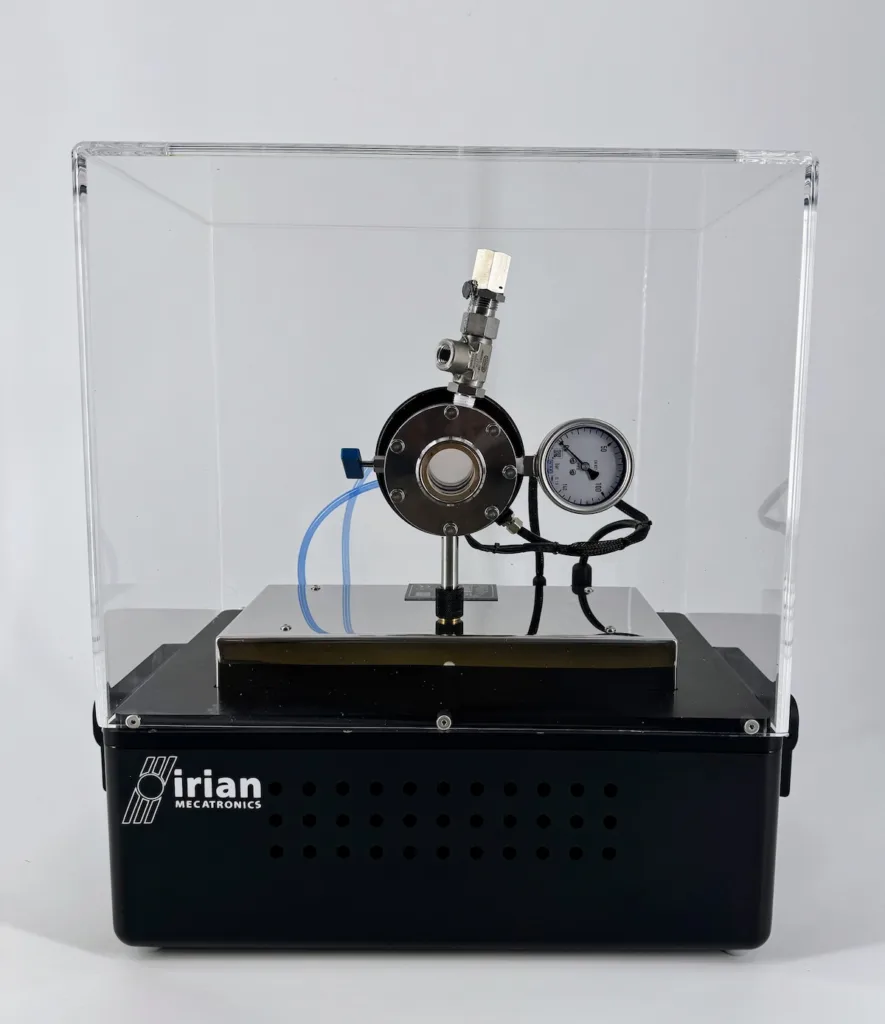
For a major energy company, IRIAN Mecatronics designed and built a high-pressure (80 bar / 1,160 psi) visualization cell to demonstrate the transition of CO2 to its supercritical state for a non-specialist audience. The fully self-contained, portable unit integrates all functions into a single carrying case, ensuring absolute safety for use at conferences and public events.
At a glance
- Client
- Major international energy company
- Field
- Energy / science education
- Technique
- Phase transition visualization
01 — The research question
How can you safely demonstrate a high-pressure phenomenon outside of a laboratory?
Observing a physical phase change or a chemical reaction under controlled pressure and temperature requires a controlled environment. When this observation needs to happen outside a lab—for training, a client demo, or a trade show—the challenge is twofold: the equipment must be miniaturized and self-contained, and it must guarantee absolute safety for an untrained audience. This was the challenge our client presented: making the transition of CO2 to its supercritical state visible and understandable during a conference. Laboratory equipment capable of reaching these conditions, such as custom HPHT reactors and cells, are typically stationary, bulky, and rely on building utilities. They are not portable or designed for operation by non-specialists in a public space.
Designing a compact, self-contained system to visualize a high-pressure (80 bar) phenomenon while guaranteeing absolute safety for public use.
02 — Our approach
Designing a 'plug-and-play' demonstration tool
Ensuring clear visualization at 80 bar
The disappearance of the supercritical meniscus is subtle. For educational impact, a wide, distortion-free view at 80 bar was essential. We integrated large-diameter optical windows that combine mechanical strength with clarity, ruling out smaller viewports that would have diminished the demonstration's visual impact.
Integrating a laboratory into a carrying case
A complete system (cell, heating, cooling, pump) is normally spread out on a lab bench. To make it portable by one person, we designed an all-in-one chassis that integrates all components into a single carrying case. The equipment is 'plug-and-play' and is controlled from a standard PC.
Securing high-pressure equipment for a public audience
Operating at 80 bar in public requires safety measures that go beyond mere robustness. In addition to designing the unit in compliance with the Pressure Equipment Directive (PED), we added redundant safety barriers: active overpressure protection and a passive shield to contain any projectiles in the unlikely event of a rupture.
03 — Technical specifications
| Maximum operating pressure | 80 bar (1,160 psi) |
|---|---|
| Operating temperature range | -10°C to +150°C (14°F to 302°F) |
| Internal cell volume | 7 cm³ |
| Viewing diameter | 30 mm |
| Control | PC-based interface (requires 3 USB ports) |
04 — Other applications
Does your application require visualizing phenomena under pressure in a compact format?
Higher education / training
To visually and safely demonstrate physicochemical phenomena (crystallization, reactions) in a classroom setting. The core concept of a compact, safe cell with simple controls would be retained, while adapting the materials and P/T range to the specific phenomenon under study.
Food & Beverage (R&D)
To visualize the effect of processes (supercritical extraction, HP pasteurization) on samples. The design would keep the windowed cell, precise control, and portability, but use food-grade materials and a customized internal geometry.
Cosmetics / Pharmaceuticals
To observe the stability or formation of emulsions or suspensions under specific conditions. The direct visualization in a closed system, small sample size, and operational safety would be maintained, with wetted materials selected for product compatibility.
An engineer from our design office replies as soon as possible.