
Case study · Precision pumps & injection systems
Generating a stable reference flow across a 1-to-5,500 range: A water meter calibration bench
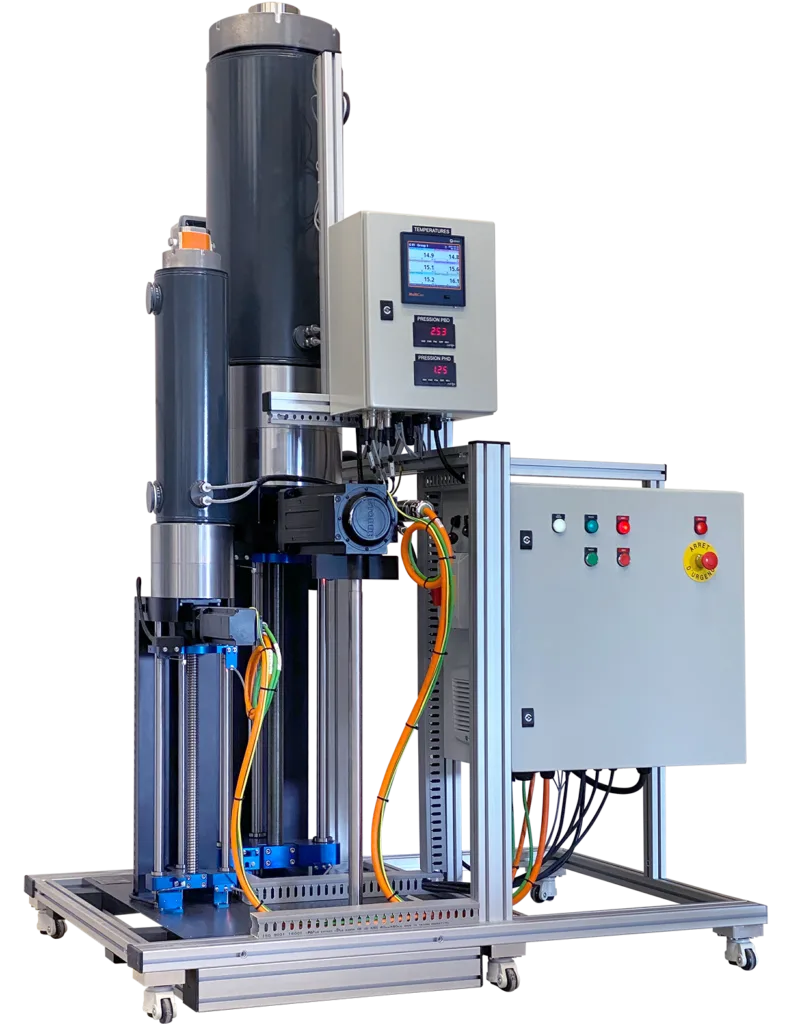
For a manufacturer of utility metering equipment, IRIAN Mecatronics designed and built a custom water meter calibration bench. The equipment generates a metrology-grade reference flow with constant accuracy over a 1-to-5,500 range, at a stable, standardized temperature.
At a glance
- Client
- Manufacturer of smart metering equipment for public utilities
- Field
- Fluid Metrology
- Technique
- Flow meter calibration
01 — The research question
Generating a stable and accurate reference flow over a very wide dynamic range
Generating a stable, known flow rate with high accuracy is a classic metrology challenge. The difficulty grows exponentially with the required dynamic range, as the technologies optimized for very low flows are fundamentally different from those needed for high flows. This project's goal was to validate fiscal water meters over their entire operating range, from 1 L/h to 5,500 L/h, with a single test bench. A standard pump hits a dead end here: one sized for the maximum flow rate lacks accuracy and stability at very low speeds, while one designed for the finesse of low flows cannot deliver the required power.
How can we guarantee constant metrological accuracy over a 1-to-5,500 flow rate range, while also controlling the thermal stability of the test fluid?
02 — Our approach
Our approach: From physical hurdles to design principles
Ensuring accuracy over a 1-to-5,500 dynamic range
To guarantee perfect linearity from a near-drip (1 L/h) to full flow (5,500 L/h), we ruled out a single-pump design. Our modular architecture uses specialized actuators for different flow sub-ranges. This gives the user a single bench for the entire test spectrum, without compromising on accuracy.
Controlling the fluid's thermal stability
The test protocols at +25°C (77°F) and +50°C (122°F) require rapid temperature changes. To counter the high thermal inertia of the pumps, we designed an active thermoregulation system using a heat exchanger. It heats and cools the circuit, cutting the stabilization time from 50°C to 25°C to under 10 minutes and maximizing the bench's productivity.
Compensating for circuit deformation under pressure
Pressurizing the system up to 25 bar (363 psi) causes the pump bodies to deform elastically, which skews the delivered volume. Rather than resorting to costly oversizing, we modeled this deformation. A real-time correction algorithm compensates for the physical effect, ensuring the accuracy of the injected volume regardless of the pressure.
03 — Technical specifications
| Flow rate range | 1 to 5,500 L/h |
|---|---|
| Maximum operating pressure | 25 bar (363 psi) |
| Test temperature setpoints | +25°C (77°F) and +50°C (122°F) |
| Cooling time (50°C to 25°C) | < 10 minutes |
04 — Other applications
Is your need similar? What would stay, what would change.
Pharmaceuticals / Biotechnology
For precisely dosing reagents into bioreactors, the dual-pump principle for dynamic range and the double-jacket thermal regulation would be retained. Materials (316L stainless steel, PEEK) and sanitary design (CIP/SIP) would be adapted to GMP requirements.
Aerospace / Automotive
To test fuel injectors or pumps at different rates, the modular architecture, thermal regulation, and pressure compensation would remain relevant. The fluids (kerosene) and safety standards (ATEX) would dictate specific materials and seals.
Geoscience / CO2 Capture
For the controlled injection of fluids (supercritical CO2) into rock samples, the dual-pump principle for dynamic range and high-pressure deformation compensation are directly transposable. The design would evolve for much higher pressures and temperatures, with materials like Hastelloy.
An engineer from our design office replies as soon as possible.