
Case study · Geoscience & subsurface studies
Measuring permeability across 9 orders of magnitude: A custom high-pressure gas permeameter
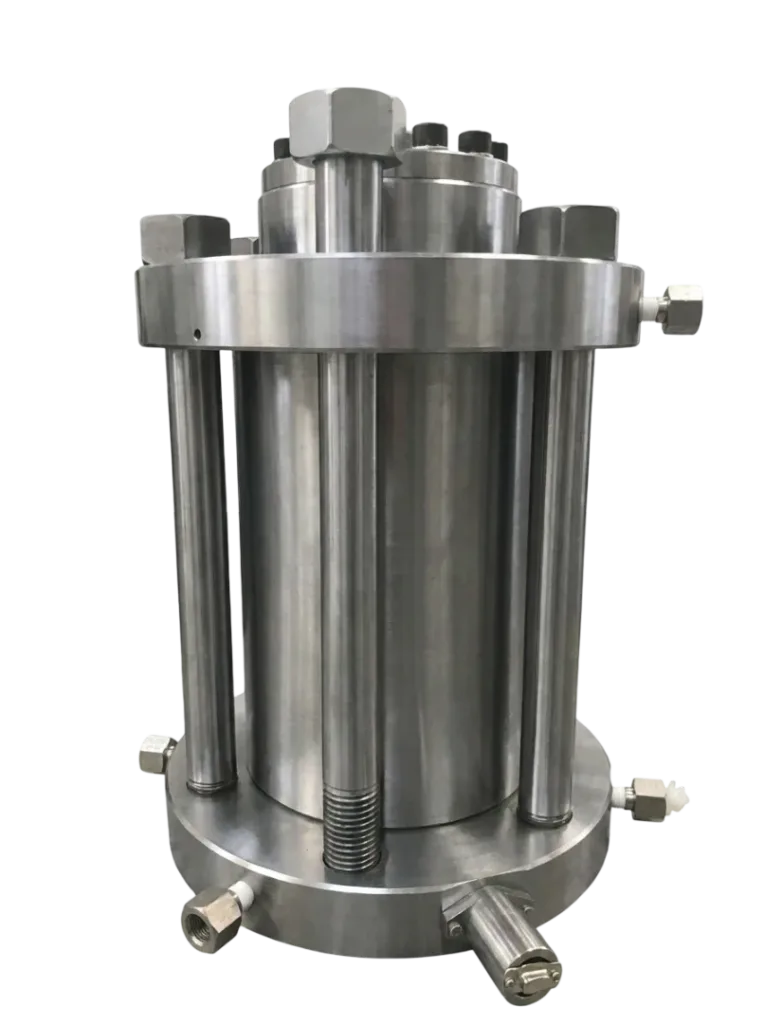
For a civil engineering research laboratory, IRIAN Mecatronics designed and built a custom gas permeameter. The equipment measures the permeability of rock samples over a 9-decade range, under a confining pressure of 600 bar.
At a glance
- Client
- University civil engineering research laboratory
- Field
- Geoscience
- Technique
- Intrinsic gas permeability measurement
01 — The research question
How can you measure a physical property over a very wide dynamic range with a single instrument?
Some physical properties, like the permeability of a material, can vary by several orders of magnitude from one sample to another. Standard sensors have a limited measurement range, forcing labs to use multiple instruments or switch sensors mid-test. This makes measurements discontinuous, complex, and expensive. In this project, a research lab needed to characterize the gas permeability of rock samples ranging from highly porous to nearly impermeable, while simulating deep geological conditions (confining pressure up to 600 bar). Off-the-shelf flow meters, which cannot cover such a broad range, would have made the tests tedious and the results inconsistent.
The challenge: To measure both very high gas flow rates (permeable rocks) and near-zero flow rates (tight rocks) with a single device, without compromising accuracy at either end of the scale.
02 — Our approach
Our approach: From measurement principle to test cell
Using an indirect measurement principle to cover the full range
Since no direct-reading flow meter can span 9 orders of magnitude, we based the measurement on the rate of pressure change in two calibrated volumes. This principle (the transient method), directly related to Darcy's law, is valid across the entire range. The user gets a single, continuous measurement without having to switch sensors.
Designing a specialized circuit to optimize speed and sensitivity
A single circuit would have been too slow for high permeabilities or not sensitive enough for low ones. We therefore designed two switchable circuits: an upstream 'high-pressure' circuit for high flow rates and a downstream 'low-pressure' circuit for minute flows. This optimizes the measurement time for each type of sample.
Securing the sample under high triaxial stress
To apply 600 bar of confining pressure without damaging the rock, we developed a self-compensating mechanical cell. It maintains isostatic pressure and protects the sample's integrity during pressurization cycles. This approach is central to our work in custom HPHT test benches for geoscience and subsurface studies.
03 — Technical specifications
| Permeability measurement range | 10⁻¹² to 10⁻²¹ m² |
|---|---|
| Maximum confining pressure | 60 MPa (600 bar / 8,700 psi) |
| Sample diameter | 50 mm |
| Sample height | 30 to 100 mm |
| Test gases | Argon, Nitrogen, Helium compatible |
04 — Other applications
Could this approach apply to your project?
Construction materials
To characterize the air or water permeability of high-performance concrete or geomembranes. The pressure decay measurement principle and dual-circuit architecture would still apply; the cell and test fluids would be adapted.
Food or pharmaceutical packaging
To measure the very low oxygen or water vapor permeability of barrier films. The downstream circuit of our test rig, optimized for infinitesimal flows, could be directly transferred. The cell would be designed for flat films under low differential pressure.
Technical textiles and membranes
To assess the 'breathability' of fabrics from waterproof to highly breathable. The pressure decay method with specialized circuits remains the most suitable approach, but the cell would be designed for flexible samples and low pressures.
An engineer from our design office replies as soon as possible.