
Case study · Geoscience & subsurface studies
In-situ X-ray imaging of rock deformation: a custom 300-bar transparent triaxial cell
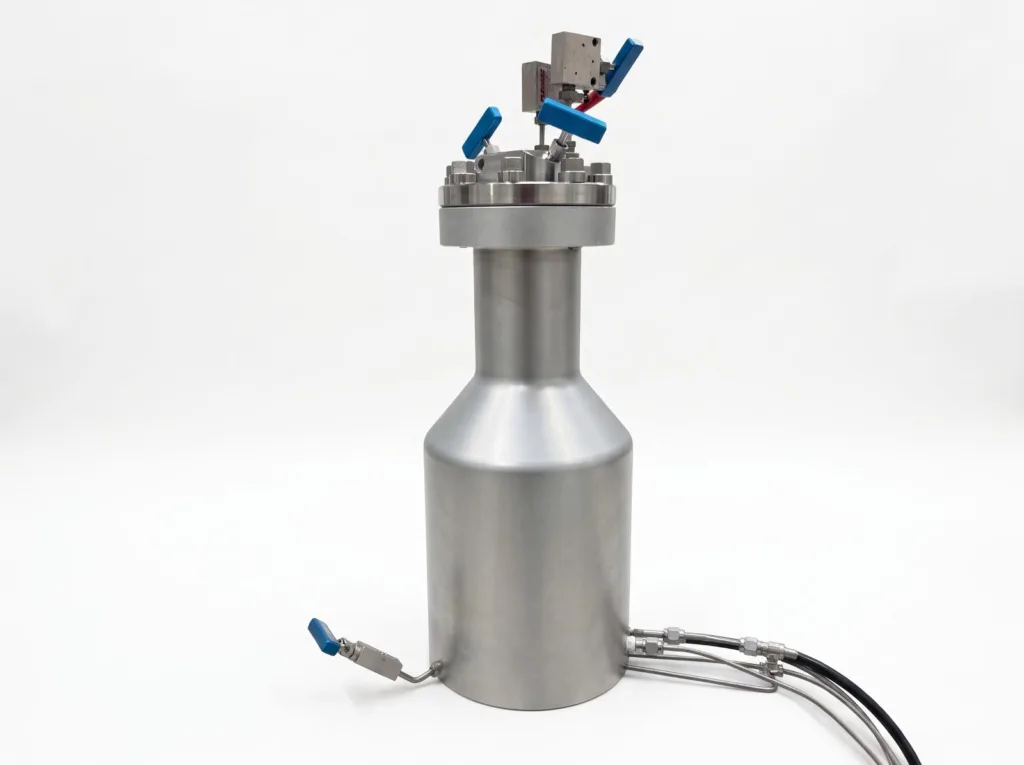
For a geoscience research lab, IRIAN Mecatronics designed a custom triaxial test cell. The equipment applies 300 bar of confining and pore pressure and a 25 kN axial load while imaging the sample with X-ray tomography.
At a glance
- Client
- An academic geoscience research laboratory
- Field
- Geosciences
- Technique
- Triaxial testing, in-situ X-ray tomography
01 — The research question
How can you characterize the mechanical behavior of a material under stress while observing it with non-destructive imaging?
Characterizing a material's behavior under triaxial stress (confining pressure, pore pressure, axial load) is a classic challenge in <a href="https://irian-mecatronics.com/geoscience-subsurface-studies-hpht-laboratory-equipment/">geosciences</a> and materials science. The need becomes more complex when you have to observe internal mechanisms in real time, like crack propagation or porosity evolution, without destroying the sample. X-ray computed tomography is the method of choice for this, but it imposes a major constraint: the test equipment must be transparent to X-rays. A research laboratory needed to simulate deep geological conditions to study rock deformation. This involved reaching 300 bar of pressure, a 25 kN axial load, and 60°C, all while performing a CT scan.
The technical challenge was to ensure the mechanical strength and sealing of a cell at 300 bar and 25 kN, using an X-ray transparent aluminum body, while integrating multiple fluid and sensor ports.
02 — Our approach
The approach: balancing mechanical strength and X-ray transparency
Withstanding 300 bar with an X-ray transparent material
The difficulty was finding a material that was both strong enough for 300 bar and transparent enough for imaging. An aluminum alloy was chosen for its compromise between low density and high mechanical properties, ruling out steels (too opaque) and polymers (too weak). Sizing by calculation ensures safety while allowing the visualization of the rock's internal micro-mechanisms.
Measuring axial load accurately by compensating for pressure
At 300 bar, the confining pressure exerts a parasitic force of several tons on the piston. To neutralize this force and measure the true load on the sample, a double-acting piston was designed. The pressure acts on two opposite faces of the same area, canceling its effect. This allows the user to precisely control the deviatoric stress applied to the rock.
Integrating fluids and instrumentation in a compact volume
The equipment required numerous ports sealed for 300 bar (fluids, sensors, thermocouples). Rather than drilling into the cell body and weakening it, all connections were centralized on two custom-machined end caps. This solution provides a compact, robust, and easy-to-instrument rig with grouped and accessible connections.
03 — Technical specifications
| Confining pressure | 300 bar (4,350 psi) |
|---|---|
| Pore pressure | 300 bar (4,350 psi) |
| Operating temperature | Ambient to 60 °C (140 °F) |
| Maximum axial load | 25 kN |
| Piston stroke | 5 mm |
| Sample size | Ø 40 mm x 80 mm |
| Overall dimensions | Ø 152 mm x 440 mm |
04 — Other applications
Does your project also require in-situ observation under stress?
Materials science
To characterize crack formation in a composite under load, the principle of an X-ray transparent cell with mechanical loading and environmental control remains relevant. Only the materials, temperature and force ranges, and sample grips would change.
Food processing
To study how a product's structure evolves during a pressurized process, the ability to see inside a pressure vessel is transposable. The materials would become food-grade, and the pressures and connections would be adapted to the process.
Biomedical
To test an implant under cyclic loading while simulating physiological conditions, the principle of a transparent cell with axial loading is applicable. The materials would be biocompatible, the dimensions smaller, and the force and pressure ranges much lower.
An engineer from our design office replies as soon as possible.