

Case study · Geoscience & subsurface studies
Studying six-month reaction kinetics in corrosive media: a custom six-reactor HPHT bench
For a major geoscience research center, IRIAN Mecatronics designed and built a test bench with six independent HPHT reactors. The system simulates long-term biogeochemical processes by maintaining stable, extreme conditions: 150 bar (2175 psi) pressure, 150°C (302°F) temperature, and a corrosive environment with brine and H₂S.
01 — The research question
How to study reaction kinetics over several months without equipment contaminating the sample?
Studying very slow reaction kinetics, such as fluid-rock interactions in geological storage, requires keeping a sample under stable conditions for weeks or months. In a corrosive environment, the equipment itself becomes a source of contamination: even minor ion leaching or wall effects can skew the analyses and invalidate a time-consuming test.
The challenge for this project was to combine several requirements that are rarely met at once: extreme corrosion resistance (high-salinity brine + H₂S), stable HPHT conditions for six months, effective mixing for a three-phase system (solid, liquid, gas), and near-zero dead volume for valid sampling. No off-the-shelf custom HPHT reactor could meet all these requirements simultaneously across six parallel units.
Ensuring a sample remains uncontaminated and representative over a very long period in an extremely corrosive HPHT environment that degrades equipment and skews measurements.
02 — Our approach
The design approach: four choices to ensure measurement reliability
To meet the project's specifications, our engineering team focused on four key areas. Each decision was made to ensure the measured data reflects only the sample's chemistry, not the limitations of the instrumentation.
-
Ensuring absolute chemical inertness
Over six months, even high-grade stainless steel would have suffered from pitting corrosion in the presence of brine and H₂S, contaminating the test. We therefore manufactured all wetted parts from Hastelloy C276. Using a single alloy eliminates any risk of galvanic corrosion and ensures complete chemical inertness.
-
Ensuring representative sampling
For a kinetic study, any fluid stagnating in a sampling line (dead volume) skews the analysis. Instead of using remote sensors and valves, we integrated all measurement and sampling functions as close as possible to the reaction volume, directly on the reactor head, thereby eliminating dead volumes.
-
Homogenizing a three-phase system (solid-liquid-gas)
The reactions being studied depended on the interfaces between phases. It was crucial to keep the rock particles in suspension and maximize gas-liquid mass transfer. A powerful, custom-designed mechanical stirring system was developed to ensure the medium's homogeneity and to confirm that the measured kinetics were driven by chemistry, not by physical limitations.
-
Facilitating parallel operation of six reactors
Managing six long-term tests is demanding. To optimize experimental throughput and safety, we mounted all six reactors on a single frame. This design centralizes control and monitoring on a single interface while facilitating individual access, assembly, and cleaning for each unit.
03 — Beyond this project
Does your project have similar requirements?
Fine chemicals / catalysis
For studying long-duration reactions (e.g., hydrogenation, synthesis) with a solid catalyst where purity is critical, the principle of a stirred, inert HPHT reactor with low dead volume remains the same. The material (Inconel, Titanium) and certification (ATEX) would change depending on the reactants.
Energy / CO₂ Capture
For testing material aging or solvent efficiency in prolonged contact with supercritical CO₂, a common challenge in custom CCUS reactor systems, and acid gases (H₂S), the need for multiple parallel HPHT vessels, acid corrosion resistance, and stable long-term conditions are directly transferable requirements.
New materials / biomimicry
For synthesizing materials via hydrothermal routes (e.g., zeolites, ceramics), precursors must be kept in suspension at high pressure and temperature. The need for stirred reactors that can withstand extreme pH levels and provide precise thermal control to manage crystallization presents a very similar challenge.
04 — Specifications
The values for this project. Every system is custom-built, so they adapt to your requirements.
Show specifications · 6, independently controlled · up to 150 bar (2175 psi) · up to 150°C (302°F)
| Number of reactors | 6, independently controlled |
|---|---|
| Operating pressure | up to 150 bar (2175 psi) |
| Operating temperature | up to 150°C (302°F) |
| Wetted material | Hastelloy C276 |
| Typical test duration | up to 6 months |
| Liquid medium | Brines with salinity up to 360 g/L |
IRIAN Mecatronics designs and builds custom high-pressure, high-temperature equipment for research laboratories, technical centres and industry.
About the companyThey trust us






















05 — FAQ
Frequently asked questions
Can this type of reactor be used for studies with pressurized hydrogen?
Yes, the principle of a multi-reactor bench for long-term testing is transferable to hydrogen applications. The main adaptation would be the material selection to prevent hydrogen embrittlement. The entire project would also be designed to comply with ATEX regulations, which dictates specific choices for instrumentation, ventilation, and overall safety, as seen in our bench for flammable gases.
Is it possible to design a similar system for higher pressures, for example, 500 bar?
Yes, designing equipment for pressures up to several thousand bar is part of our core expertise. The design principles (chemical inertness, stirring, ergonomics) would remain valid. Moving to 500 bar would require a complete mechanical redesign (wall thickness, sealing technology, types of valves and fittings) in accordance with the Pressure Equipment Directive (PED) to ensure safety.
Is a single, larger-volume reactor an option instead of six small ones?
Absolutely. The choice between multiple small reactors and a single larger one depends on the objective. A multi-reactor setup is ideal for parallel parameter screening. A single, larger-volume reactor is relevant for scale-up studies or pilot batch production. The overall architecture, particularly the stirring and thermal management systems, would be adapted to ensure homogeneity on a larger scale.
Can this reactor bench operate in continuous mode instead of batch?
This system was designed for batch experiments, optimized for very long residence times. Switching to continuous flow operation (CSTR-type) is a different project that fundamentally changes the design. It requires adding continuous injection and withdrawal systems and a different approach to homogenization. We also design custom continuous flow reactors for this type of need.
Is your research limited by corrosion, contamination, or the stability of your current reactor?
Describe the reaction you want to study and the conditions that cause your standard equipment to fail. Our engineering team will analyze your project's feasibility and get back to you with a proposal for a custom solution.
Related projects
 Geoscience & subsurface studies
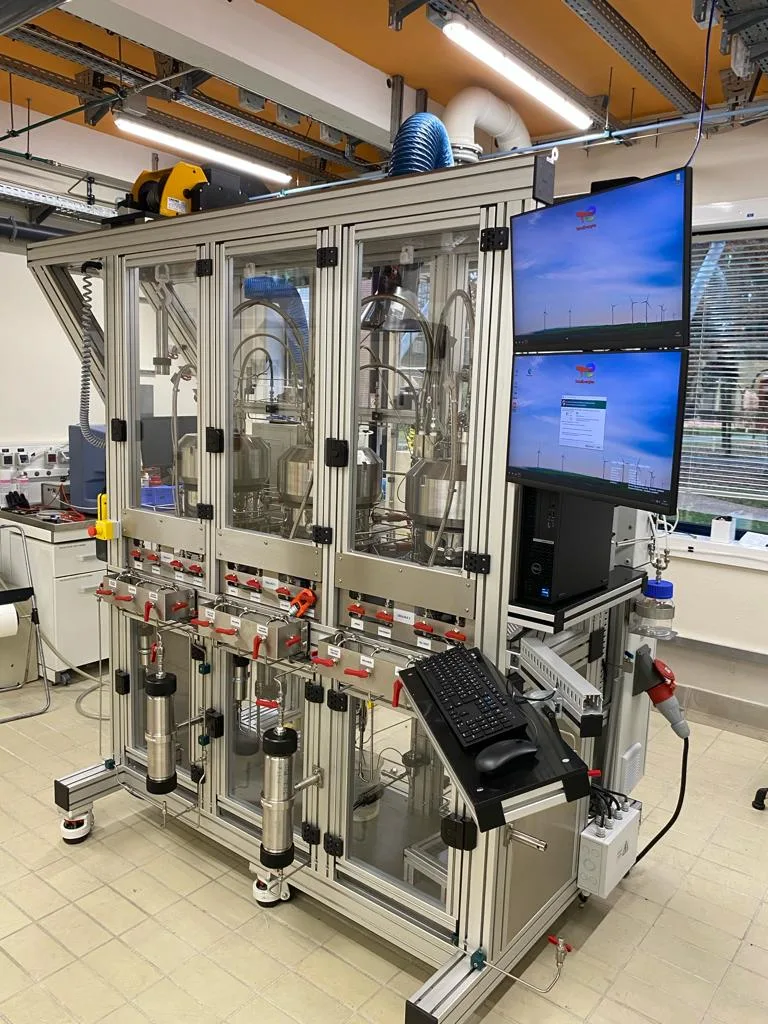
Multi-cell 400 bar / 250°C test bench for formation damage analysis
 Geoscience & subsurface studies
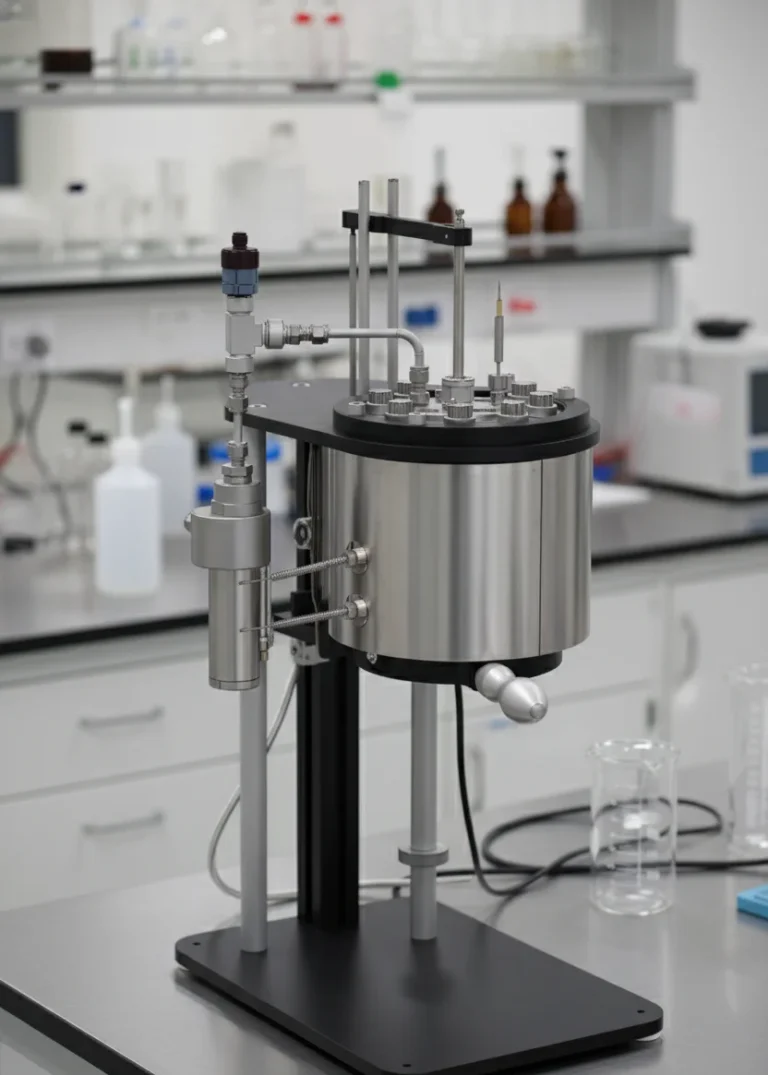
Multi-mode HPHT reactor for geochemical simulation in corrosive media
Geoscience & subsurface studies500 bar500°C105 mLConfidential project · photo withheld
Geoscience & subsurface studies
Custom HPHT Permeameter for Rock Permeability Testing at 500°C / 500 bar in Corrosive Fluids
HPHT reactors & cells100 bar350 °C2 LConfidential project · photo withheld
HPHT reactors & cells
Studying corrosive reactions at 100 bar & 350°C: a custom 2L Hastelloy C276 stirred reactor