
Case study · Geoscience & subsurface studies
Automated laboratory coring machine with servo-control for intact sample retrieval
IRIAN Mecatronics designed and built a custom laboratory coring machine for a materials science R&D center. The equipment automates sample retrieval by using servo-control on the cutting force, ensuring the physical and structural integrity of the core plugs—a critical requirement for valid analysis.
01 — The research question
How to core a sample without altering its properties?
Coring a sample from a solid material is a fundamental step in many analyses, for both research and quality control. The challenge is to ensure the retrieved sample is perfectly representative of the original material. However, the cutting process itself inherently induces mechanical and thermal stresses that can alter its properties, causing microcracks, residual stress, or changes in the crystalline structure. The validity of all downstream analysis therefore depends on mastering the sample retrieval process.
Our client, an R&D center, needed to core samples from a wide variety of materials, many of which were fragile or heterogeneous. Standard coring equipment, which operates with fixed cutting parameters, caused damage that rendered the samples unusable for analysis. A completely different approach was needed: one where the cutting process adapts in real-time to the material's response to preserve its integrity.
Performing an inherently destructive cutting operation while preserving the physical and structural integrity of the sample.
02 — Our approach
A design driven by sample integrity
The machine's design meets three inseparable requirements: ensuring non-destructive sampling, guaranteeing the repeatability of test campaigns, and providing the flexibility needed for a research laboratory. Every technical decision was made based on its impact on the final quality of the sample.
-
Servo-controlling the cut to preserve material structure
The challenge was to cut without inducing stresses that would skew the analyses. Instead of using fixed, open-loop parameters, we implemented a servo-control system that adjusts the advance and rotation speeds based on real-time force measurements. This allows the machine to adapt to the material's resistance, minimizing stress and ensuring an intact sample.
-
Automating the cycle to ensure repeatability
For results to be statistically comparable, each sampling operation must be identical. We developed a fully automated and programmable cycle. The operator defines a recipe, and the controller executes the process and records all parameters, ensuring rigorous repeatability and traceability that would be impossible to achieve manually.
-
Designing a versatile system for various materials
An R&D center handles materials with various geometries. A hyper-specialized machine would have been a poor investment. We therefore designed flexible clamping interfaces and a versatile control system, allowing the equipment to be quickly adapted to new samples and materials, much like we do on our geotechnical test benches.
03 — Beyond this project
Does your project have similar requirements?
Civil engineering, structural health monitoring
The requirement is to core concrete or rock samples without creating microcracks that could weaken the structure. The principle of using force feedback to adapt the cutting process to the material's hardness would remain the same.
Food industry, quality control
The goal is to take a sample (e.g., cheese, fruit) without crushing it or altering its texture. The fine control of cutting speed and force, along with automation for repeatability, are directly transferable principles.
Biomedical, hard tissue research
For bone or implant biopsies, avoiding thermal or mechanical alteration is critical. The high-precision guidance and cutting parameter control of our approach are principles that would remain identical, just applied on a miniaturized scale.
IRIAN Mecatronics designs and builds custom high-pressure, high-temperature equipment for research laboratories, technical centres and industry.
About the companyThey trust us




















04 — FAQ
Frequently asked questions
Can this servo-controlled coring machine be used for very soft materials or under fluid?
Yes, the principle of adapting the cut to the material's response is particularly well-suited for soft materials, where excessive force would cause deformation. The design would be modified to include specific cutting tools (geometry, coating), a cutting fluid management system (lubrication, cooling, recovery), and lower-range force sensors, but the control logic would remain the same.
Can a precision coring system be designed for very large samples?
Yes, the principles of automation and servo-control are scale-independent. For large samples, the changes would involve the mechanical structure (frame, guides, rigidity) and the power of the motors. The control system and the philosophy of non-destructive sampling would remain the same, with the main limitations being the overall size and handling of the parts.
Can such a sampling machine be certified for use in a cleanroom or an ATEX environment?
Yes, designing equipment for critical environments is a core part of our engineering services. For a cleanroom, we would use compatible materials (stainless steel), surface treatments, and components (lubricants, cabling). For an ATEX environment, all electrical and mechanical components that could generate a spark would be certified for the required zone.
How is the traceability of coring parameters ensured for each sample?
Traceability is handled by the integrated control system. For each sampling cycle, the system records all parameters (rotation speed, advance rate, applied force, position) as a function of time. This data is saved in a time-stamped file linked to the sample ID, ensuring a complete and usable history for every core plug retrieved.
Is sample damage skewing your analysis results?
Describe your requirements, the material involved, and the properties you need to preserve. Our engineering team will analyze your project's feasibility and get back to you with a proposed approach.
Related projects
 Geoscience & subsurface studies
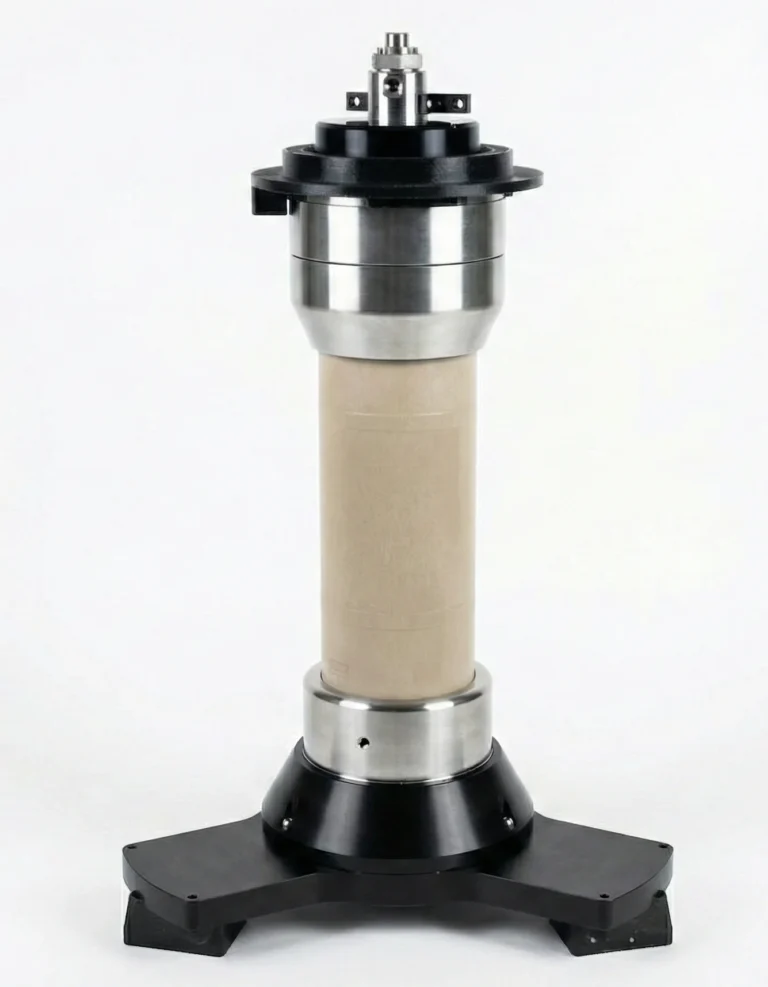
Custom x-ray transparent triaxial cell for BRGM: in-situ 3D tomography analysis
 Geoscience & subsurface studies
3-in-1 uniaxial tester (CUT) for petroleum rock characterization
 Geoscience & subsurface studies
Custom HPHT triaxial testing press for geomechanics research
 Geoscience & subsurface studies
High-precision osmosis test bench for argillite studies