

Case study · Geoscience & subsurface studies
In-situ X-ray imaging of rock deformation: a custom 300-bar transparent triaxial cell
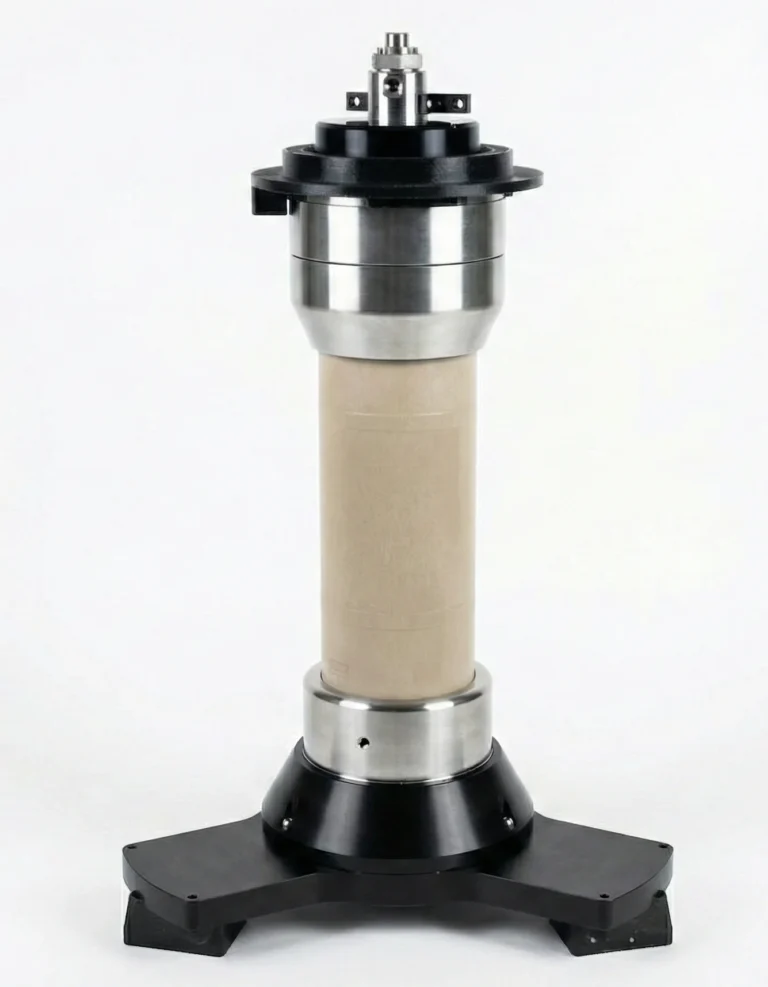
For a geoscience research lab, IRIAN Mecatronics designed a custom triaxial test cell. The equipment applies 300 bar of confining and pore pressure and a 25 kN axial load while imaging the sample with X-ray tomography.
01 — The research question
How can you characterize the mechanical behavior of a material under stress while observing it with non-destructive imaging?
Characterizing a material's behavior under triaxial stress (confining pressure, pore pressure, axial load) is a classic challenge in <a href="https://irian-mecatronics.com/geoscience-subsurface-studies-hpht-laboratory-equipment/">geosciences</a> and materials science. The need becomes more complex when you have to observe internal mechanisms in real time, like crack propagation or porosity evolution, without destroying the sample. X-ray computed tomography is the method of choice for this, but it imposes a major constraint: the test equipment must be transparent to X-rays.
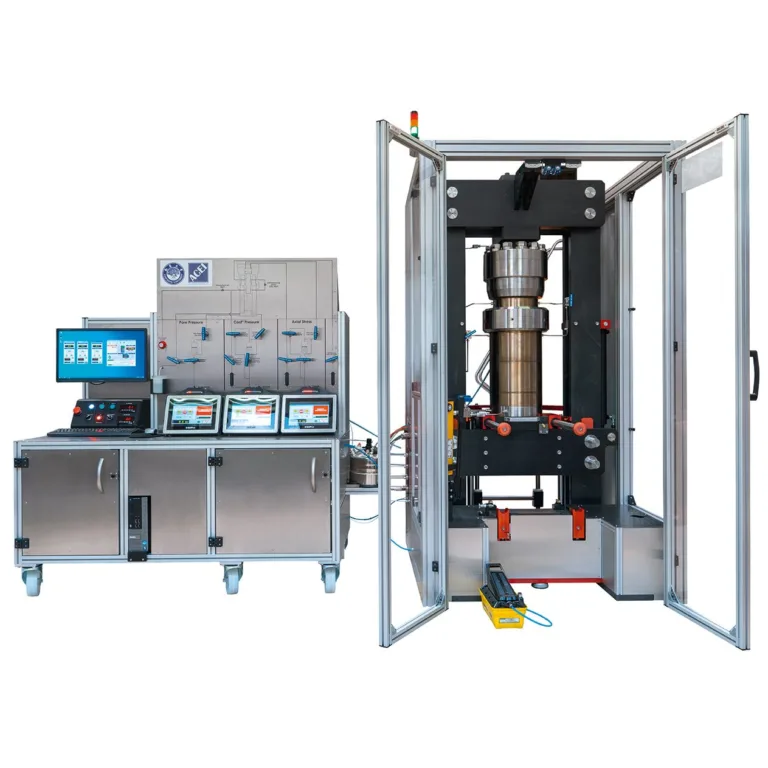
A research laboratory needed to simulate deep geological conditions to study rock deformation. This involved reaching 300 bar of pressure, a 25 kN axial load, and 60°C, all while performing a CT scan. Standard triaxial testing systems, built from steel like our <a href="https://irian-mecatronics.com/project/hpht-triaxial-press-geomechanics-research/">HPHT triaxial testing press</a>, are opaque to X-rays. The few transparent cells available on the market could not withstand this combination of pressure and load in a volume compatible with a CT scanner.
The technical challenge was to ensure the mechanical strength and sealing of a cell at 300 bar and 25 kN, using an X-ray transparent aluminum body, while integrating multiple fluid and sensor ports.
02 — Our approach
The approach: balancing mechanical strength and X-ray transparency
The design centered on three main trade-offs to achieve pressure resistance, X-ray transparency, and measurement accuracy within a compact volume.
-
Withstanding 300 bar with an X-ray transparent material
The difficulty was finding a material that was both strong enough for 300 bar and transparent enough for imaging. An aluminum alloy was chosen for its compromise between low density and high mechanical properties, ruling out steels (too opaque) and polymers (too weak). Sizing by calculation ensures safety while allowing the visualization of the rock's internal micro-mechanisms.
-
Measuring axial load accurately by compensating for pressure
At 300 bar, the confining pressure exerts a parasitic force of several tons on the piston. To neutralize this force and measure the true load on the sample, a double-acting piston was designed. The pressure acts on two opposite faces of the same area, canceling its effect. This allows the user to precisely control the deviatoric stress applied to the rock.
-
Integrating fluids and instrumentation in a compact volume
The equipment required numerous ports sealed for 300 bar (fluids, sensors, thermocouples). Rather than drilling into the cell body and weakening it, all connections were centralized on two custom-machined end caps. This solution provides a compact, robust, and easy-to-instrument rig with grouped and accessible connections.
03 — Beyond this project
Does your project also require in-situ observation under stress?
Materials science
To characterize crack formation in a composite under load, the principle of an X-ray transparent cell with mechanical loading and environmental control remains relevant. Only the materials, temperature and force ranges, and sample grips would change.
Food processing
To study how a product's structure evolves during a pressurized process, the ability to see inside a pressure vessel is transposable. The materials would become food-grade, and the pressures and connections would be adapted to the process.
Biomedical
To test an implant under cyclic loading while simulating physiological conditions, the principle of a transparent cell with axial loading is applicable. The materials would be biocompatible, the dimensions smaller, and the force and pressure ranges much lower.
04 — Specifications
The values for this project. Every system is custom-built, so they adapt to your requirements.
Show specifications · 300 bar (4,350 psi) · Ambient to 60 °C (140 °F) · 25 kN
| Confining pressure | 300 bar (4,350 psi) |
|---|---|
| Pore pressure | 300 bar (4,350 psi) |
| Operating temperature | Ambient to 60 °C (140 °F) |
| Maximum axial load | 25 kN |
| Piston stroke | 5 mm |
| Sample size | Ø 40 mm x 80 mm |
| Overall dimensions | Ø 152 mm x 440 mm |
IRIAN Mecatronics designs and builds custom high-pressure, high-temperature equipment for research laboratories, technical centres and industry.
About the companyThey trust us






















05 — FAQ
Frequently asked questions
Can this X-ray transparent triaxial cell be used with corrosive fluids like H2S?
Yes, the cell's design can be adapted for corrosive fluids. This would involve replacing the aluminum alloy with compatible materials like titanium alloys or Hastelloy C276, which also offer acceptable X-ray transparency. All wetted parts, including seals and sensors, would be selected for their chemical resistance. The overall architecture of the cell would remain the same.
Can you design a similar cell for higher temperatures, for example 200°C?
Reaching 200°C (392°F) is feasible, but it adds several constraints. We would need to select a metal alloy that retains its mechanical properties at that temperature, integrate a heating system, and manage thermal expansion to maintain sealing. The choice of sensors and electrical feedthroughs would also need to be adapted. The design remains possible by leveraging our experience with <a href="https://irian-mecatronics.com/custom-hpht-reactors-autoclaves-analysis-cells/">HPHT equipment</a>.
Can this design be miniaturized for samples of a few millimeters for micro-tomography?
Yes, miniaturization is a common adaptation. The cell's core principles, particularly pressure compensation and integrated connections, remain valid. For samples a few millimeters in size, the cell would be completely redesigned to optimize volume, reduce the sample-to-detector distance, and adapt the force and pressure ranges. Manufacturing would involve high-precision machining techniques.
How is synchronization handled between the mechanical measurements and the CT scanner's image acquisition?
The equipment is designed to integrate with the client's setup. The control system we provide can generate trigger signals for the CT scanner at key moments during the test. Conversely, it can receive signals to pause the test during acquisition. All data (pressure, force, displacement, temperature) is timestamped to allow for precise correlation with the 3D images.
Is your experiment stalled because you can't observe your sample under stress?
Describe your pressure, temperature, and imaging constraints. Our engineering team will analyze your project's feasibility and get back to you with a proposed approach.
Related projects
 Geoscience & subsurface studies
Custom x-ray transparent triaxial cell for BRGM: in-situ 3D tomography analysis
 Geoscience & subsurface studies
Custom HPHT triaxial testing press for geomechanics research
 Geoscience & subsurface studies
Custom Hastelloy C276 HPHT reactor system for geoscience research
 Geoscience & subsurface studies
Multi-mode HPHT reactor for geochemical simulation in corrosive media