
Skip to content

HPHT mechanical testing

High-pressure, high-temperature triaxial test systems

Our triaxial systems replicate the mechanical stresses and HPHT conditions found deep underground. They allow researchers in geomechanics and materials science to precisely characterize the behavior of rocks and other solids, for applications ranging from deep reservoir simulation to studies under Earth's mantle conditions.

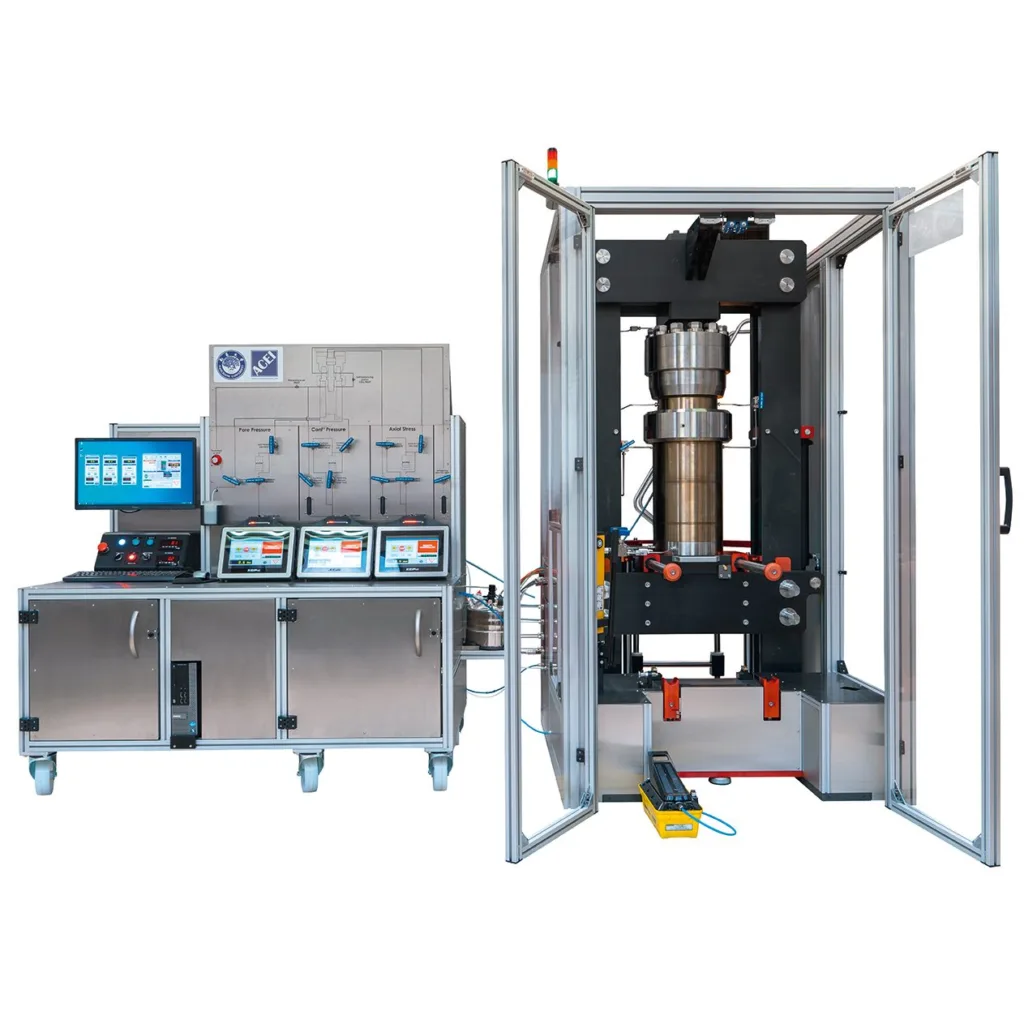
High-pressure triaxial test cell installed in a research laboratory

01 — Range

Three configurations for simulating subsurface conditions

Each system in our range is designed for a specific application, from standard characterization in civil engineering to fundamental research under extreme conditions. The right configuration depends on the simulated depth (confining pressure), the required stress paths, and whether the tests are static or dynamic.

40 MPa triaxial cell

This configuration is designed for standard geotechnical and civil engineering tests, enabling basic rock characterization at shallow depths. It determines fundamental mechanical properties such as failure strength and permeability under moderate pressure and temperature. It is the standard choice for studies that do not require deep reservoir simulation or complex dynamic testing.

Axial and radial pressure up to 40 MPa (5,800 psi), ambient to 50°C (122°F), sample Ø 1.5 in x 3 in.


100 MPa / 680 MPa HPHT triaxial cell

Designed for reservoir research, this cell is used to study fatigue, failure, and fluid-rock interactions. Its ability to apply cyclic axial and radial stresses up to 2 Hz makes it ideal for simulating seismic cycles or injection and production operations. It provides a broad scope for geomechanics studies under HPHT conditions, with comprehensive instrumentation for measuring permeability, porosity, and acoustic properties.

Radial confining pressure 100 MPa (14,500 psi), axial stress up to 680 MPa (98,600 psi), ambient to 200°C (392°F), sample Ø 1 in, 1.5 in, 40 mm.

150 MPa / 1000 MPa very high-pressure triaxial cell

This system extends the capabilities of the 100 MPa cell to deep reservoir conditions. It offers the same dynamic testing capabilities up to 2 Hz but under a higher confining pressure of up to 150 MPa. It is the preferred tool for detailed mechanical characterization of rocks from petroleum reservoirs or deep geological storage sites where stresses are extremely high. It integrates the same measurement options as the 100 MPa configuration.

Radial confining pressure 150 MPa (21,750 psi), axial stress up to 1000 MPa (145,000 psi), ambient to 200°C (392°F), sample Ø 1 in, 1.5 in, 40 mm.

02 — Measurements

Available physical and mechanical measurements

Our triaxial systems can be equipped to perform a range of continuous measurements during deformation tests.

Permeability (gas, with or without pressure oscillation)

Permeability measurement quantifies fluid flow through rock under stress. This is essential data for reservoir studies, CO2 storage, or assessing the safety of geological formations.

Pore volume, porosity

Determining the pore volume and how it changes with stress helps characterize the rock's storage capacity. This measurement is crucial for evaluating the potential of a reservoir or a geological storage site.

Electrical Resistivity

Electrical resistivity measurement helps characterize fluid saturation and track the progress of saturation fronts or chemical reactions within the sample, offering a dynamic view of internal processes.

P- and S-wave acoustic velocity

This measurement determines the material's dynamic elastic moduli. It is used to correlate laboratory data with seismic logs and to detect the onset and propagation of damage within the rock.

Axial and radial strain

Precise measurement of sample strain is fundamental to determining its mechanical properties, such as Young's modulus, Poisson's ratio, and the failure criterion, which define its behavior under load.

03 — Our approach

From specification to autonomous operation

Each system is delivered turnkey, following a process that ensures it meets test requirements and allows research teams to become proficient quickly.

  1. Configure the test equipment

    Our in-house engineering team (mechanical, instrumentation, automation) analyzes the requirements of your experimental protocol. We adapt the standard configuration to integrate specific sensors and the necessary control mode, ensuring the system precisely meets your measurement goals.

  2. Validate performance at the factory

    Manufacturing is systematically followed by a factory acceptance test (FAT). This key step validates that the equipment conforms to the specifications—from mechanical performance to data acquisition—before it is shipped to your site.

  3. Commission and train operators

    Our engineers install the equipment in your laboratory. Commissioning includes comprehensive user training to ensure safe, efficient, and autonomous operation of the system from day one.

Our triaxial systems are central to Geoscience & subsurface studies. They enable the simulation of extreme environments and are often coupled with analyses in fluid dynamics.

They trust us

  • CNRS
  • CEA
  • BRGM
  • Ifremer
  • EDF
  • TotalEnergies
  • Michelin
  • CETIM
  • Centrale Lille
  • Université de Pau et des Pays de l'Adour
  • Sonatrach
  • Saudi Aramco
  • Nanchang University
  • Adisseo
  • Lafarge
  • MDS
  • MIO – Mediterranean Institute of Oceanography
  • IRT Saint Exupéry
  • IRD – French National Research Institute for Sustainable Development
  • Groupe INSA
  • Aix-Marseille Université
  • logo-icmcb

04 — FAQ

Frequently asked questions

Can P- and S-wave velocities be measured during a deformation test?

Yes, P- and S-wave velocity measurement can be integrated into all our triaxial configurations. Piezoelectric sensors are built into the axial compression platens to continuously measure wave travel times, allowing for velocity calculation throughout the deformation test. This feature is available as an option on the 6 GPa press.

What is the maximum frequency for cyclic loading tests?

The 100 MPa and 150 MPa HPHT cells are specifically designed for dynamic testing. They can apply radial and axial stress oscillations at frequencies up to 2 Hz. This capability makes it possible to simulate cyclic phenomena, such as pressure variations in a reservoir during injection/production or stresses induced by seismic events.

How is sample strain measured?

Axial strain is measured in all configurations, typically via piston displacement. For higher accuracy, non-contact inductive sensors can be mounted directly on the sample, while an LVDT is used on the 6 GPa press. Radial strain can be measured on the 40, 100, and 150 MPa cells using measuring chains or other dedicated sensors.

Do the systems comply with safety standards for pressure equipment?

Yes, safety is a fundamental design criterion. All our triaxial systems are designed in compliance with the Pressure Equipment Directive (PED 2014/68/EU). For the most critical equipment, such as the 100 and 150 MPa HPHT cells, we obtain explicit certification from a notified body to guarantee compliance with the strictest European regulatory requirements.

Need to characterize a material under HPHT triaxial conditions?

Our engineers can help you define the most suitable configuration for your test protocol. Let's discuss your measurement objectives, sample constraints, and pressure and temperature conditions.

Discuss your project