Skip to content

Custom test equipment

Fluid dynamics and phase behavior

We design custom test rigs for engineers and researchers who study phase changes or fluid behavior under stress. Our equipment is built to observe and quantify complex phenomena—from crystallization under flow to phase transitions in extreme conditions—where standard solutions are inadequate.

01 — The problems we solve

Your test, our solutions

Every fluid dynamics test presents unique challenges. Identify your challenge to discover how we have designed equipment to solve it.

See what happens inside the fluid

A phase change is understood by watching it: hydrate formation, bubble point, transition to the supercritical state. Keeping a clear view despite pressure, cold or corrosion takes a window or a transparent body designed together with the vessel.

Delivered for

See the 3 projects ↓

02 — Measurements

Measurements and observations

Each piece of equipment is instrumented to quantify the phenomena under study and understand the underlying mechanisms.

Thermodynamic and flow properties

Measuring pressure, temperature, volume, flow rate, or viscosity quantifies a fluid's behavior and validates thermodynamic models. This data is essential for correlating operating conditions with observed phenomena.

Visual observation of phase changes

Direct observation with a camera, through viewports or a sapphire cell body, is crucial to understanding the kinetics of a phenomenon. It is used to determine a bubble or dew point and to analyze crystallization morphology.

Compositional analysis

For multiphase systems, sampling each phase at equilibrium conditions allows for determining their composition through external analysis. This measurement is essential for building accurate phase diagrams and understanding mass transfer.

03 — Projects

Our projects in fluid dynamics

6 projects

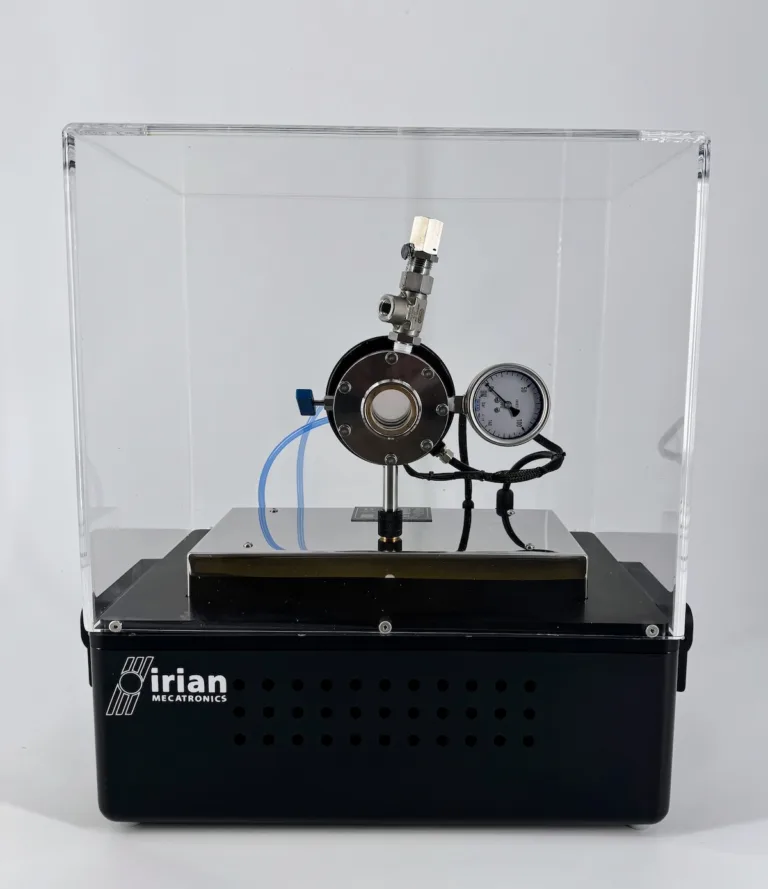
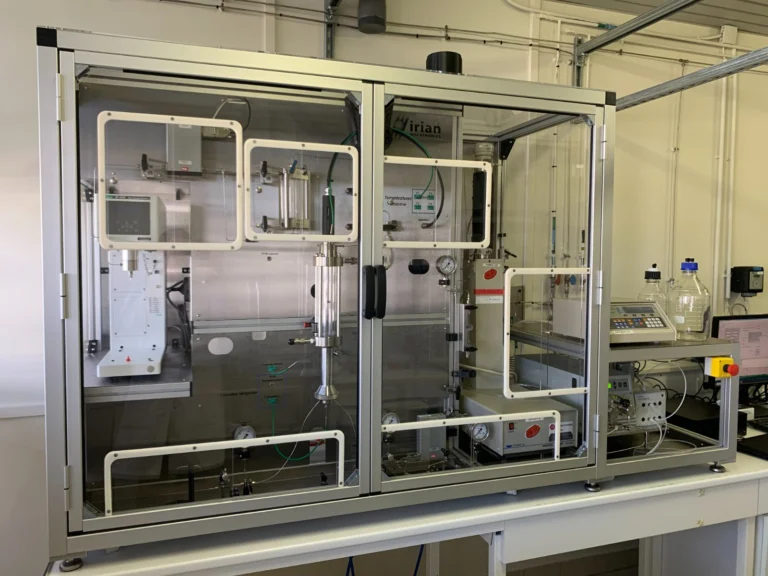
3D view of a motorised 50 mL variable-volume cell rated for 500 bar Fluid dynamics & phase behavior 500 bar / 150°C titanium variable volume cell for HP fluid research Design of a 50 mL titanium HPHT cell for studying fluid phase behavior at 500 bar / 150°C. A custom solution that integrates magnetic… Portable supercritical CO2 demonstrator in its transparent protective enclosure Fluid dynamics & phase behavior Supercritical CO2 demonstration cell Design and fabrication of a portable, self-contained high-pressure (80 bar) visualization cell for the energy sector. Housed in a briefcase, the equipment allows for… Complete DRA test pilot: flow loop, tanks and control cabinets Fluid dynamics & phase behavior HPHT pilot unit for simulating turbulent flow with DRA agents Custom test rig to quantify the efficiency of Drag-Reducing Agents (DRAs) for the energy industry. The equipment generates turbulent flow at 50 bar while… High-pressure sapphire column reactor on its pivoting stand Fluid dynamics & phase behavior Custom 120 bar sapphire column for gas hydrate research Modular 120 bar reactor with a sapphire column for visualizing hydrate formation in corrosive media. The design allows switching between a porous medium and… 1000 bar fluid injection bench with a microfluidic network cooled to −70 °C Fluid dynamics & phase behavior 1000 bar high-pressure injection bench for extreme low-temperature (-70°C) microfluidic studies Design of a microfluidic cell to observe fluid phase changes at -70°C (-94°F) and 1000 bar (14,500 psi). Built for energy research, this custom… PVT cell for petroleum fluid analysis Fluid dynamics & phase behavior Design and delivery of a turnkey PVT laboratory with a custom 1000 bar high-pressure unit Design and manufacturing of a complete laboratory for reservoir fluid analysis (PVT, viscosity, density) for the Oil & Gas sector. The integrated system operates…
04 — Our approach

From your need to your test rig

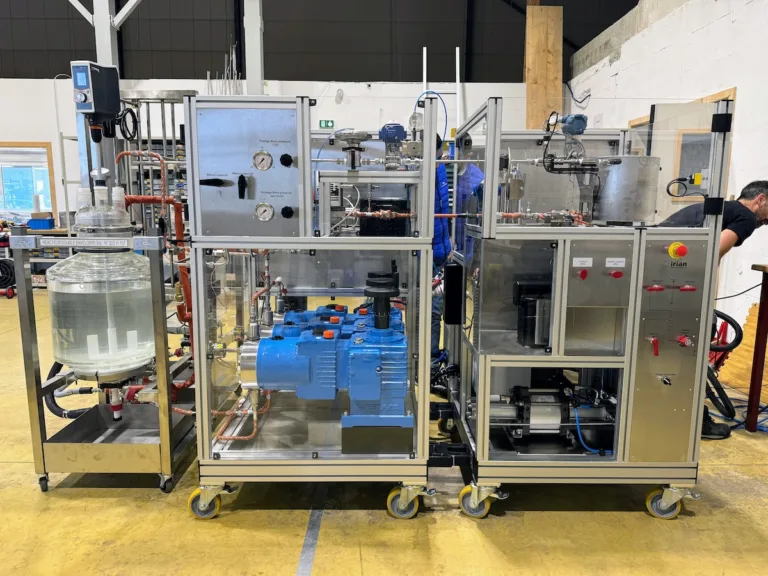
We design and build each piece of equipment as a unique project, working closely with your research teams from the analysis of the scientific problem to commissioning in your laboratory.

  1. Analyzing the need and designing the solution

    We start from the phenomenon you need to study to define the equipment's specifications. Our in-house engineering team (mechanical, instrumentation, automation) then designs a custom solution that precisely addresses your scientific question, selecting the most suitable technologies and materials for your constraints.

  2. Manufacturing and factory testing

    Manufacturing takes place in our Morlaàs workshop, in compliance with our ISO 9001 certification and applicable directives like the PED. Before any delivery, we conduct the factory acceptance test (FAT) with you to validate that the equipment meets all specifications.

  3. On-site installation and support

    We handle the equipment's commissioning in your laboratory and train your teams to ensure rapid adoption and autonomous operation. We then remain available to provide preventive or corrective maintenance and to upgrade the system according to your future needs.

Our test rigs are often used for high-pressure visualization or extreme environment simulation. They can be configured as process pilot plants or integrate a full-visibility PVT cell.

They trust us

  • CNRS
  • CEA
  • BRGM
  • Ifremer
  • EDF
  • TotalEnergies
  • Michelin
  • CETIM
  • Centrale Lille
  • Université de Pau et des Pays de l'Adour
  • Sonatrach
  • Saudi Aramco
  • Nanchang University
  • Adisseo
  • Lafarge
  • MDS
  • MIO – Mediterranean Institute of Oceanography
  • IRT Saint Exupéry
  • IRD – French National Research Institute for Sustainable Development
  • Groupe INSA
  • Aix-Marseille Université
  • logo-icmcb

05 — FAQ

Frequently asked questions

Are your systems delivered 'turnkey', or do I need to provide peripherals like pumps or software?

Yes, each test rig is a complete, tested, and ready-to-use system. It includes all the peripherals required for its operation: fluid supply, often with high-pressure pumps of our own design; precise pressure and temperature control; all hardware and software safety features; the control PLC; and the supervision interface for control and data acquisition.

How do you ensure visualization quality in difficult conditions like cryogenics or corrosive environments?

Visualization quality is a major design criterion. We ensure it by selecting transparent materials, such as sapphire, suited to your chemical and mechanical constraints. For the most complex cases, we develop specific solutions, for example, a highly localized cooling system that keeps an optic perfectly clear at -70°C (-94°F) by preventing any frost formation.

My product is fragile and shear-sensitive. How can I be sure your test rig won't degrade it?

We design the fluidic circuit specifically to preserve your sample's integrity. For a drag reducing agent (DRA), for example, the challenge is to measure its effectiveness in a turbulent regime without the pumping system degrading it. We solved this problem by using gentle pumping in the circulation loop and generating turbulence only within the measurement section.

Is it possible to study multiple phenomena or flow conditions with the same equipment?

Yes, modularity is often built into our designs to maximize the equipment's potential. For example, we designed a high-pressure sapphire column for gas hydrate studies with interchangeable internals. This allows the researcher to use the same test rig to simulate flow in a porous medium or an agitated flow and compare the formation kinetics in both conditions.

Do you need to reproduce a flow or a phase change under specific conditions?

Describe the test you want to run. Our engineering team will analyze your needs to design the equipment that will allow you to get the measurements and observations you expect.

Discuss your project