

Case study · Geoscience & subsurface studies
Modular HPHT reactor for corrosive fluid-rock interaction studies (550 bar)
For a public geoscience research center, IRIAN Mecatronics designed and manufactured a custom high-pressure, high-temperature (HPHT) reactor. The system simulates fluid-rock interactions under deep reservoir conditions (550 bar / 8,000 psi, 250°C / 482°F) with highly corrosive gases like H2S, while providing the modularity to easily switch between different experimental configurations.
01 — The research question
How to simulate multiple geochemical scenarios in corrosive HPHT conditions with a single piece of equipment?
Studying geochemical interactions in deep reservoirs requires replicating extreme conditions: high pressure, high temperature, and aggressive fluids such as brines containing H2S or CO2. Each experimental protocol—whether static reaction, percolation, or gas-phase interaction—typically requires a dedicated, specialized autoclave.
Our client needed to conduct these different types of experiments with a single system to save on cost and lab space, and to ensure data consistency. However, no standard off-the-shelf solution offered the modularity to switch between configurations while guaranteeing resistance to such aggressive fluids at 550 bar.
The challenge was to design a modular reactor architecture that could be reconfigured for different experiments while ensuring flawless sealing and material integrity against corrosion from combined high temperature, high pressure, and aggressive multiphase fluids.
02 — Our approach
A modular and safe design for research in extreme conditions
Our engineering team addressed the specifications by focusing on four key areas: absolute corrosion resistance, functional modularity, operator ergonomics, and redundant safety systems.
-
Ensuring integrity against the most aggressive fluids
The combination of hot brine, H2S, and CO2 attacks most steels. We therefore opted for a dual-barrier defense: an Alloy 625 structure for mechanical integrity, lined with a PTFE coating on all wetted surfaces. This approach prevents both equipment degradation and sample contamination.
-
Enabling multiple protocols with a single reactor
To switch between a static (batch) mode and a floating-piston configuration, we designed a system with interchangeable lids. Each lid holds the specific instrumentation for one operating mode. This approach avoids overcomplicating the design with unused ports, thereby reducing potential leak points.
-
Facilitating the handling of a heavy system
A high-pressure reactor is heavy, and opening it is a delicate operation. To simplify frequent handling in the lab, the reactor body is mounted on an articulated mechanical stand. This mechanism assists the operator with opening and closing, making sample access faster and safer.
-
Ensuring maximum safety at 550 bar
To prevent any risk from accidental overpressure, we integrated a dual safety system compliant with the PED (Pressure Equipment Directive). An active system cuts off the heating in case of deviation, addressing the cause at its source. As a last resort, a rupture disc—a purely mechanical passive device—releases the pressure if a critical threshold is reached.
03 — Beyond this project
Does your project resemble this case study?
CO2 Capture, Utilization, and Storage (CCUS)
To study the interaction between supercritical CO2 (with impurities like H2S and brine) and rock or wellbore cement. The core HPHT architecture, corrosion resistance, and control system would be retained, while the volume and ports would be adapted.
Energy (geothermal, oil & gas)
To test corrosion inhibitors or material aging in HPHT production fluids containing H2S. The design of the corrosion reactor and safety features would be kept, with the addition of specific instrumentation.
Geological hydrogen storage
To assess hydrogen embrittlement and biogeochemical reactions. The high-pressure gas capability and modularity are transferable. Materials would need to be certified for hydrogen compatibility, and ATEX safety protocols would be adapted.
04 — Specifications
The values for this project. Every system is custom-built, so they adapt to your requirements.
Show specifications · 550 bar (8,000 psi) · 250°C (482°F) · 700 cm³
| Operating Pressure | 550 bar (8,000 psi) |
|---|---|
| Operating Temperature | 250°C (482°F) |
| Usable Volume (standard configuration) | 700 cm³ |
| Usable Volume (with PTFE beaker) | 520 cm³ |
| Wetted Materials | Alloy 625, PTFE lining |
| Operating Modes | Batch (with/without beaker, with probes), Floating piston (without probes) |
| Control & Communication | Ethernet/IP |
| Certification | PED 2014/68/EU |
IRIAN Mecatronics designs and builds custom high-pressure, high-temperature equipment for research laboratories, technical centres and industry.
About the companyThey trust us






















05 — FAQ
Frequently asked questions
Can this modular reactor be used with high-pressure hydrogen?
Yes, the principle of a modular HPHT reactor is adaptable for hydrogen service. The main modification would be the material selection to prevent hydrogen embrittlement, along with adding H2-specific sensors and safety protocols, as we do for our test benches for flammable gases. The general architecture and control system would remain similar.
Is it possible to design a similar reactor for pressures above 1,000 bar?
Yes, our engineering team regularly designs custom HPHT reactors and cells for much higher pressures. To exceed 1,000 bar, the mechanical design would be revised: wall thicknesses, seal types, and the closure system would be reinforced. The principle of modularity with interchangeable lids remains applicable.
Can this reactor be adapted for core flooding experiments?
Absolutely. The modular design of this reactor was intended to accommodate a core flooding mode. This would involve designing a third, specific top assembly incorporating fluid inlet and outlet lines, a core holder for the rock sample, and associated instrumentation such as differential pressure sensors. The reactor body and heating system would remain the same.
How are data acquisition and control managed on this type of equipment?
The equipment is controlled by an industrial PLC (Programmable Logic Controller) with a PC-based interface. This allows users to program test sequences, regulate pressure and temperature, and continuously log all parameters. As is standard practice for us, on-site commissioning includes training for operators on how to use the control software.
Does your experimental protocol require multiple configurations that standard autoclaves cannot combine?
Describe your constraints and the operating conditions you need to achieve. Our engineering team will analyze your project's feasibility and get back to you with a detailed technical proposal.
Related projects
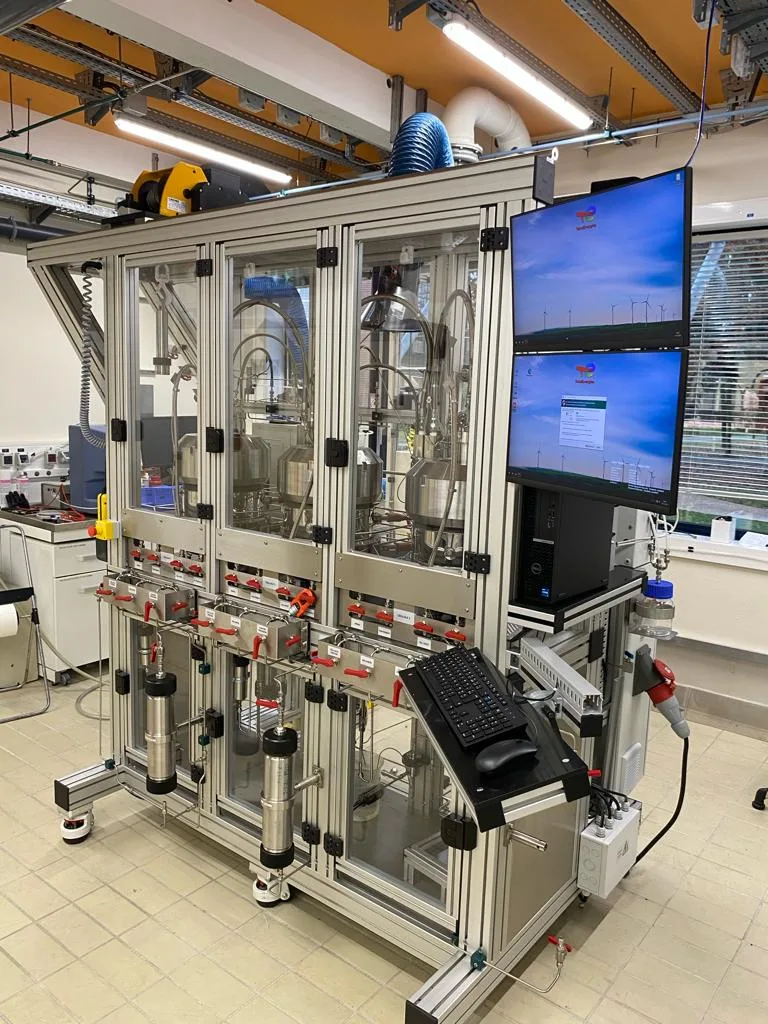 Geoscience & subsurface studies
Multi-cell 400 bar / 250°C test bench for formation damage analysis
Geoscience & subsurface studies
Multi-cell 400 bar / 250°C test bench for formation damage analysis
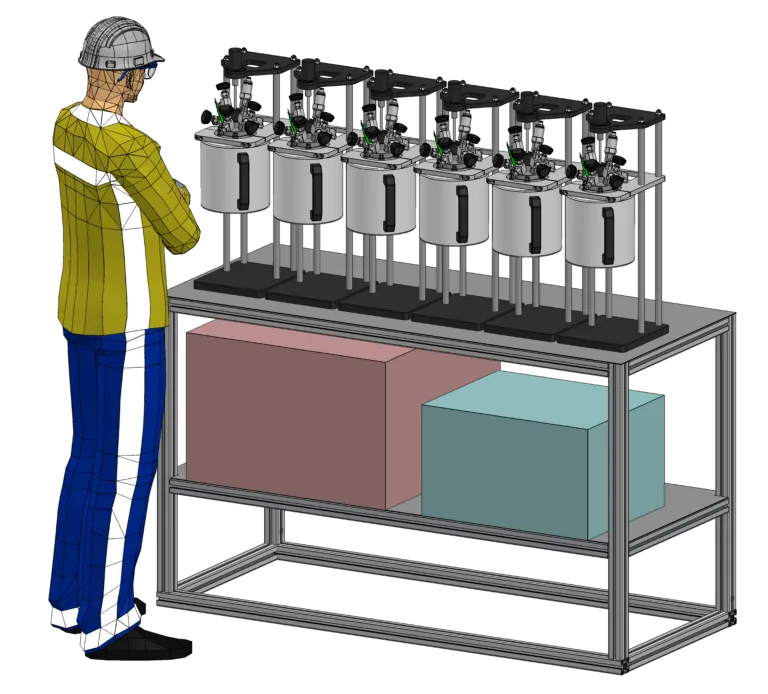 Geoscience & subsurface studies
Custom Hastelloy C276 HPHT reactor system for geoscience research
Geoscience & subsurface studies500 bar500°C105 mLConfidential project · photo withheld
Geoscience & subsurface studies
Custom HPHT Permeameter for Rock Permeability Testing at 500°C / 500 bar in Corrosive Fluids
HPHT reactors & cells100 bar350 °C2 LConfidential project · photo withheld
HPHT reactors & cells
Studying corrosive reactions at 100 bar & 350°C: a custom 2L Hastelloy C276 stirred reactor
Geoscience & subsurface studies
Custom Hastelloy C276 HPHT reactor system for geoscience research
Geoscience & subsurface studies500 bar500°C105 mLConfidential project · photo withheld
Geoscience & subsurface studies
Custom HPHT Permeameter for Rock Permeability Testing at 500°C / 500 bar in Corrosive Fluids
HPHT reactors & cells100 bar350 °C2 LConfidential project · photo withheld
HPHT reactors & cells
Studying corrosive reactions at 100 bar & 350°C: a custom 2L Hastelloy C276 stirred reactor