

Case study · Geoscience & subsurface studies
Custom HPHT Permeameter for Rock Permeability Testing at 500°C / 500 bar in Corrosive Fluids
For a public geoscience research institute, IRIAN Mecatronics designed and built a custom high-pressure, high-temperature (HPHT) permeameter. The equipment measures the permeability of rock samples over long periods under extreme conditions—500 bar (7,250 psi) and 500°C (932°F)—while exposed to aggressive aqueous fluids.
01 — The research question
How to measure the permeability of a porous material under HPHT conditions with corrosive fluids?
Measuring rock permeability involves flowing a fluid through a sample and measuring the resulting pressure drop. Keeping these conditions stable and repeatable becomes a major challenge as pressure and temperature rise, especially with corrosive fluids. The equipment design must ensure a perfect seal, chemical compatibility of all materials, and accurate temperature measurement at the core of the experiment, as temperature governs fluid viscosity and thus the final calculation.
Our client needed to simulate conditions found in geothermal reservoirs or CO2 storage sites, involving temperatures of 500°C (932°F), pressures of 500 bar (7,250 psi), and aggressive fluids (acids, bases). Off-the-shelf permeameters cannot simultaneously reach these pressure and temperature levels. More importantly, their sealing technologies (polymers, elastomers) and standard materials cannot withstand hot corrosion from aqueous fluids.
The challenge: To maintain a perfect, long-lasting seal around a rock sample subjected to very high pressure and temperature with corrosive fluids, without compromising measurement accuracy or operator safety.
02 — Our approach
A design driven by measurement accuracy and operator ergonomics
The design of this permeameter hinged on three key decisions to address the challenges of temperature, corrosion, and serial testing.
-
Inverting the cell architecture for safer, faster handling
Conventional HPHT cells require handling a heavy lid. To make serial testing easier, we inverted this architecture: the top cap is fixed, and the cell body moves down. This gives the operator direct access to the sample without lifting any heavy parts, making changeovers safer and faster.
-
Placing instruments at the core for reliable temperature measurement
Fluid temperature is critical for calculating permeability. Measuring it on the outer wall would be inaccurate. We integrated three thermocouples as close as possible to the rock, with two directly in the fluid. This gives the user the true temperature, eliminating a major source of error in their calculations.
-
Ensuring a 500°C seal with polymer-free gaskets
At 500°C (932°F), polymer seals are destroyed. To guarantee a seal at 500 bar (7,250 psi), we implemented a technology based on compressed graphite gaskets. This solution, proven on our <a href="https://irian-mecatronics.com/project/500c-130-bar-corrosion-test-reactors-for-materials-research/">custom corrosion test reactors</a>, allows the equipment to operate safely across its entire functional range.
03 — Beyond this project
Does your project involve one of these applications?
Geothermal energy
To assess reservoir performance, it is crucial to measure how rock permeability changes when exposed to hot, corrosive brines. The HPHT cell's architecture, corrosion-resistant materials, and core temperature measurement would remain relevant.
Nuclear waste storage
Studying the long-term behavior of containment materials like clays and concretes requires maintaining stable conditions over long periods. This rig's ability to operate with specific fluids and perform low-flow measurements would be directly transferable.
High-temperature hydrogen production
Characterizing electrode materials in contact with superheated steam is a key challenge. The cell's principle, precise heating system, and high-temperature sealing would be kept, while adapting materials for <a href="https://irian-mecatronics.com/hydrogen-atex-test-benches/">hydrogen compatibility</a>.
04 — Specifications
The values for this project. Every system is custom-built, so they adapt to your requirements.
Show specifications · 500 bar (7,250 psi) · 500°C (932°F) · Ø 1.5" x 3" (Ø 38.1 x 76.2 mm)
| Operating pressure | 500 bar (7,250 psi) |
|---|---|
| Operating temperature | 500°C (932°F) |
| Sample dimensions | Ø 1.5" x 3" (Ø 38.1 x 76.2 mm) |
| Wetted materials (pore fluid) | Inconel 625 |
| Cell body and caps material | 316LN |
| Injection pump (upstream) | 0.1 µL/min to 105 mL/min, 517 bar max, volume 223.5 mL |
IRIAN Mecatronics designs and builds custom high-pressure, high-temperature equipment for research laboratories, technical centres and industry.
About the companyThey trust us






















05 — FAQ
Frequently asked questions
Can this type of permeameter be used with gases like CO2 or hydrogen at 500°C?
Yes, the permeameter's general architecture can be adapted for gases. For supercritical CO2, materials like Inconel 625 are well-suited. For hydrogen, a materials compatibility study would be needed to prevent high-temperature embrittlement. The main change would be the fluid management system, which would use mass flow controllers and gas boosters instead of <a href="https://irian-mecatronics.com/precision-pumps-injection-systems-for-research-and-industry/">syringe pumps</a>.
Can you design a permeability test rig for even higher pressures and temperatures?
Yes, designing equipment for conditions exceeding 500 bar (7,250 psi) and 500°C (932°F) is one of our core activities. It involves more advanced mechanical analysis under the Pressure Equipment Directive (PED), the selection of specific steel grades or alloys, and thicker walls. The principles of precise instrumentation and ergonomic design still apply.
Can the equipment accommodate larger or differently shaped rock samples?
Absolutely. As a custom design, the cell dimensions are adapted to the sample size required by the client. A larger sample size would trigger a complete reassessment of the cell's mechanical design, the heating system, and the frame. The inverted architecture is actually even more relevant for handling heavier samples.
How is the permeability measurement automated on this type of test rig?
The rig is driven by a control system that automates the entire process. It manages pressure and temperature setpoints, the pump's injection flow rate, and continuously records sensor data. Test sequences can be programmed for long-term autonomous experiments, which are validated during Factory Acceptance Tests (FAT).
Is your current equipment reaching its limits in temperature, pressure, or chemical compatibility?
Describe your constraints and the test conditions you need to achieve. Our engineering team will analyze your project's feasibility and get back to you with a proposed approach.
Related projects
 Geoscience & subsurface studies
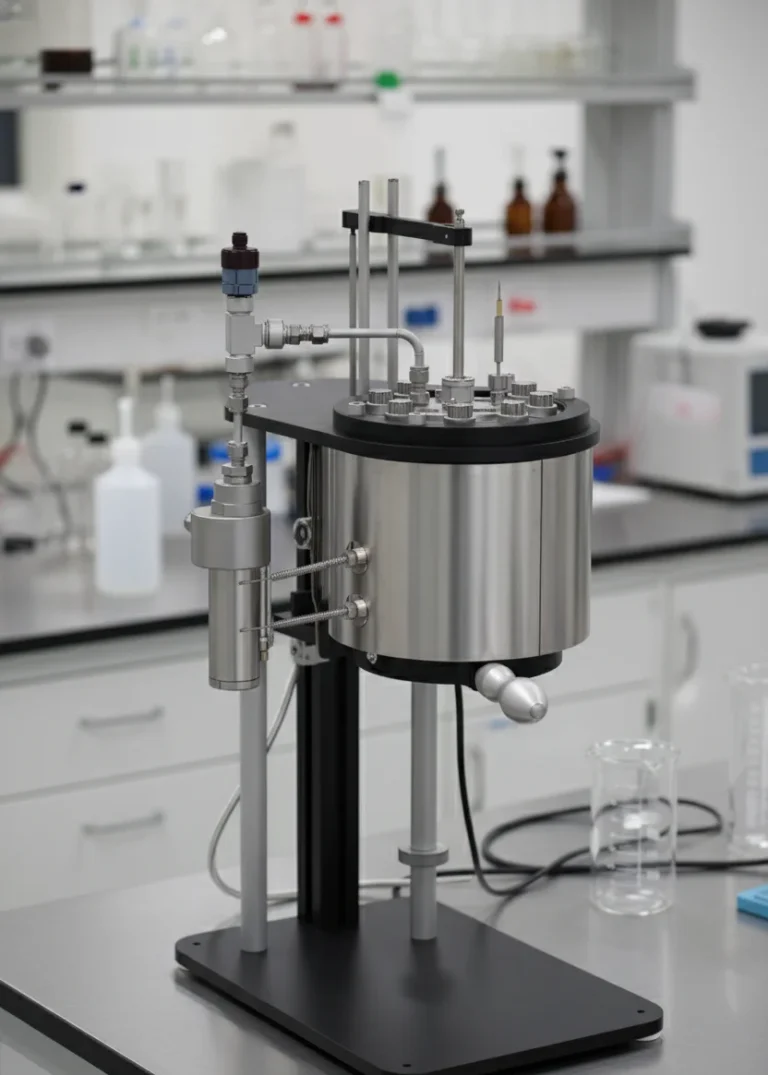
Multi-mode HPHT reactor for geochemical simulation in corrosive media
Geoscience & subsurface studies
Multi-mode HPHT reactor for geochemical simulation in corrosive media
 Geoscience & subsurface studies
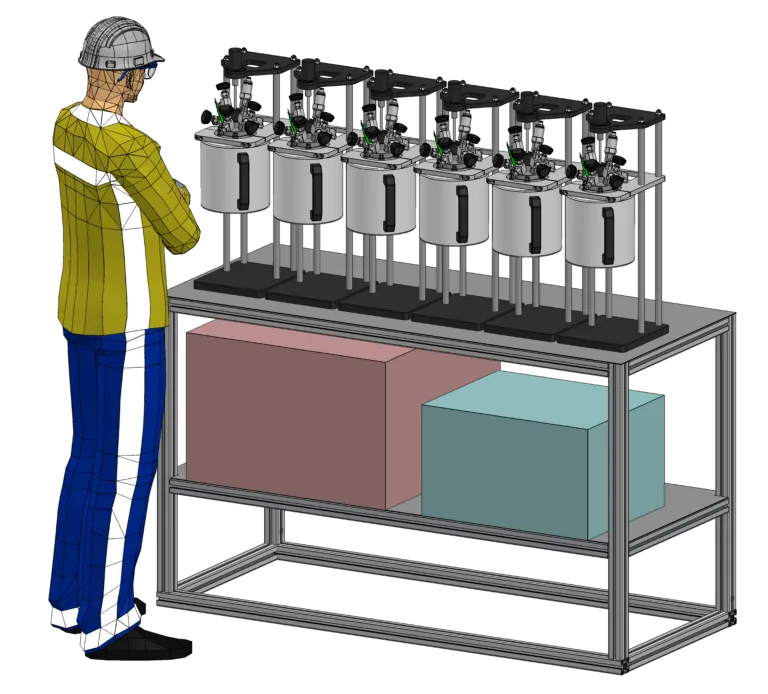
Custom Hastelloy C276 HPHT reactor system for geoscience research
Geoscience & subsurface studies
Custom Hastelloy C276 HPHT reactor system for geoscience research
 Geoscience & subsurface studies
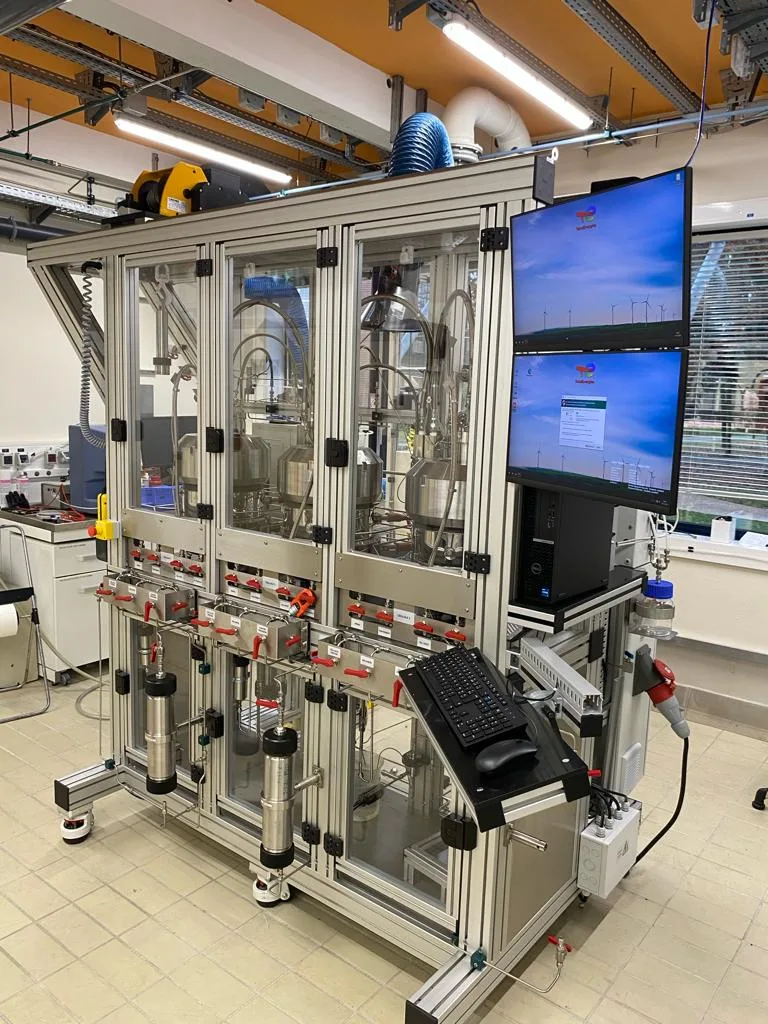
Multi-cell 400 bar / 250°C test bench for formation damage analysis
HPHT reactors & cells100 bar350 °C2 LConfidential project · photo withheld
HPHT reactors & cells
Studying corrosive reactions at 100 bar & 350°C: a custom 2L Hastelloy C276 stirred reactor
Geoscience & subsurface studies
Multi-cell 400 bar / 250°C test bench for formation damage analysis
HPHT reactors & cells100 bar350 °C2 LConfidential project · photo withheld
HPHT reactors & cells
Studying corrosive reactions at 100 bar & 350°C: a custom 2L Hastelloy C276 stirred reactor