

Case study · Geoscience & subsurface studies
Autonomous 1380 bar HPHT test bench for stable, long-duration aging studies
For a major energy company, IRIAN Mecatronics designed and built a dual-cell test bench to simulate material aging at 1380 bar (20,000 psi) and 300°C (572°F). The equipment ensures absolute pressure stability over very long periods, enabling safe, unattended operation.
01 — The research question
How to reliably simulate long-term material aging under extreme, unattended conditions?
To qualify the durability of materials such as cements and drilling fluids, laboratories must replicate downhole conditions (high pressure, high temperature) and maintain them for days or even weeks. The main challenge is ensuring these test conditions remain perfectly stable, without any drift, so that post-mortem analyses reflect true material aging rather than equipment-induced artifacts.
For this project, our client needed to validate formulations for critical applications. While a standard autoclave could reach the target pressure and temperature, it could not guarantee absolute stability over the required duration. Moreover, off-the-shelf solutions offered neither the productivity of running two tests in parallel nor the ergonomics needed to handle heavy cells safely and efficiently.
Maintaining a perfectly stable extreme pressure of 1380 bar over a long period, despite fluid volume changes caused by inevitable micro-fluctuations in temperature.
02 — Our approach
The design approach: solving four challenges for a reliable and productive test
Our engineering team analyzed the project's reliability, safety, and ergonomic constraints to design a system where every feature addresses a specific challenge in the specifications.
-
Actively compensating for volume variations
In a confined volume, the slightest temperature fluctuation causes pressure to change. For an aging test that must remain stable for weeks, a simple initial pressurization is insufficient. We integrated a system that actively and continuously compensates for fluid volume variations, ensuring the pressure setpoint remains stable throughout the test cycle.
-
Making cell handling safer and faster
The caps for cells rated at 1380 bar are extremely heavy, making them difficult and risky to handle. Instead of relying on an external hoist, we integrated an assistance system into the frame that cancels the cap's weight and guides it during closure. This allows a single operator to load and unload samples safely and effortlessly, boosting the laboratory's productivity.
-
Ensuring safety during unattended operation
Equipment operating 24/7 at 1380 bar and 300°C requires foolproof safety. We implemented layered safety systems: PLC-driven software controls backed by passive physical devices (rupture discs, pressure relief valves) that are fully independent of the control system. This redundancy ensures the protection of personnel and the laboratory, even in the event of a control failure. It's a principle we also apply to our test benches for flammable gases.
-
Controlling cooldown to preserve the sample
Reliable post-mortem analysis requires "freezing" the sample's state at the precise end of the test plateau. Slow, uncontrolled passive cooling would allow chemical reactions to continue, skewing the results. Our system ensures that the cooling phase is as rapid and controlled as the heating phase, preserving the sample's integrity for analysis.
03 — Beyond this project
Does your project look like this?
Nuclear
Studying material aging over several months requires ultra-stable long-term pressure control and redundant safety systems for unattended operation. These principles are directly transferable, with material selection adapted to withstand irradiation.
Polymer Chemistry
Syntheses in supercritical conditions require precise pressure control to compensate for reaction-induced volume changes, as well as accurate thermal management. These are two core capabilities of this equipment, which can be augmented with stirring or injection systems.
Deep Geothermal
Testing the resistance of materials in aggressive geothermal fluids relies on the same ability to maintain stable HP/HT conditions and use corrosion-resistant alloys (Hastelloy, Titanium), an expertise we leverage in our custom reactors.
04 — Specifications
The values for this project. Every system is custom-built, so they adapt to your requirements.
Show specifications · 1380 bar (20,000 psi) · 300°C (572°F) · 2, with independent control
| Operating pressure | 1380 bar (20,000 psi) |
|---|---|
| Operating temperature | 300°C (572°F) |
| Number of test cells | 2, with independent control |
| Footprint | Compact, less than 1.5 m wide |
| Required utilities | Standard (water, compressed air, domestic power) |
IRIAN Mecatronics designs and builds custom high-pressure, high-temperature equipment for research laboratories, technical centres and industry.
About the companyThey trust us






















05 — FAQ
Frequently asked questions
What pressure and temperature stability can be expected from this type of aging bench over a long duration?
The actual stability is a key parameter we define with you based on your test's sensitivity. The active control principle enables very high stability (e.g., around ±0.5 bar and ±0.1°C), far superior to that of a static autoclave. The final performance depends on the quality of the chosen instrumentation, the tuning of the control loops, and the thermal stability of the laboratory environment.
Can this test bench be adapted for highly corrosive fluids like H2S or concentrated brine?
Yes, absolutely. The design of our Custom HPHT Reactors & Cells is systematically adapted for chemical compatibility. For corrosive environments, we select high-performance alloys for all wetted parts, such as Inconel, Hastelloy, Titanium, or Super Duplex stainless steel. The specific grade is chosen based on the fluid composition, temperature, and pressure.
Is it possible to design a similar system with more than two cells, or with larger sample volumes?
Yes, our test benches have a modular architecture. We can design multi-reactor systems to increase productivity; for instance, we have built benches with 6 HPHT reactors. The cell volume can also be customized. A larger volume would primarily affect the power requirements for heating and cooling and the sizing of the pressure generator, but the core principles of control and safety would remain identical.
Does the equipment comply with the Pressure Equipment Directive (PED)?
Yes, all our equipment is designed and manufactured in compliance with the European Pressure Equipment Directive (PED 2014/68/EU) when required by its risk category. Our in-house design office conducts the risk analysis, performs sizing calculations according to applicable codes (e.g., ASME, CODAP), and ensures full material traceability, delivering a complete technical file to the client.
Are your long-duration tests limited by the stability of your current equipment?
Tell us about your constraints and the conditions you need to maintain. Our engineering team will analyze the feasibility of your project and propose a technical approach.
Related projects
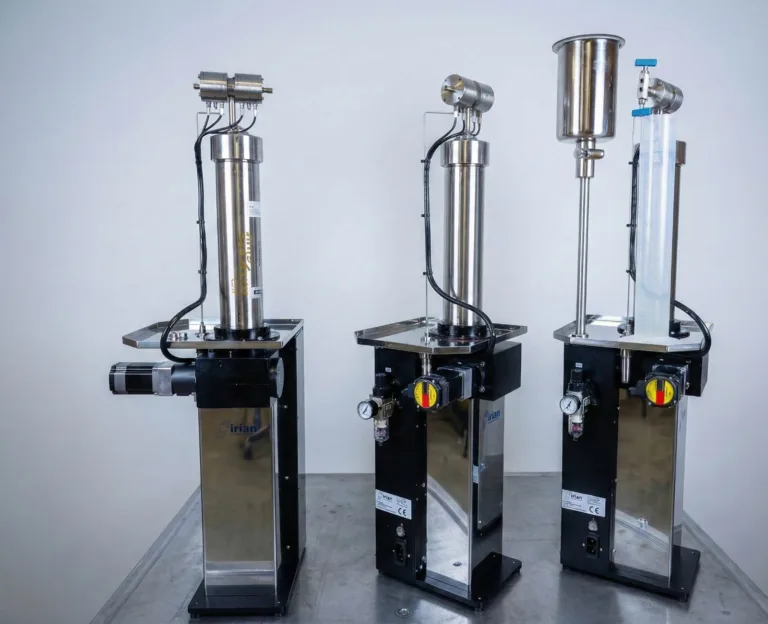 Geoscience & subsurface studies
Retrofitting proprietary high-pressure pumps for PVT analysis
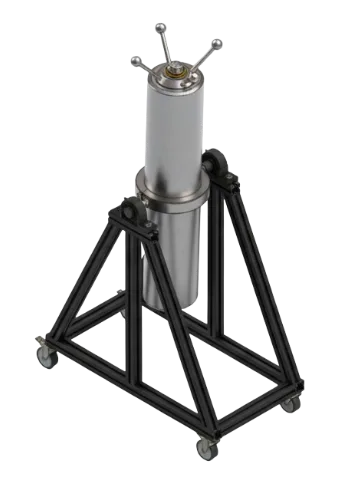 Geoscience & subsurface studies
1200‑bar floating piston cells for HPHT reservoir fluid studies
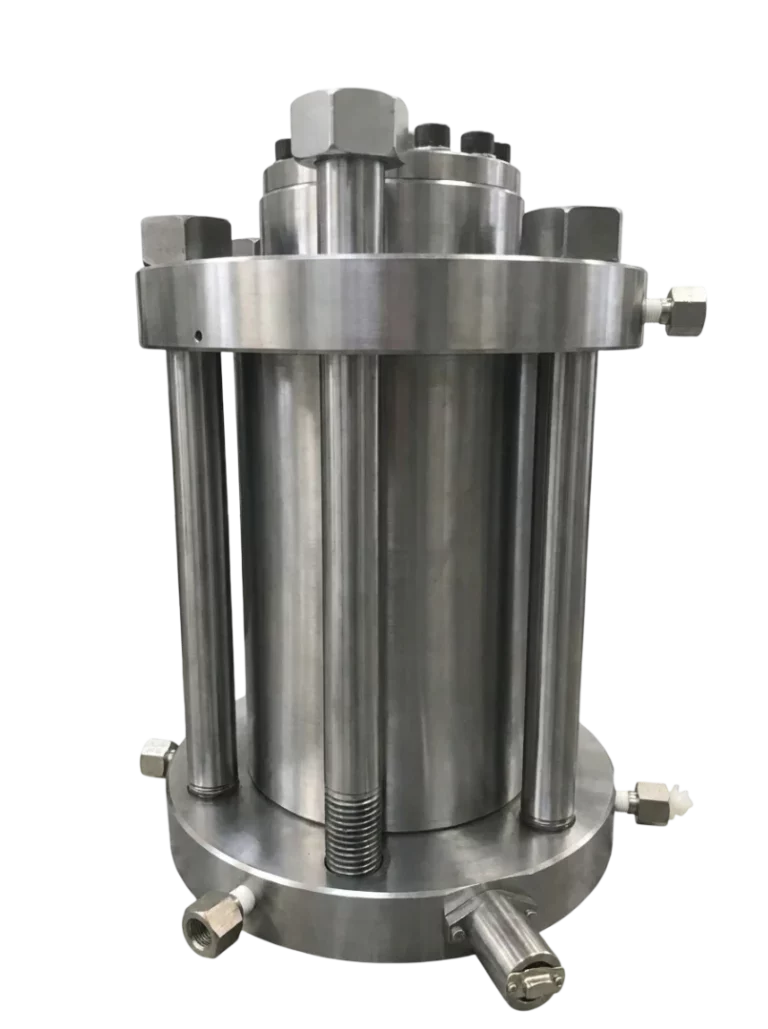 Geoscience & subsurface studies
Wide-range gas permeability test bench and triaxial cell for geomechanics
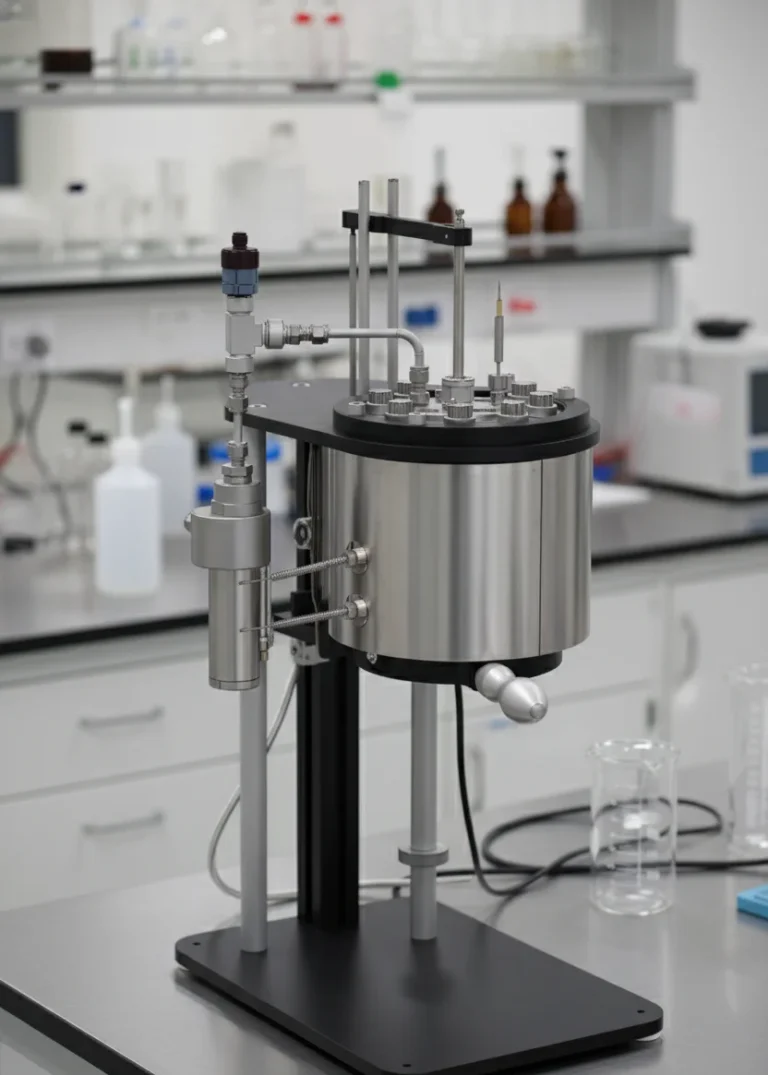 Geoscience & subsurface studies
Multi-mode HPHT reactor for geochemical simulation in corrosive media