
Case study · Geoscience & subsurface studies
Custom 5-Liter HPHT cells for storing and transferring fluids at 1200 bar
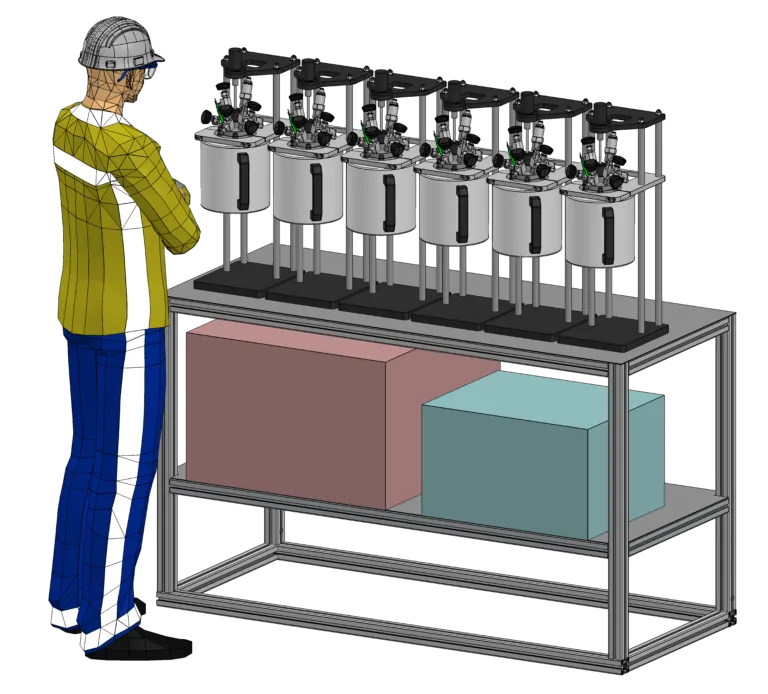
For the R&D center of a major international energy company, IRIAN Mecatronics designed and built a set of six 5-liter storage and transfer cells. This custom equipment allows researchers to handle corrosive fluid samples under extreme conditions (1200 bar / 17,400 psi, 150°C / 302°F) while ensuring sample integrity and operator safety.
01 — The research question
How to store, transfer, and condition large-volume fluid samples at extreme pressure and temperature?
Handling fluid samples at High Pressure High Temperature (HPHT) is a common need in R&D, from reservoir fluid analysis to process chemistry and geosciences. The challenge grows with the sample volume: the mass, inertia, and mechanical stresses on the pressure vessel increase by an order of magnitude, making operator safety the primary design driver.
In this project, a lab needed a set of versatile cells to handle representative samples from oil reservoirs. Standard equipment was ruled out by the combined constraints: a pressure of 1200 bar (17,400 psi) and a temperature of 150°C (302°F), applied to a 5-liter volume containing highly corrosive fluids (brines, CO2). Off-the-shelf solutions could meet one or two of these requirements, but none could combine all of them, especially at such a large volume.
Reconciling the mass and size of a large-volume vessel rated for 1200 bar with the need for simple, fast, and safe handling in a laboratory environment.
02 — Our approach
Our approach: an integrated design for safety and versatility
The design was driven by three principles: ensuring sample integrity, guaranteeing operator safety and ergonomics, and maintaining versatility. Each technical choice addresses a specific challenge.
-
Ensuring corrosion resistance
The fluids under study (brines, hydrocarbons with CO2) are extremely corrosive at 150°C (302°F) and 1200 bar (17,400 psi). To prevent sample contamination and ensure the equipment's longevity, we selected a specific metal alloy. Its composition provides natural passivity and high mechanical strength in these hot, chloride-rich, and acid gas environments.
-
Assisting handling and mixing
A 5-liter cell rated for 1200 bar is too heavy to be rotated safely by hand. We therefore decoupled the pressure containment from the handling mechanism: the cell is integrated into a mobile external frame that bears the load and assists with rotation. This solution, simpler and more robust than an internal agitator with complex sealing, allows a single operator to mix the contents and move the cell effortlessly.
-
Securing high-temperature heating
Heating a metal vessel of this size to 150°C (302°F) creates a surface that poses a severe burn risk. To protect the operator, a distributed external heating system is fully enclosed in a thermally insulated protective casing. This insulation ensures safety, improves temperature stability, and reduces energy consumption.
03 — Beyond this project
Can this approach solve your problem?
Fine chemicals / Polymers
For batch syntheses in large-volume reactors under pressure and in corrosive environments, this approach remains relevant. The principles of a pivoting frame for mixing and safe, enclosed heating would be maintained, while adapting the material (Hastelloy, Inconel) and adding the necessary process connections.
Deep geothermal / CO2 storage
Studying the interaction between geothermal fluids or supercritical CO2 and rock samples requires large-volume HPHT test benches. The design for high pressure and corrosion resistance (brines, CO2, H2S) is directly transferable, with adjustments to materials and integrated sensors.
Food processing / Supercritical extraction
Supercritical CO2 extraction requires efficient mixing inside a pressure vessel. The concept of a large-volume tilting cell is ideal for this. The materials would be food-grade (316L stainless steel), the pressures more moderate, and the closures optimized for frequent opening and closing cycles.
04 — Specifications
The values for this project. Every system is custom-built, so they adapt to your requirements.
Show specifications · 1200 bar / 17,400 psi · 150°C / 302°F · 2 to 5 liters
| Operating pressure | 1200 bar / 17,400 psi |
|---|---|
| Operating temperature | 150°C / 302°F |
| Useful volume | 2 to 5 liters |
| Number of units built | 6 |
IRIAN Mecatronics designs and builds custom high-pressure, high-temperature equipment for research laboratories, technical centres and industry.
About the companyThey trust us






















05 — FAQ
Frequently asked questions
Are these HPHT cells compliant with the Pressure Equipment Directive (PED)?
Yes, absolutely. All our equipment is designed in compliance with the Pressure Equipment Directive (PED 2014/68/EU) when its risk category requires it. Our in-house engineering team performs the risk analysis, design calculations, material selection and traceability, and compiles the complete technical file to ensure the system's regulatory compliance.
Can this tilting cell design be adapted for more aggressive fluids like H2S?
Yes, the design principle is fluid-independent. Compatibility is ensured by the choice of material. For media containing hydrogen sulfide (H2S) or other highly corrosive compounds, we select nickel alloys such as Inconel or Hastelloy, as we did for this HPHT reactor bench in Hastelloy. An analysis of your specific needs will determine the most suitable grade.
Can the mixing or transfer cycle of these cells be automated?
Yes, a cell like this can be fully automated. The handling frame can be fitted with a motor to control the tilting speed and angle, and the manual valves can be replaced with actuated valves. The entire system can then be controlled by a PLC program to execute repeatable mixing or transfer sequences without manual intervention.
What is the volume limit for this type of tilting HPHT cell design?
There is no theoretical limit, but there is a practical one related to ergonomics and laboratory footprint. Beyond a certain volume (e.g., 10-20 liters), the system's weight and inertia become so large that mixing by tilting is less practical than an internal stirring system. The choice depends on the application: tilting is ideal for gentle mixing and for systems where an internal moving part would pose a sealing or cleaning challenge.
Do you need to handle large fluid volumes at high pressure and temperature?
Describe your requirements, no matter how specific. Our engineering team will analyze your project's feasibility and get back to you with a proposed approach.
Related projects
 Geoscience & subsurface studies
Multi-mode HPHT reactor for geochemical simulation in corrosive media
 Geoscience & subsurface studies
Multi-cell 400 bar / 250°C test bench for formation damage analysis
 Geoscience & subsurface studies
Custom x-ray transparent triaxial cell for BRGM: in-situ 3D tomography analysis
 Geoscience & subsurface studies
Custom Hastelloy C276 HPHT reactor system for geoscience research