Skip to content

Testing with flammable gases

Hydrogen and ATEX test rigs

We design and build custom equipment to safely conduct experiments with hydrogen and other flammable gases, or to operate in explosive atmospheres (ATEX). We build the tool you need to achieve your experimental goals while managing all associated risks.

01 — The problems we solve

Running tests with hydrogen or in ATEX zones

Our equipment is designed to meet the specific challenges of handling hydrogen and operating in explosive environments. Select your situation to see solutions we have already implemented.

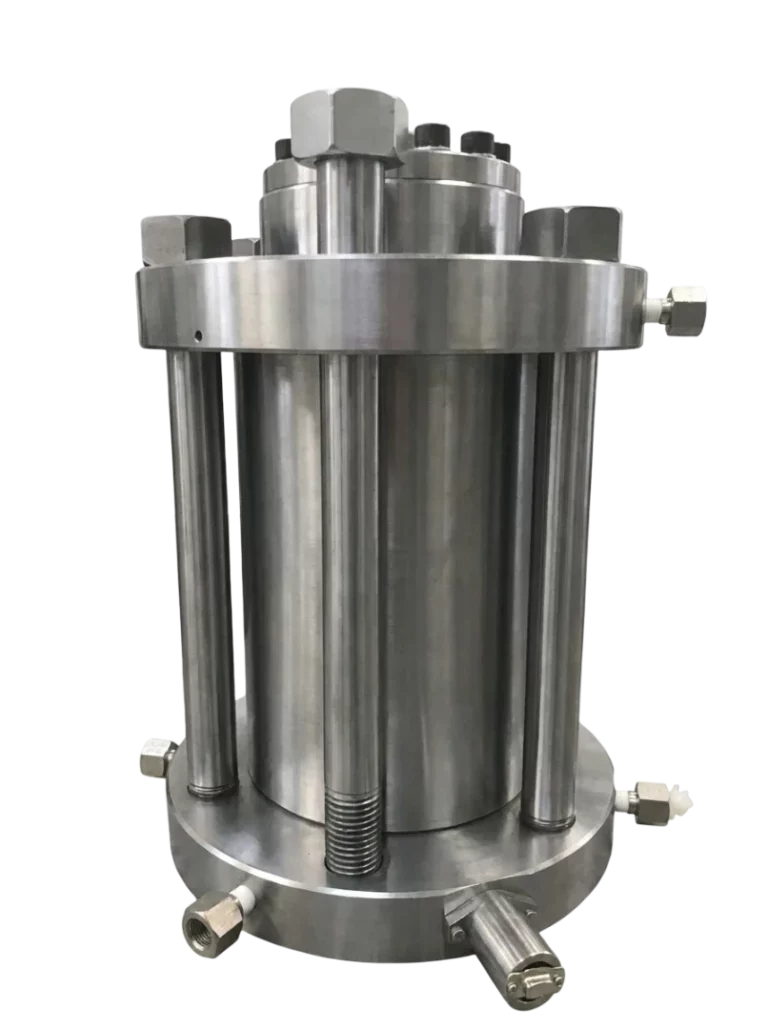
Testing materials under high-pressure hydrogen

The challenge is to combine high pressure and high temperature with hydrogen's wide flammability range and low ignition energy. The equipment must not only contain the pressure but also eliminate all ignition sources and manage potential leaks to ensure the test is safe.

Delivered for

See the project ↓

Automating an operation in an ATEX zone

The difficulty lies in designing a custom machine where every component—motor, sensor, electronic device—is certified for the relevant ATEX zone. The goal is to eliminate human intervention in a hazardous environment with a reliable, fully remote-controlled system that ensures both productivity and operator safety.

Delivered for

See the project ↓

Running reactions under hydrogen

This requires a regulated gas supply, efficient mixing, and precise thermal control within a safe environment for flammable gases. Accurately measuring gas consumption under pressure is a major challenge, as it is essential for obtaining reliable kinetic data and tracking the reaction's progress.

Delivered for

See the 2 projects ↓

02 — Custom-built

Custom configurations

Each test rig is a unique design, tailored to the experimental conditions, safety constraints, and measurement goals of your project.

Autoclaves and test rigs for flammable gases

Designed to expose samples to flammable gases under controlled pressure and temperature. The number of stations, ATEX compliance level, leak detection and management systems, and sample loading ergonomics are defined specifically for each project.

Reactors for hydrogen service

Dedicated to running chemical reactions such as catalytic hydrogenation. The volume, pressure, agitation type, gas feed system, and consumption measurement method are custom-designed to meet the requirements of the process under study and the nature of the data sought.

Custom machines for ATEX zones

Used to automate a function or process in an environment where an explosive atmosphere may form. The function to be performed, the level of automation, the interfaces, and the operator safeguards are entirely designed for the target application, whether for production or maintenance.

Gas permeability test rigs

Designed to measure the ability of a gas to flow through a porous material under stress. The equipment is adapted to the nature of the gas (H2, CO2, etc.), the mechanical stresses to be applied, and the permeability range to be measured, especially for the very low values critical for geological storage.

03 — Measurements

Measurements and control

The reliability of a test depends on the precision of its control system and the relevance of the measured parameters. Each system is instrumented to provide the data that matters.

Pressure, temperature, flow rate, and gas consumption

These measurements are essential for controlling experimental conditions, tracking reaction progress, and collecting kinetic data. They form the basis for understanding and optimizing the phenomenon under study.

Hydrogen and flammable gas detection

This is a critical safety function that protects operators and the facility. By triggering alarms and emergency shutdown procedures in the event of a leak, it ensures a controlled and immediate response to any incident.

Gas permeability

This measurement quantifies a material's ability to let a gas pass through it. It is essential data for studies on geological storage, barrier materials, or membrane performance.

Alarm and event history

This feature ensures full traceability of tests and rig operations. It helps with diagnostics in case of an incident and enables continuous improvement of protocols by logging all significant system events.

04 — Projects

Our hydrogen and ATEX projects

5 projects

05 — Our approach

Our approach: from scientific question to qualified test rig

We design each piece of equipment as a custom scientific instrument. Our process is centered on your experimental need and total risk control.

  1. Understanding the phenomenon to be studied

    Our design process starts not with a technical specification sheet, but with your scientific question. This ensures that the final test rig will be a relevant tool for your research, capable of reproducing the conditions and providing the measurements you need to answer it.

  2. Designing the custom solution

    Every test is unique, and safety is non-negotiable. We design the rig specifically for your conditions, incorporating a thorough risk analysis from the outset to control the hazards associated with flammable gases, pressure, and temperature.

  3. Delivering a complete, qualified system

    To ensure a quick and safe handover, each rig is tested and validated in our factory (FAT). We then handle the installation, on-site commissioning, and comprehensive training for users on how to operate and maintain the equipment.

Our expertise in designing equipment for geoscience and subsurface studies and developing process pilot plants is often applied to projects involving custom reactors and the simulation of extreme environments.

They trust us

  • CNRS
  • CEA
  • BRGM
  • Ifremer
  • EDF
  • TotalEnergies
  • Michelin
  • CETIM
  • Centrale Lille
  • Université de Pau et des Pays de l'Adour
  • Sonatrach
  • Saudi Aramco
  • Nanchang University
  • Adisseo
  • Lafarge
  • MDS
  • MIO – Mediterranean Institute of Oceanography
  • IRT Saint Exupéry
  • IRD – French National Research Institute for Sustainable Development
  • Groupe INSA
  • Aix-Marseille Université

06 — FAQ

Frequently asked questions

How do you ensure the ATEX compliance of your equipment?

Compliance is ensured through a system-level approach, not just by selecting certified components. It is based on a detailed upfront risk analysis, the selection of zone-rated hardware, and the integration of active safety features like ventilation, inerting, or gas detection, all designed to control the risk at its source.

Can your test rigs perform tests according to specific standards, such as those for hydrogen embrittlement?

Our equipment is designed to create the physical conditions (pressure, temperature, atmosphere) required by a standard. We deliver a tool capable of reliably and safely reproducing an experimental protocol, giving you the means to conduct your tests in compliance. However, the rig itself is not certified to a specific test standard.

What is the maximum pressure you can reach with hydrogen?

We do not define a catalog limit, as our approach is to design the equipment for the specific needs of the test. The performance of our past projects, such as the autoclaves for hydrogen testing we have built, serve as examples of our capabilities and as a starting point for designing your own system.

Besides the reaction vessel, what does a test rig delivery include?

We deliver a turnkey solution, ready to operate. This includes the entire system: fluid supply, precise pressure and temperature control, all safety features, the control PLC, and the supervision software with data acquisition. The service also covers factory acceptance testing (FAT), on-site commissioning, and training.

Have a project involving hydrogen or an ATEX zone?

Describe the experiment you need to run and the conditions to reproduce. Our engineering team will analyze your constraints to design a custom, high-performance, and safe solution.

Discuss your project