

Case study · Extreme Environment Simulation Systems
Custom High-Pressure Syringe Pump: Injecting Corrosive Fluids at 800 bar with Microliter Stability
For a fundamental chemistry research lab, IRIAN Mecatronics designed and built a high-pressure syringe pump to inject corrosive fluids at 800 bar. The equipment combines a five-order-of-magnitude flow range with microliter stability, where no standard equipment existed.
01 — The research question
How to inject a corrosive fluid at a very low, stable flow rate under very high pressure?
Injecting a fluid with stability and precision is a common challenge, but the difficulty increases exponentially when very high pressure, extremely low flow rates, and high chemical corrosivity are involved. Most pumps excel in one or two of these areas: HPLC pumps offer precision but not chemical resistance, while industrial pumps handle pressure and corrosion but lack the finesse for microfluidics.
In this project, a laboratory sought to continuously simulate the conditions of deep-sea hydrothermal vents for research on the origin of life. They needed to inject concentrated brines and dissolved corrosive gases into an experimental cell at 800 bar, with a flow range from rapid purging to quasi-static injection over several days. No off-the-shelf equipment could meet all four constraints simultaneously.
The technical challenge was to reconcile the immense mechanical force needed to push a fluid at 800 bar with the fine control required to regulate a stable flow rate at the nanoliter-per-second scale.
02 — Our approach
Our design approach: four constraints, four solutions
The design of this equipment addressed four critical, interdependent requirements: fluid resistance, precise control over a wide range, experimental flexibility, and operator safety.
-
Ensuring sample purity against corrosion
The fluids (brines, dissolved gases) were highly aggressive. To prevent any contamination of the experiments and ensure durability, we selected a unique alloy, Hastelloy C-276, for all wetted parts. This guarantees the user that their results are not skewed by metal leaching.
-
Mastering a five-order-of-magnitude flow range
To cover the range from 0.1 µL/min to 60 mL/min, we chose an oversized motor drive for power, controlled by high-resolution electronics for finesse. This precise feedback control allows the researcher to switch from a microfluidic experiment to a rapid purge with a single precision injection system.
-
Allowing for adaptation to future research protocols
Research equipment must be able to evolve. Instead of a monolithic design, we engineered a frame that accepts interchangeable syringe bodies. This allows the researcher to mount a small volume to reach maximum pressure with expensive products, or a large volume for long-duration tests at moderate pressure.
-
Ensuring operator safety at 800 bar
Such high pressure represents a major energy hazard. Safety is based on three independent levels: a physical shield against projectiles, a hardwired safety circuit that cuts power in case of a fault, and software limits. This redundancy is essential for any project involving the simulation of extreme environments.
03 — Beyond this project
Could this approach solve your problem?
Energy (CO2 capture, hydrogen)
The common constraint is the controlled injection of supercritical fluids or gases at very high pressure. The principle of a powerful mechanical drive with precision control would remain, as would the need for specific materials (H₂, H₂S compatibility), but certifications (ATEX) might change.
Pharmaceuticals (continuous flow synthesis)
The need for very precise dosing in pressurized microfluidic reactors is similar. The high flow stability and high-resolution motor control would be retained, but the materials (pharma-grade stainless steel, PEEK) and cleanability requirements (GMP, FDA) would be different.
Geosciences (Oil & Gas)
For enhanced oil recovery studies, the ability to maintain stable pressure and flow over long periods is key. Robustness and corrosion resistance remain relevant, as in our HPHT reactor bench in Hastelloy, but back-pressure regulation and temperature control would need to be added.
04 — Specifications
The values for this project. Every system is custom-built, so they adapt to your requirements.
Show specifications · 800 bar (11,600 psi) · 0.1 µL/min to 60 mL/min · 0.05 µL/min
| Maximum operating pressure | 800 bar (11,600 psi) |
|---|---|
| Flow rate range | 0.1 µL/min to 60 mL/min |
| Flow rate stability | 0.05 µL/min |
| Syringe volumes | 10 mL (at 800 bar / 11,600 psi) and 25 mL (at 340 bar / 4,930 psi) |
| Wetted parts material | Hastelloy C-276 |
IRIAN Mecatronics designs and builds custom high-pressure, high-temperature equipment for research laboratories, technical centres and industry.
About the companyThey trust us






















05 — FAQ
Frequently asked questions
Can this high-pressure pump operate at high temperatures?
Yes, the pump's design can be adapted for high-temperature operation. This involves a thermal analysis to select appropriate materials (seals, pump body) and potentially insulating or cooling the motor drive system. The mechanical design and safety features are then reviewed based on the target temperature.
Can this pump be used to inject supercritical gases or viscous fluids?
Yes, the architecture is compatible. For supercritical gases, the choice of materials and seals is critical to ensure leak-tightness. For viscous fluids, the power of the drive system is the main advantage; the motor and gearbox will be sized to provide the necessary torque while maintaining flow rate precision.
Can this syringe pump model be adapted for pressures above 800 bar?
Yes, but this would be a new design project. Reaching higher pressures (UHP) requires a complete redesign of the pressurized parts (body, piston, fittings) in accordance with the Pressure Equipment Directive (PED). The frame and push mechanism must also be reinforced, but the precision control principle remains the same.
How does this syringe pump integrate into an existing test rig?
Integration is a core part of our projects. The pump is delivered with its control software, but our automation engineering team can also provide drivers (e.g., LabVIEW) or implement a standard communication protocol (e.g., Modbus TCP/IP) so you can control it from your own supervision system.
Is your current equipment limiting your flow range or working pressure?
Describe your pressure, flow rate, and chemical compatibility constraints. Our engineering team will analyze the feasibility of your project and get back to you with a technical proposal.
Related projects
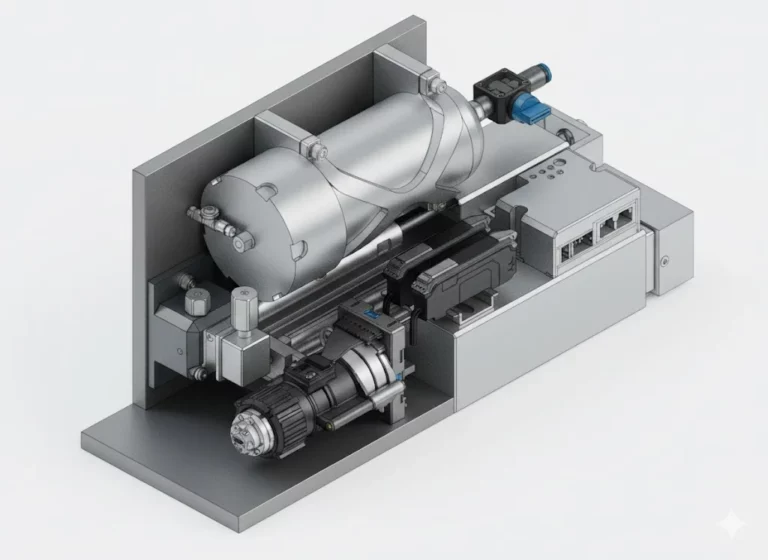 Extreme Environment Simulation Systems
High-Pressure Injection Skid for Microgravity Process Control
Extreme Environment Simulation Systems
High-Pressure Injection Skid for Microgravity Process Control
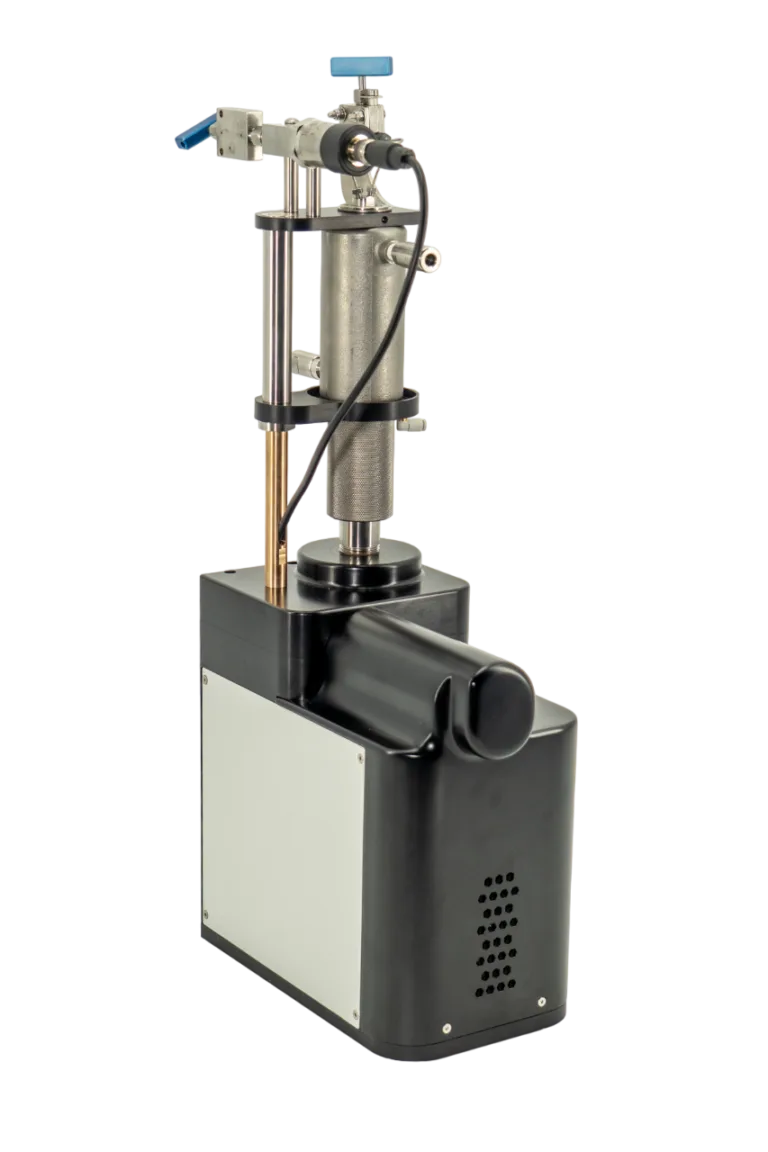 Extreme Environment Simulation Systems
12CC 600 bar Volumetric Pump for Pressure Control in Corrosive Media (Na2S) for CNRS
Extreme Environment Simulation Systems
12CC 600 bar Volumetric Pump for Pressure Control in Corrosive Media (Na2S) for CNRS
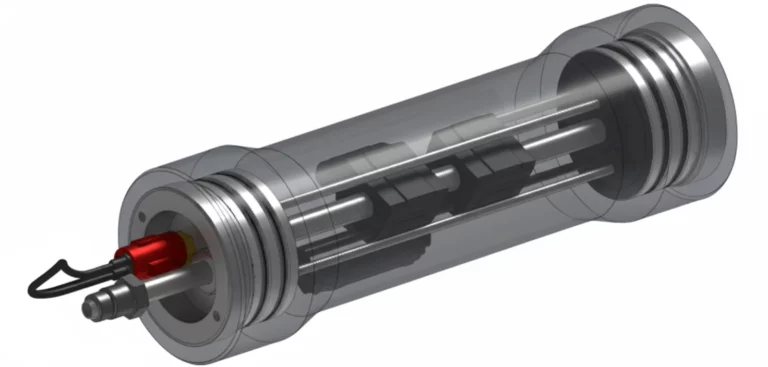 Extreme Environment Simulation Systems
Marinized 6000m Flowmeter: Qualifying Measurement in Extreme Environments for Oceanographic Research
Extreme Environment Simulation SystemsConfidential project · photo withheld
Extreme Environment Simulation Systems
High-Pressure Autoclaves for Flammable Gas (ATEX) Testing
Extreme Environment Simulation Systems
Marinized 6000m Flowmeter: Qualifying Measurement in Extreme Environments for Oceanographic Research
Extreme Environment Simulation SystemsConfidential project · photo withheld
Extreme Environment Simulation Systems
High-Pressure Autoclaves for Flammable Gas (ATEX) Testing