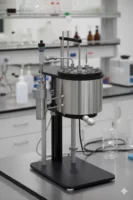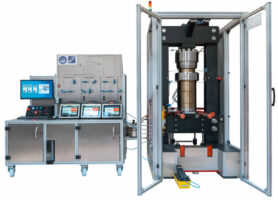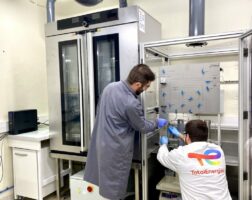
300 bar Triaxial Cell for In-Situ X-Ray Characterization
For a geoscience research laboratory, we designed and manufactured a custom triaxial cell to study rock deformation under X-ray computed tomography (CT) imaging. The equipment operates at up to 300 bar of confining and pore pressure, at 60°C, while applying a 25 kN axial load.
The design’s key feature is a body made of 2024 T3 aluminum alloy, ensuring the transparency required for X-rays without compromising mechanical integrity.
The Challenge: Seeing Through Steel
Studying the behavior of rocks under stress (geomechanics) is critical for applications like CO2 storage, geothermal energy, and wellbore stability. Standard triaxial cells can apply confining pressure, pore pressure, and an axial load to a sample, but their high-strength steel bodies make them completely opaque. This limits researchers to measuring bulk effects, preventing them from observing the internal mechanisms of cracking, fluid percolation, or porosity changes in real time.
The challenge was to engineer an enclosure that could withstand 300 bar of internal pressure and a high axial load, yet remain transparent enough to X-rays to allow for 3D tomography of the sample during the test. This meant reconciling two contradictory physical requirements: high mechanical strength, which calls for dense materials and thick walls, and low X-ray attenuation, which demands the exact opposite.
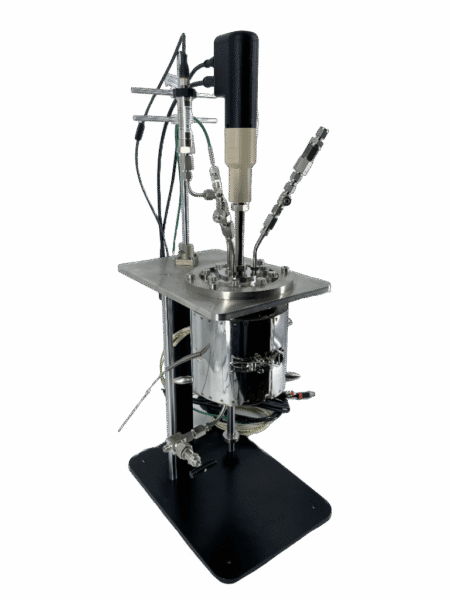
An Integrated Design Built for Transparency
Our approach was to determine the best material-geometry compromise and then integrate all other functionalities around this central choice.
- A High-Strength Aluminum Body: After analyzing stresses and attenuation properties, we selected an aerospace-grade aluminum alloy (2024 T3). This material offers a much more favorable strength-to-density ratio than steel for this specific application. The cell’s geometry was optimized through calculation to guarantee safety at 300 bar while minimizing the material thickness along the X-ray path.
- Modular Architecture: The equipment is structured into three main sub-assemblies. The upper end cap integrates fluid connections (pore pressure, bleed) and a port for an ultrasound transducer. The base plate serves as the mechanical support and a connection hub for instrumentation and fluids. Finally, an axial loading system with a self-compensated piston applies the deviatoric stress. This modularity simplifies assembly and maintenance.
- Interface Management: A cell of this type is more than just a pressure vessel. It must accommodate feedthroughs for fluids, electrical cables for sensors and actuator power, and measurement signals. We designed specific leak-proof penetrators, notably for a future piezoelectric actuator, low-voltage sensors, and a 220 VAC power supply. Each connection is positioned to avoid interfering with the scanner’s field of view and to preserve the integrity of the pressure vessel. This integration capability is at the core of our expertise in geomechanics research equipment.
Transferability & Your Future Projects
The principle of a pressure vessel transparent to an imaging technique opens up possibilities far beyond geomechanics.
- Materials Science: For the in-situ study of deformation and failure in composite materials, metal foams, or 3D-printed structures under mechanical and thermal stress. The shared physical constraint is observing internal structural changes under load.
- Energy Storage: To visualize volume changes and mechanical degradation (swelling, cracking) of battery electrodes during charge/discharge cycles, under representative confining stresses. The constraint is imaging microstructural evolution inside a sealed, pressurized system.
- Biomaterials: To characterize the mechanical behavior of implants or prosthetics under cyclic loads in a controlled fluid environment, observing their integration or wear in 3D. The constraint is real-time 3D observation of material performance within a simulated biological environment.
Technical specifications
- Confining Pressure: 300 bar
- Pore Pressure: 300 bar
- Operating Temperature: Ambient to 60 °C
- Maximum Axial Force: 25 kN
- Transparent Body Material: Aluminum 2024 T3
- Wetted Materials: 316 Stainless Steel, 17.4 PH, FKM, PTFE
- Sample Dimensions: Ø 40 mm x 80 mm (Ø ~1.57 in x ~3.15 in)
- Overall Dimensions: Ø 152 mm x 440 mm (Ø ~5.98 in x ~17.32 in)
Examples of Similar Designs