
Case study · Precision pumps & injection systems
Safely metering corrosive acid under pressure: a custom positive displacement pump for the chemical industry
For a client in the chemical industry, IRIAN Mecatronics designed and built a custom positive displacement pump. The equipment accurately meters 98% sulfuric acid at operating pressures up to 15 bar (218 psi), ensuring intrinsic safety and full chemical compatibility.
01 — The research question
How to accurately meter a chemically aggressive fluid under pressure while ensuring operator safety and equipment longevity?
Controlled metering of reactive fluids is a common operation in many industrial processes. The challenge intensifies when the fluid is both chemically aggressive and pressurized. This requires guaranteeing not only flow rate accuracy, but also long-term equipment integrity and absolute operational safety. Standard pumping solutions, often designed for less severe conditions, quickly reach their material and functional limits.
Our client needed to inject 98% sulfuric acid into a process within a specific flow rate range and at a pressure of 10 to 15 bar (145 to 218 psi). No off-the-shelf pump could handle the combination of this extremely corrosive fluid, the pressure, and the requirement for passive safety in case of a shutdown. The risk of material failure, leakage, or loss of flow control made a standard solution unsuitable for their process development pilot plants.
Achieving a perfect, durable seal and precise metering under pressure with a fluid that destroys most common sealing materials and metals.
02 — Our approach
Our approach: from constraint to design principle
Faced with specifications where safety and reliability were paramount, our engineering team based the design on three key decisions.
-
Selecting materials with validated chemical inertness
98% sulfuric acid aggressively attacks most metals and elastomers. We therefore selected a specific combination of materials for all wetted parts, including the dynamic seals, to guarantee total chemical inertness up to 15 bar (218 psi). This choice prevents any risk of leakage and ensures the equipment's longevity.
-
Adopting an intrinsically safe mechanical drive
To ensure a stable flow rate and passive safety, we chose a non-reversible mechanical drive architecture. Unlike systems that require an active brake, this one locks mechanically in the event of a power failure. The pressure is maintained without any external action, eliminating a potential failure point and making the process intrinsically safe. This is a principle we apply to many of our custom injection systems.
-
Integrating dual overpressure protection
Because an overpressure event with this fluid would be critical, we built in redundant protection. The control system includes a configurable software safety that stops the pump if a threshold is exceeded. In parallel, a passive and completely independent hardware safety (a rupture disk) protects the system even if the control fails, ensuring absolute protection.
03 — Beyond this project
Does your application share these challenges?
Pharmaceuticals / Biotechnology
High-precision metering of corrosive reagents into pressurized bioreactors requires perfect chemical inertness. The principle of a secure positive displacement drive and the choice of pharmaceutical-grade materials (PEEK, Hastelloy) would remain the same.
Energy / CO2 Capture
Injecting amine solvents for CO2 capture, which are corrosive when hot, requires robustness and reliability. The design of a positive displacement pump with suitable materials and a non-reversible drive for safety would be directly transferable.
Geosciences
Simulating reservoir conditions requires injecting acidic brines into rock samples at very high pressures. The principle of a positive displacement pump that ensures corrosion resistance and precise volume control remains relevant, adapting the materials for extreme pressures.
04 — Specifications
The values for this project. Every system is custom-built, so they adapt to your requirements.
Show specifications · 2 liters · up to 15 bar (218 psi) · 40 to 10,000 ml/h
| Usable volume | 2 liters |
|---|---|
| Operating pressure | up to 15 bar (218 psi) |
| Equipment flow rate range | 40 to 10,000 ml/h |
| Client's required flow rate range | 389 to 1416 ml/h |
| Operating temperature | Ambient |
IRIAN Mecatronics designs and builds custom high-pressure, high-temperature equipment for research laboratories, technical centres and industry.
About the companyThey trust us




















05 — FAQ
Frequently asked questions
How can this pump be adapted for other corrosive fluids like nitric acid, caustic soda, or solvents?
Adapting the pump to another corrosive fluid depends entirely on material selection. For each project, our engineering team performs a chemical compatibility analysis to choose the most suitable metal alloy (Hastelloy, Inconel, Titanium, etc.) and sealing polymers (PTFE, FFKM, etc.). The pump's operating principle remains the same; only the wetted materials are changed.
Can this type of positive displacement pump achieve higher pressures or lower flow rates?
Yes, the performance is custom-designed. For higher pressures, we size the pump body thickness, the fasteners, and the motor power accordingly. For lower flow rates or higher precision, we can select a higher-resolution motor and a finer gear reduction mechanism. Each piece of equipment is engineered and built to the client's specifications.
Can this pump be designed for use in an explosive atmosphere (ATEX) zone?
Yes, we regularly design equipment for regulated environments, including ATEX. In such cases, all electrical components (motor, sensors, control cabinet) are certified for the required zone. The mechanical design also incorporates grounding and ignition source prevention requirements, as seen on this ATEX-rated bench for flammable gas testing.
How does the pump's control system integrate with an existing process control system (DCS)?
Our equipment's control system is designed for easy integration. We can provide standard communication interfaces (e.g., Modbus, Profibus, Ethernet/IP) so the pump can be controlled directly by an existing PLC or DCS. This allows for remote control of the flow rate or pressure and retrieval of measurement data (pressure, injected volume) for process traceability.
Does your process require safe, precise metering of a difficult fluid?
Describe your challenge. Our engineering team will analyze the feasibility and get back to you.
Related projects
 Precision pumps & injection systems
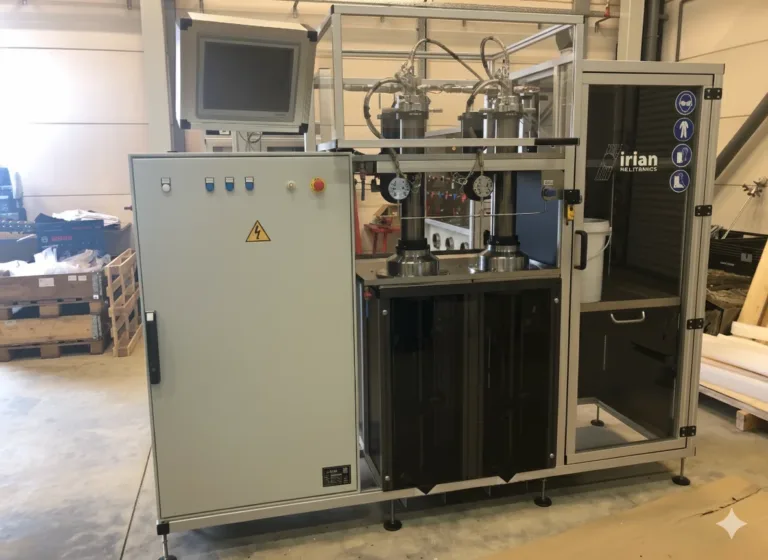
Custom dual-piston injection pump for mixing complex industrial fluids
 Precision pumps & injection systems
Water meter test bench: automated dual syringe pump for wide flow ranges
 Precision pumps & injection systems
12CC 600 bar volumetric pump for pressure control in corrosive media (Na2S) for CNRS
 Precision pumps & injection systems
High-Pressure Bioreactor Retrofit: Reliable Operation at 10 000 Psi in Corrosive Media