
Case study · Process development & chemical pilot plants
Custom pilot plant for high-pressure phase separation
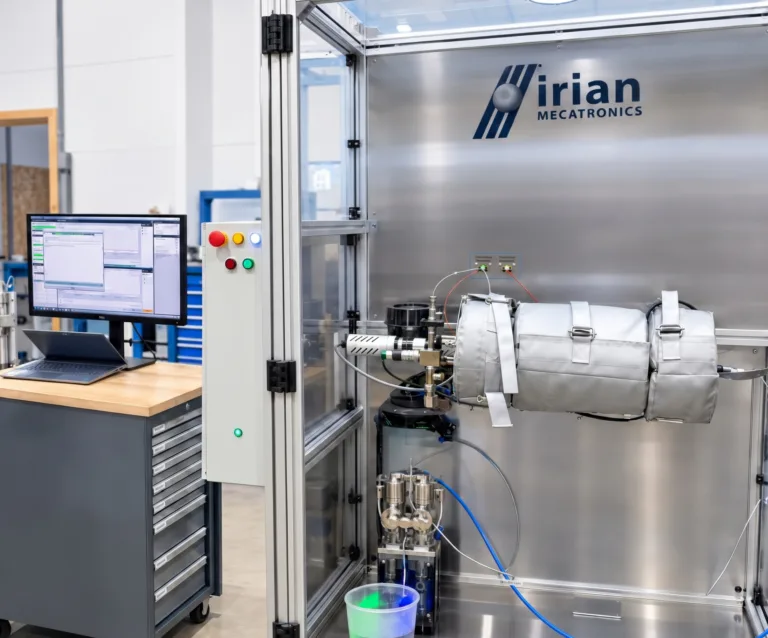
For an industrial leader, IRIAN Mecatronics designed and built a semi-industrial pilot plant for mixing and separating multi-phase fluids. The equipment allows studying the process under controlled pressure and temperature, with critical instrumentation to measure the interface between phases in real time.
01 — The research question
How do you scale up an industrial process while mastering its key parameters?
Moving from a laboratory discovery to industrial production is a critical step. It often requires validating and optimizing process parameters on an experimental process pilot plant at an intermediate scale. This scale-up stage reduces technical and financial risks before investing in a full-scale production unit, ensuring the process is robust, repeatable, and economically viable.
Our client needed to optimize a multi-phase fluid mixing and separation process. The challenge was to do so under precise pressure and temperature conditions, in vessel volumes representative of a semi-industrial scale. Standard equipment could not combine these requirements with the critical instrumentation needed for a fine, real-time measurement of phase separation, which was the key to understanding the process.
The technical challenge was to measure an interface between two immiscible liquids with millimeter accuracy in real time, inside a closed, pressurized, and heated vessel.
02 — Our approach
A design driven by measurement, safety, and operability
The pilot plant's design addressed three major challenges: obtaining a reliable measurement to control the process, ensuring absolute operational safety, and providing an ergonomic design that facilitates frequent handling.
-
Instrumenting the interface to understand separation
In a closed, pressurized vessel, visual measurement is impossible. To achieve the millimeter accuracy required by the client's models, we integrated a level measurement technology that travels through the gas and reflects off the liquid-liquid interface. This provides the operator with precise, recordable physical data to control the separation efficiency.
-
Ensuring safety through defense in depth
Handling fluids under high pressure and temperature demands uncompromising safety. Rather than relying on a single software-based safety system, we layered independent levels of protection: PLCs for alerts, dedicated hardware relays (SIL 2) for emergency shutdowns, and ultimate mechanical safeguards like rupture discs. This approach ensures operator protection and the reliability of long-term tests.
-
Improving maintenance and ergonomics
The vessel lids, weighing around 100 kg, make frequent cleaning time-consuming and risky. To make the operator self-sufficient and prevent musculoskeletal disorders, we integrated a dedicated lifting system into the frame. This solution eliminates reliance on workshop equipment and cuts down the time between campaigns, increasing the pilot plant's utilization rate.
03 — Beyond this project
Does your process involve mastering phase separation?
Food & Cosmetics
To separate essential oils from water, accurate interface measurement is key to yield. The principles of continuous measurement, automation, and cleanable design would remain, but materials (316L stainless steel, food-grade seals) and certifications (FDA, EC 1935/2004) would be adapted.
Water treatment & decontamination
To control the draining of hydrocarbons in a separator, reliable interface measurement is essential to prevent non-compliant discharges. The measurement principle and valve automation would be retained, while adapting the scale, materials (corrosion resistance), and certifications (ATEX).
Hydrometallurgy
In liquid-liquid extraction for metal purification, controlling the interface is crucial. The online measurement and control system would be similar. Materials would change radically (PPH, PVDF, special alloys) to withstand concentrated acids and bases at high flow rates.
04 — Specifications
The values for this project. Every system is custom-built, so they adapt to your requirements.
Show specifications · ±2 mm · SIL 2 · approx. 100 kg
| Interface measurement accuracy | ±2 mm |
|---|---|
| Safety integrity level (SIL) of critical sensors | SIL 2 |
| Indicative vessel lid weight | approx. 100 kg |
IRIAN Mecatronics designs and builds custom high-pressure, high-temperature equipment for research laboratories, technical centres and industry.
About the companyThey trust us













05 — FAQ
Frequently asked questions
Can this type of pilot plant be used with corrosive fluids or fluids containing solids?
Yes, this is a common adaptation. Material selection becomes the critical step: we choose special stainless steels, nickel-based alloys (Hastelloy, Inconel) as on our corrosion reactors, or PFA/PTFE linings. For solids, the geometry of the vessels and agitators is redesigned to prevent dead zones and abrasion.
How does the interface measurement adapt to very high pressures?
The chosen level measurement principle is inherently pressure-independent. For very high pressures, the challenge shifts to the mechanical design of the vessels (compliance with the Pressure Equipment Directive), the choice of materials, and the technology of the sealed feedthroughs for the sensor. For vacuum applications, sealing and material outgassing become the priorities.
Is it possible to integrate this measurement system into an existing installation?
Yes, retrofitting it onto an existing installation is possible. Our engineering team first analyzes the available mechanical (flanges), electrical, and automation interfaces. The main constraint is having a suitable port on the vessel for the sensor. We can supply a complete subsystem including the sensor, its electronics, and its software interface.
Can a phase separation pilot plant be designed for an ATEX zone?
Absolutely. Designing for explosive atmospheres (ATEX) is part of our standard practice. All electrical components (sensors, motors, enclosures) would be certified for the required zone. The risk analysis is more extensive, including electrostatic ignition risks, and the documentation is specific (ATEX file, safety instructions).
Does your pilot process face an instrumentation or operational challenge that standard equipment can't handle?
Describe your constraint, even at a preliminary stage. Our in-house engineering team will analyze your project's feasibility and get back to you with concrete solutions.
Related projects
 Process development & chemical pilot plants
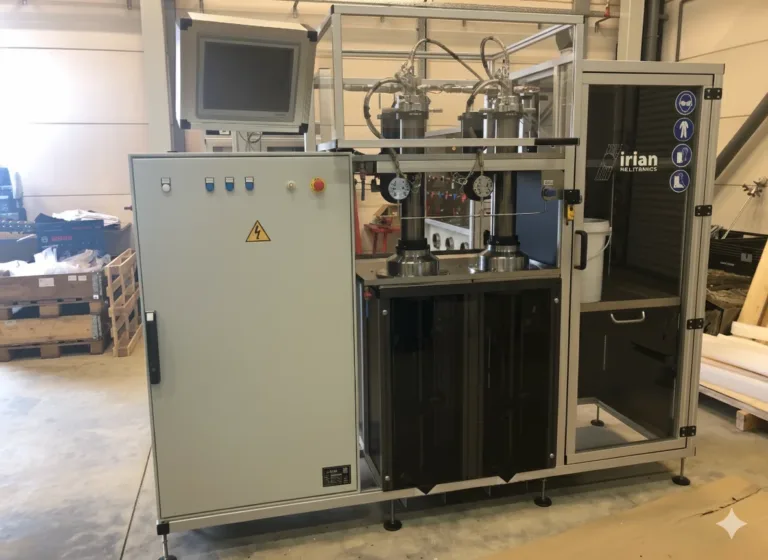
Custom dual-piston injection pump for mixing complex industrial fluids
 Process development & chemical pilot plants
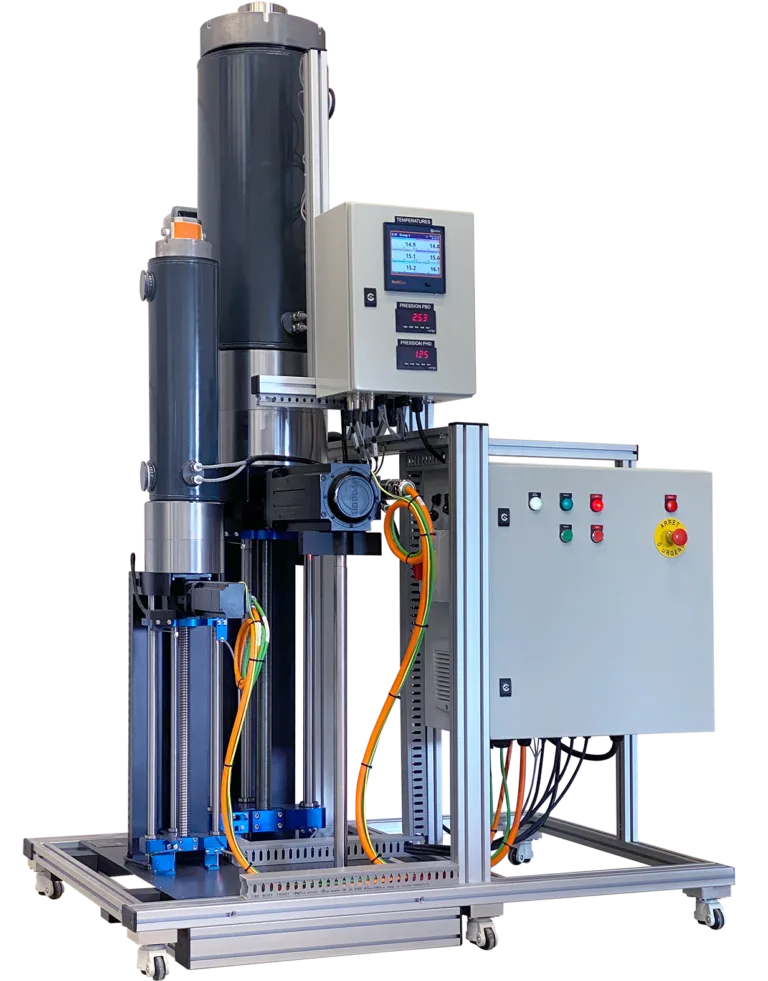
Water meter test bench: automated dual syringe pump for wide flow ranges
HPHT reactors & cells200 bar300°CConfidential project · photo withheld
Process development & chemical pilot plants
High-pressure continuous flow reactors for gas-liquid process research
 Process development & chemical pilot plants
Custom high-pressure rotating reactor for mechanochemistry at 250 bar