

Case study · HPHT reactors & cells
High-pressure rotating reactor for mechanochemistry
For a public research lab in materials chemistry, IRIAN Mecatronics designed and built a high-pressure rotating reactor for mechanochemistry studies in supercritical CO2. This custom equipment performs ball milling operations at up to 250 bar (3,625 psi) and 100°C (212°F), ensuring a perfect seal during continuous rotation.
01 — The research question
How to seal and stabilize a multi-liter reactor that rotates under high pressure and temperature?
Many synthesis and testing processes in chemistry, geoscience, and materials science require vigorous agitation to ensure mass transfer between phases or to provide mechanical energy. When these processes must be conducted under high pressure and/or high temperature, rotating the entire reactor is often the most effective solution, but it poses a major technical challenge in sealing the moving shaft.
This project aimed to perform ball milling operations in supercritical CO2 at 250 bar (3,625 psi) and 100°C (212°F). Such an operation is impossible with standard equipment: commercial mills are not designed to hold pressure, and standard high-pressure reactors are typically static, with internal stirring that is unsuitable for ball milling.
The technical challenge was to maintain a perfect dynamic seal on a large-diameter rotating shaft subjected to 250 bar (3,625 psi) and 100°C (212°F), while withstanding the chemical environment of supercritical CO2 and the mechanical stresses of rotation.
02 — Our approach
Designing a high-pressure rotating reactor: key decisions
To achieve the required performance while ensuring absolute safety, our engineering team solved three main challenges: dynamic sealing under extreme conditions, instrumenting a rotating body, and managing the system's physical limits.
-
Ensuring a dynamic seal at 250 bar
Supercritical CO2 is an aggressive solvent for polymers, and the combination of pressure and rotational speed (400 rpm) creates extreme stress. We selected a multi-barrier sealing system with specific materials and hardened contact surfaces, ruling out single-seal solutions. The benefit is total safety and the ability to run long-duration experiments without leaks.
-
Instrumenting and heating the rotating vessel
Measuring internal pressure and temperature and powering a heating jacket without tangled cables is a classic challenge in rotating systems. The chosen solution is a slip ring, which provides a reliable and continuous electrical connection. This gives the operator real-time control and monitoring of key reaction parameters, which is essential for data quality and safety. A similar principle is used in our multi-mode reactors for geochemistry.
-
Securing operation at physical limits
the pressure × Velocity (PV) product has a physical limit beyond which the seal is no longer guaranteed. Rather than a simple alarm that relies on the operator, we implemented an active safety feature: the control system automatically reduces the speed if the pressure increases, to always stay below the safety threshold. The equipment is intrinsically safe across its entire operating range.
03 — Beyond this project
Does your process require intense agitation under high pressure?
Pharmaceuticals / fine chemicals
This principle applies to slurry hydrogenation reactions under high-pressure hydrogen. The concept of a rotating reactor, dynamic sealing, and control system would remain, but the materials would need to be certified as H2-compatible, and the entire system would require ATEX certification.
Geosciences
To study fluid-rock interactions under reservoir conditions, a rotating reactor can simulate flow using centrifugal force. The principle of a sealed HPHT rotating vessel and a slip ring would be retained. The materials would be adapted for more corrosive fluids (H2S, brines) and potentially higher pressures and temperatures. See our other equipment for geoscience and subsurface studies.
Waste Treatment
Wet air oxidation or hydrothermal liquefaction processes for biomass treat slurries under pressure and temperature. The robust rotating reactor concept is ideal for managing these multiple phases. The materials, volume, and loading systems would need to be adapted.
04 — Specifications
The values for this project. Every system is custom-built, so they adapt to your requirements.
Show specifications · 250 bar (3,625 psi) · 2 L · Ambient to 100°C (212°F)
| Operating pressure | 250 bar (3,625 psi) |
|---|---|
| Internal volume | 2 L |
| Operating temperature | Ambient to 100°C (212°F) |
| Maximum rotational speed | 400 rpm |
| Total cell mass | 19 kg |
| Total mass (bench + cell) | 120 kg |
| Overall dimensions (W x D x H) | 1324 x 714 x 1935 mm |
| Cell positioning | Horizontal or vertical, with locking system |
IRIAN Mecatronics designs and builds custom high-pressure, high-temperature equipment for research laboratories, technical centres and industry.
About the companyThey trust us






















05 — FAQ
Frequently asked questions
Can this type of rotating reactor be used with hydrogen or corrosive fluids?
Yes, the design principle is adaptable. For use with hydrogen, the choice of materials is critical to prevent embrittlement, and the entire equipment package (motor, instrumentation, cabinet) must be designed for use in explosive atmospheres (ATEX certification). For corrosive fluids (acids, brines, H2S), we select nickel alloys (Hastelloy, Inconel) or titanium instead of stainless steel.
Is it possible to design a ball mill for pressures above 250 bar?
Yes, it is technically feasible. The main limiting factor is the Pressure × Velocity (PV) product that the dynamic sealing system can withstand. For higher pressure, it may be necessary to reduce the maximum rotational speed or to design a more complex sealing system, for example with lubrication or cooling. Our engineering team studies each project to validate the most suitable and safest solution, in accordance with the Pressure Equipment Directive (PED).
Is this rotating reactor principle applicable to larger volumes?
Yes, the concept can be scaled up for larger volumes, such as for a semi-industrial pilot plant. The design challenges change in scale: managing weight, mechanical stress on the shaft and bearings, the required motor power, and safety aspects become predominant. Our integrated engineering team (mechanical, automation, instrumentation) has experience with these scale-up projects.
Can the reactor integrate sampling or injection functions during rotation?
Yes, this is a frequent request. Adding ports for injecting reactants or sampling during an experiment is entirely possible. This requires integrating a rotary fluid union in addition to the electrical slip ring. The complexity of the sealing system increases, but this significantly expands the equipment's experimental capabilities.
Is your process limited by the lack of effective agitation in your high-pressure reactor?
Describe your constraints, the pressure and temperature conditions, and the fluids involved. Our integrated engineering team will analyze your project's feasibility and get back to you.
Related projects
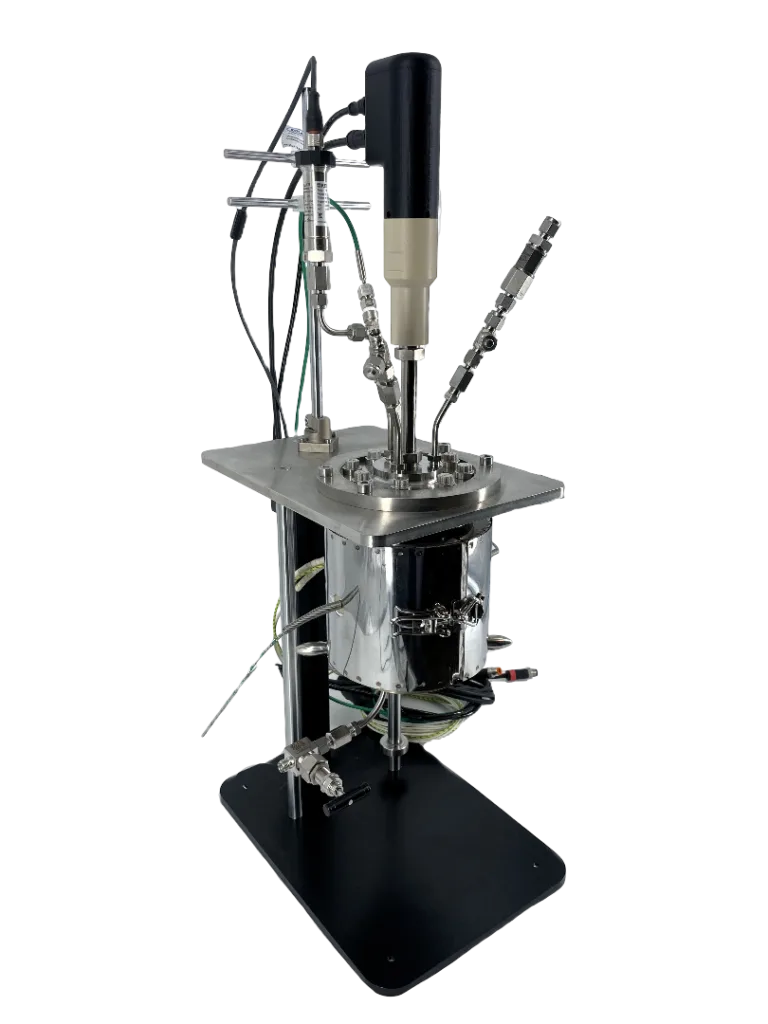 HPHT reactors & cells
500°C / 130 bar corrosion test reactors for materials research
HPHT reactors & cells200 bar300°CConfidential project · photo withheld
HPHT reactors & cells
Pressurized flow reactor systems for CO2 capture (CCUS) research
HPHT reactors & cells200 bar300°CConfidential project · photo withheld
HPHT reactors & cells
High-pressure continuous flow reactors for gas-liquid process research
HPHT reactors & cells
500°C / 130 bar corrosion test reactors for materials research
HPHT reactors & cells200 bar300°CConfidential project · photo withheld
HPHT reactors & cells
Pressurized flow reactor systems for CO2 capture (CCUS) research
HPHT reactors & cells200 bar300°CConfidential project · photo withheld
HPHT reactors & cells
High-pressure continuous flow reactors for gas-liquid process research